BEIJING, Nov. 17 (Xinhua) -- Norwegian salmon, Maltese bluefin tuna, Russian king crab and Canadian spot prawns, once rare sights in China, are now quickly finding their way onto many Chinese dinner tables.
At the 9th China International Import Expo (CIIE), which concluded last week in Shanghai in east China, Christian Chramer, CEO of the Norwegian Seafood Council, said Norway's salmon exports to China had maintained strong growth. China is currently Norway's second-largest salmon export market.
"China is now becoming more and more important for our country. Every exporter in Norway knows the importance of the Chinese market," he noted.
Today, supported by an efficient cold chain and online delivery system, fresh Norwegian seafood is processed upon arrival in China and can reach consumers' homes within as little as half an hour of an online order. "This distribution is so impressive," Chramer said.
The CEO voiced hope for the agreement on Norwegian wild-caught seafood signed by China and Norway, saying that once it takes effect, it will help more Norwegian seafood enter the Chinese market, giving Chinese consumers access to a wider range of high-quality, fresh seafood.
Beyond the CIIE, Norwegian exporters are also active at industry-specific gatherings. Late last month, Leroy Seafood Group, one of Norway's largest seafood exporters, exhibited at the 29th China Fisheries & Seafood Expo in Qingdao, east China's Shandong Province. Fredrik Kristensen, team manager for fresh salmon and trout in overseas markets at the company, said it received nearly 100 Chinese clients a day during the expo.
"Our salmon sales in China doubled last year, and we expect to continue growing rapidly this year," Kristensen added.
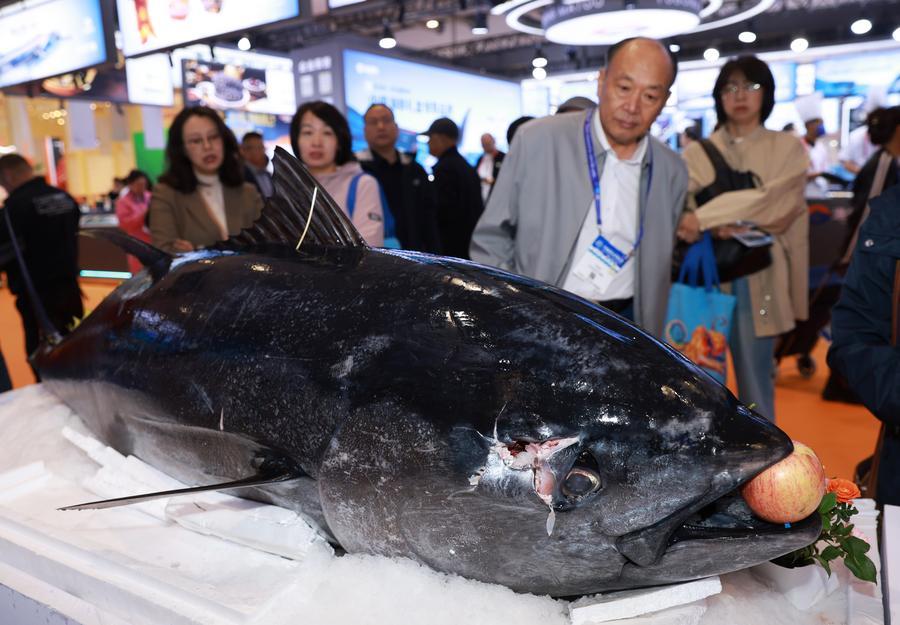
In November 2023, meanwhile, an agreement signed during Maltese Foreign Minister Ian Borg's visit to China gave Maltese farmed bluefin tuna direct access to the Chinese market. "Before that, bluefin tuna was only an exhibit at the CIIE. Now it's a Chinese commodity," Maltese Minister for Agriculture, Fisheries and Food Supply Anton Refalo said.
"We started supplying the Chinese market in 2024 with about 200 tonnes, and this year we have signed contracts to supply around 700 tonnes," said Salvu Ellul, chairman of Malta Fish Farming, adding that as Chinese consumers' demand for high-quality seafood grows, the company is actively expanding its presence in the Chinese market.
Fishery cooperation between the two countries has continued to expand since 2023. In November 2025, Refalo led a delegation to China for the 8th CIIE in Shanghai. During that trip, a protocol was signed in Beijing allowing Malta's wild-caught fishery products to enter the Chinese market for the first time.
The two countries are now working together on bluefin tuna breeding research, and in July, a batch of fertilized bluefin tuna eggs from Malta cleared quarantine in east China's Fujian Province for research purposes.
Expressing hope for extensive cooperation in fishery science and technology, Refalo said China has a lot of innovation to offer, and Malta can learn much from Chinese technique and knowledge-sharing.
From traditional seafood to premium products, a growing number of international seafood companies are setting their sights on the Chinese market in search of new growth opportunities. The 29th China Fisheries & Seafood Expo alone drew 1,617 companies from 50 countries and regions, with the number of overseas exhibitors up over 10 percent year on year.
"We had more than 40 meetings during this exhibition and signed three contracts with Chinese customers," said Ivan Novikov, deputy CEO of Russian Antey Group, noting that the company hopes to use the expo to further expand its business in China.
Novikov added that to meet Chinese consumers' demand for fresh seafood, the company ships king crab and other products to multiple Chinese cities by sea and air, while also offering frozen whole crabs and crab legs so that more consumers can enjoy Russian crab.
China is currently the largest export market for Russian king crab. According to data from the General Administration of Customs of China, Russia's exports of live crab to China reached 24,600 tonnes in the first seven months of 2026, up 17 percent year on year, with export value rising 27 percent to 698.6 million U.S. dollars.
China's sustained consumer demand is offering broader space for global seafood companies to grow. Data from the Ministry of Agriculture and Rural Affairs show that China's seafood imports had reached roughly 7.07 million tonnes in 2025, valued at 24.93 billion U.S. dollars, up 2.05 percent and 7.94 percent year on year, respectively. Per capita seafood availability nationwide reached 54.47 kilograms, a 4.25-percent increase on the previous year.
According to Fraser MacDonald, president of the Pacific Prawn Fishermen's Association, approximately 85 percent of British Columbia's spot prawns are currently exported to China.
"As trends are changing among the younger demographic in China, Canadian companies are trying to discuss ways with Chinese partners in which they can better prepare the product to reach a bigger audience in China through grocery stores and e-commerce platforms," MacDonald said.
In recent years, China has continued to widen market access for seafood imports, creating conditions for high-quality seafood from more countries to enter the Chinese market. During this year's China Fisheries & Seafood Expo, Chinese and foreign companies jointly launched an initiative on facilitating and upgrading the global seafood supply chain, which calls for promoting mutual recognition of standards, optimizing distribution channels and deepening industrial cooperation. ■