* Chinese and U.S. representatives held a ceremony in southwest China's Chengdu recently to hand over the remains of U.S. airmen who went missing along the Hump Route while helping China fight Japanese aggression during World War II (WWII).
* More than 1,000 Chinese and American aircrew members lost their lives along the route. The air corridor across the Himalayas became a vital lifeline for Allied supplies supporting China's resistance against Japanese aggression from 1942 to 1945.
* China and the United States have cooperated in searching for American military personnel missing during WWII since the 1970s. At the ceremony, a Chinese official said that China has long supported the search on humanitarian grounds and is willing to continue practical cooperation with the United States in this field.
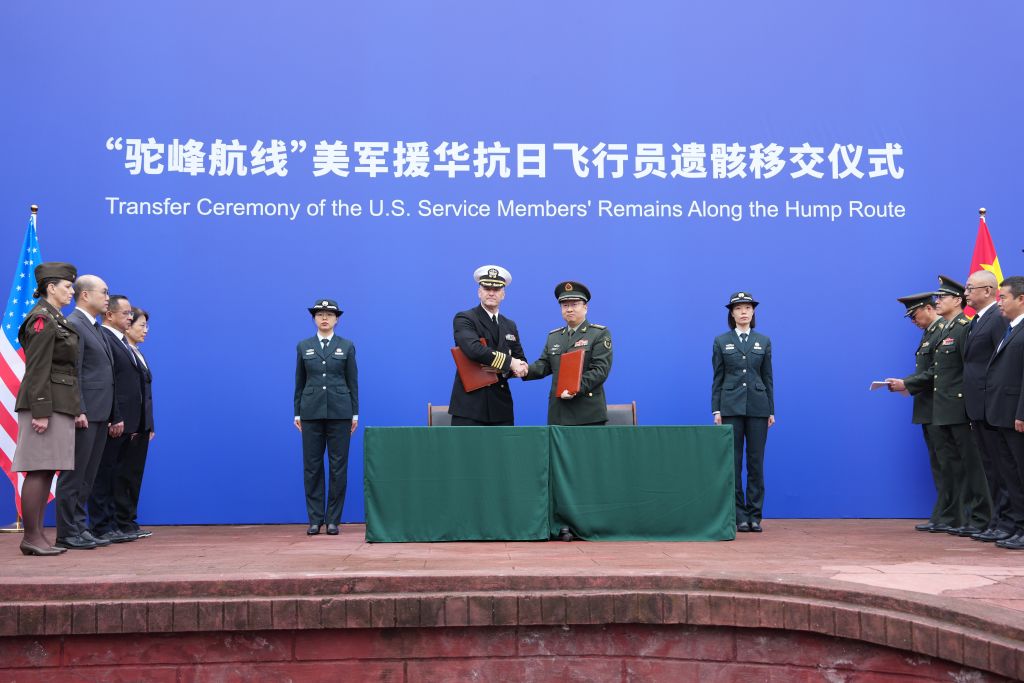
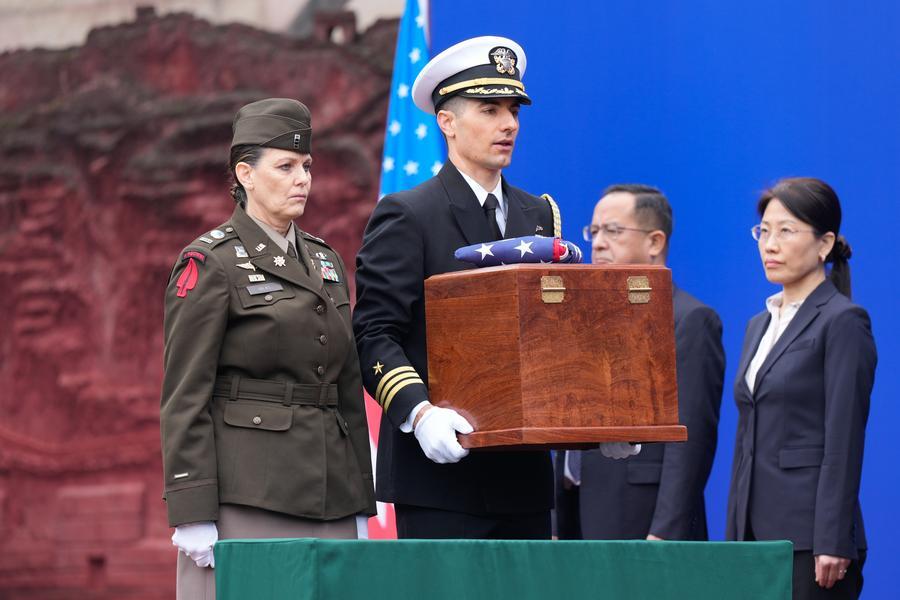
CHENGDU, Nov. 15 (Xinhua) -- Two Chinese honor guards carried a box containing human remains to a table and carefully set it down. U.S. Chief Warrant Officer Christine Bilas then gently placed a folded American national flag on top of this box.
"Bring them home," said U.S. Navy Captain Colin Alexander Eliot, a forensic expert with the Defense POW/MIA Accounting Agency (DPAA), as he watched the transfer ceremony at Jianchuan Museum in Chengdu, southwest China's Sichuan Province, on Tuesday. U.S. Navy Commander Gregory Pavone then lifted the box from the table.
Inside the box were eight bone fragments recovered from a glacier more than 5,000 meters above sea level in southwest China's Xizang Autonomous Region. Believed to be the remains of American airmen who went missing while helping China fight Japanese aggression during World War II (WWII), these bone fragments had lain in the mountains for more than 80 years. Their identities have yet to be confirmed.
The handover followed three expeditions over more than two years by a Chinese civilian search team, part of a decades-long effort by China and the United States to account for missing American military personnel.
THREE TRIPS TO THE GLACIER
Cering Qoizha, deputy curator of Jianchuan Museum's branch in Chongqing, southwest China, set out in 2024 to search for wartime aircraft wreckage and human remains in the glaciers of Nyingchi, Xizang.
A Tibetan from Sichuan's Garze Tibetan Autonomous Prefecture, he enlisted his two elder brothers and several local guides for these expeditions.
The first attempt was cut short by a damaged cable crossing over a river. After the crossing was rebuilt, the team returned and found aircraft wreckage. It was not until their third trip that they discovered the bone fragments.
The journey took them through forests and swamps, across icy rivers and up steep cliffs, where bears, hidden crevasses and ice holes posed constant dangers.
On the glacier, decades of freezing and thawing had left the remains trapped beneath rocks.
"We could only lie on the ground and use our hands and branches to turn over the rocks and search carefully," Cering Qoizha recalled. The team eventually recovered eight fragments.
He had led an earlier expedition that found American aircrew remains in Xizang in 2015.
"The crews of the Hump Route gave their lives to support China's resistance against Japanese aggression and lay alone on the glaciers for decades," Cering Qoizha said. "They were heroes. Bringing them back from the glaciers is something I wanted to do, and something I should do."
HUMAN COST OF THE HUMP
After Japanese forces occupied Myanmar in 1942 and cut off the Yunnan-Myanmar road, which was China's last major overland supply link to the outside world, China and the United States established air routes connecting the state of Assam in northeastern India with Kunming in southwest China.
Known as the Hump Route, this air corridor across the Himalayas became a vital lifeline for Allied supplies supporting China's resistance against Japanese aggression from 1942 to 1945.
The route featured snow-covered mountains, deep gorges, glaciers and tropical forests. Violent air currents, low air pressure, hail, freezing weather conditions and attacks by Japanese aircraft made the journey perilous. So many planes crashed along the route that crews came to call it the "Aluminum Trail."
More than 1,000 Chinese and American aircrew lost their lives along the route. With the high mountains and glaciers making searches exceptionally difficult, many of their remains have never been recovered.
"Every day felt like the last," Chinese pilot Zhou Bing, who flew more than 110 round trips along the route, once recalled. Friends who were together one day could be gone the next, he said.
The airlift also depended on the labor and sacrifices of ordinary Chinese people.
At Jianchuan Museum, enormous stone rollers weighing between eight and 15 tonnes recall the construction of wartime airfields in Sichuan and Yunnan, both in China's southwest. Without access to modern road rollers, dozens or even hundreds of workers had to pull these heavy stones to prepare runways. Some were injured or killed while working under harsh wartime conditions.
Chinese military personnel and civilians also monitored Japanese aircraft movements, providing American forces with information on their numbers, types, altitudes and directions when ground radar coverage was limited.
KEEPING THE SEARCH ALIVE
For Fan Jianchuan, curator of the privately run Jianchuan Museum, searching for the missing American airmen is a way of repaying a debt of gratitude.
"When a country, or a person, faces the greatest danger and hardship, having friends come to help is very important," he said.
The museum began searching for wartime aircraft wreckage in Sichuan more than 20 years ago, later extending its expeditions to the remote glaciers of Xizang.
"The Hump Route crews deserve to be remembered and thanked forever," Fan said. "In practical terms, that means finding their remains in China and returning them to the American side."
China and the United States have cooperated in searching for American military personnel missing during WWII since the 1970s. In 2008, China's Ministry of National Defense and the U.S. Department of Defense signed a memorandum of understanding in Shanghai, establishing a formal mechanism for this work.
At Tuesday's ceremony, an official with the general office of the Central Military Commission (CMC) said the joint efforts to recover the remains of missing U.S. servicemen were a testament to the two countries' history of fighting side by side against Japanese fascism during WWII.
China has long supported the search on humanitarian grounds and is willing to continue practical cooperation with the United States in this field, the official said, adding that such efforts could contribute positively to building a constructive China-U.S. relationship of strategic stability.
Another official with the Office for International Military Cooperation of the CMC said investigation and joint working teams had conducted surveys and excavations in more than 100 locations across China, drawing support from local governments and residents.
As the wartime stories of the Flying Tigers and Hump Route became more widely known, growing numbers of Chinese civilians joined the searches, the official said, citing Jianchuan Museum as a notable example.
The official said the expanding involvement of ordinary people echoed the two countries' wartime cooperation and showed that "the hope of China-U.S. relations lies in the people."
Pavone also spoke of the longstanding cooperation.
"These joint efforts have been going on for decades and are one of the most durable areas of cooperation between our two militaries," he said, thanking the museum, local authorities and Chinese military and diplomatic agencies for their contributions.
The remains still await identification. After the remains reach the United States, the DPAA will conduct DNA testing, examine historical evidence, and compare military records. Families will be notified only after identification is confirmed.
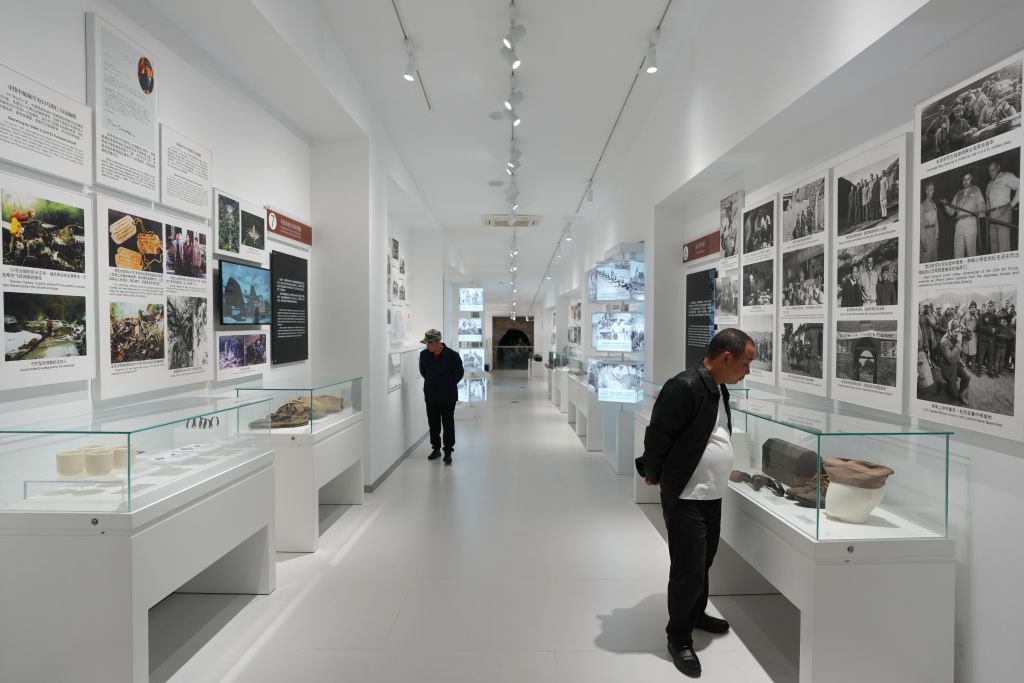
Following the ceremony, Chinese and U.S. representatives visited the Hall of the Heroes of the Flying Tigers, which commemorates the Flying Tigers and other American servicemen who assisted China during WWII.
A wall there bears ceramic portraits of 248 American servicemen. Among the thousands of artifacts on display are personal belongings donated by veterans.
One donor was Robert Gruber, an elderly American veteran who visited in 2005 while the exhibition was being prepared. When he learned that the exhibition would showcase items related to WWII American servicemen, he was moved to tears.
Gruber died not long after returning to the United States, but his belongings remain on display. They include a portrait of him in his youth in military attire and a cherished photograph of his girlfriend, kept in a frame made from the wreckage of a Japanese aircraft.
The exhibition has received more than 10 million visitors over two decades. Among the messages in its guestbooks is one from a Chinese visitor: "May the people of China and the United States remember history and cherish peace." ■
(Video reporters: Xue Chen and Tong Fang; video editors: Wu You, Zhang Mocheng and Li Ziwei)