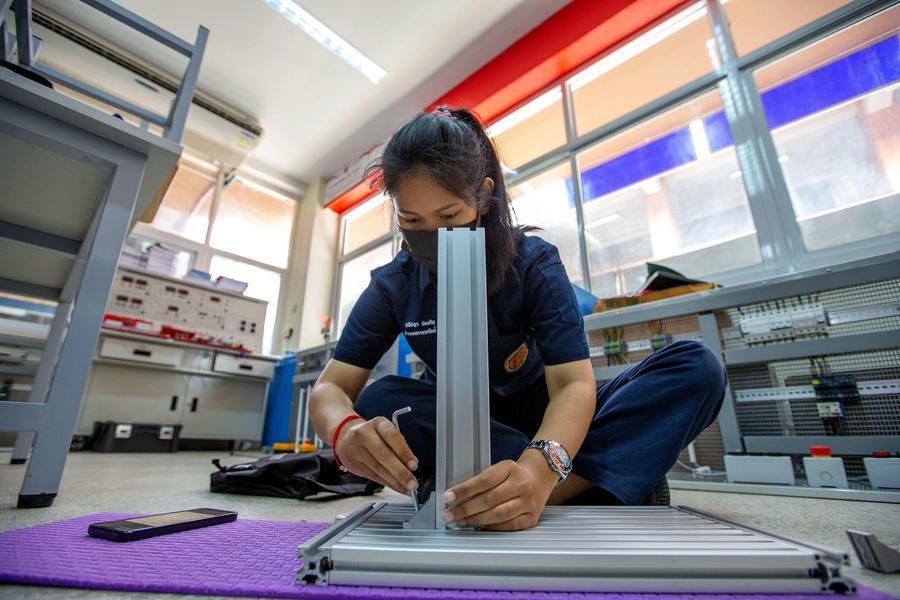
AYUTTHAYA, Thailand, Nov. 15 (Xinhua) -- In a classroom at Ayutthaya Technical College, home to the world's first Luban Workshop jointly established by China and Thailand, several humanoid desktop robots rhythmically waved their arms and stepped to the music as Surapat Pimrat skillfully operated them.
"I named one of the robots Nam Khing because it keeps me company like a best friend," said Surapat, a third-year student pursuing Vocational Certification in mechatronics and robotics at the workshop. He added that his sister, a workshop graduate now working at Haier Thailand, inspired him to enroll.
Surapat's next plan is to pursue an opportunity to deepen his expertise in China, following his sister's example: she strengthened her professional expertise and improved her Chinese-language proficiency, paving the way for her promotion to team leader.
Their experiences are shared by thousands of other Thai students who have benefited from the Luban Workshop. Named after an ancient Chinese craftsman, the workshop embodies China's tradition of craftsmanship and innovation while equipping Thai youth with practical skills.
In March 2016, Tianjin Bohai Vocational Technical College in China and Ayutthaya Technical College jointly established the world's first Luban Workshop in Thailand. Over the past decade, all six of the workshop's internationalized majors have been incorporated into Thailand's national education system.
Recalling the workshop's early days, Jarun Youbrum, then director of Ayutthaya Technical College who was involved throughout its establishment, expressed deep appreciation for the Chinese instructors.
"To help assemble and commission the equipment, they would sometimes work until two in the morning," Jarun said. "Their dedication is truly moving."
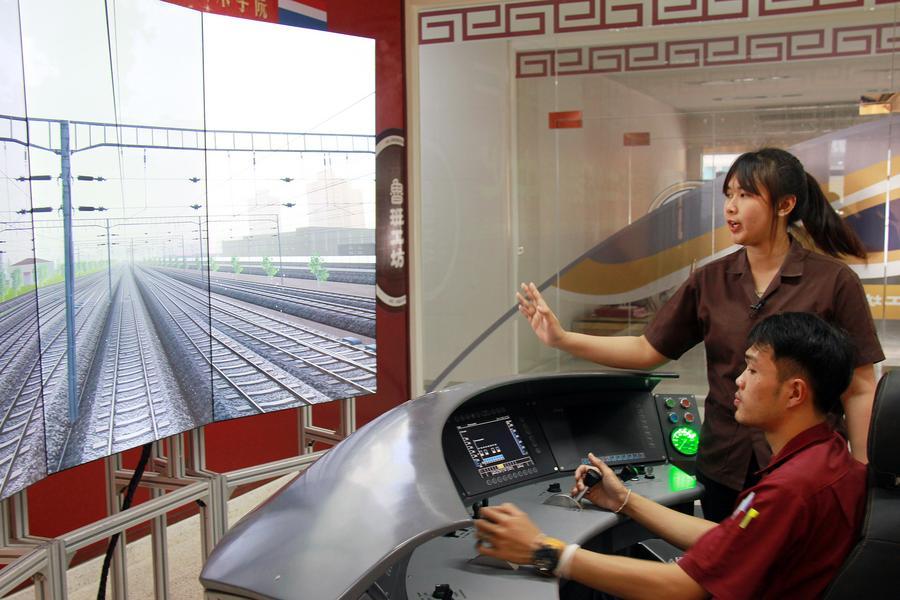
Following three phases of development, the workshop's instructional space has expanded 10 folds to 2,000 square meters, with 15 teaching and practice areas established.
According to Pakorn Muangsuk, head of the college's Mechatronics and Robotics department, Tianjin Bohai Vocational Technical College has regularly sent instructors to Thailand to train students. Ayutthaya Technical College has also dispatched its faculty to China to learn equipment operation and teaching methods.
Pakorn's department adopted the EPIP (Engineering Practice Innovation Project) teaching model, which helps students build professional knowledge and practical skills through real-world engineering projects and targeted problem-solving.
One valuable opportunity offered by the workshop is further training in Tianjin. Teerapat Sudso, an Internet of Things (IoT) major who enrolled in 2018, was selected to study there for over a year.
Teerapat has now been working for over three years as an assistant engineer at the Thai subsidiary of Zhongji Innolight, a leading Chinese manufacturer of high-speed optical modules. He mentors both Chinese and Thai apprentices.
Teerapat said the knowledge and skills he acquired at the workshop laid the foundation for his current role, and he still uses Chinese at work every day.
"Graduates from our college possess both professional skills and the ability to communicate in Chinese, which gives them a distinct advantage when seeking employment," said Pakorn. He added that as Chinese-funded enterprises continue to establish factories and begin production in Ayutthaya's industrial parks, demand for frontline workers is steadily growing.
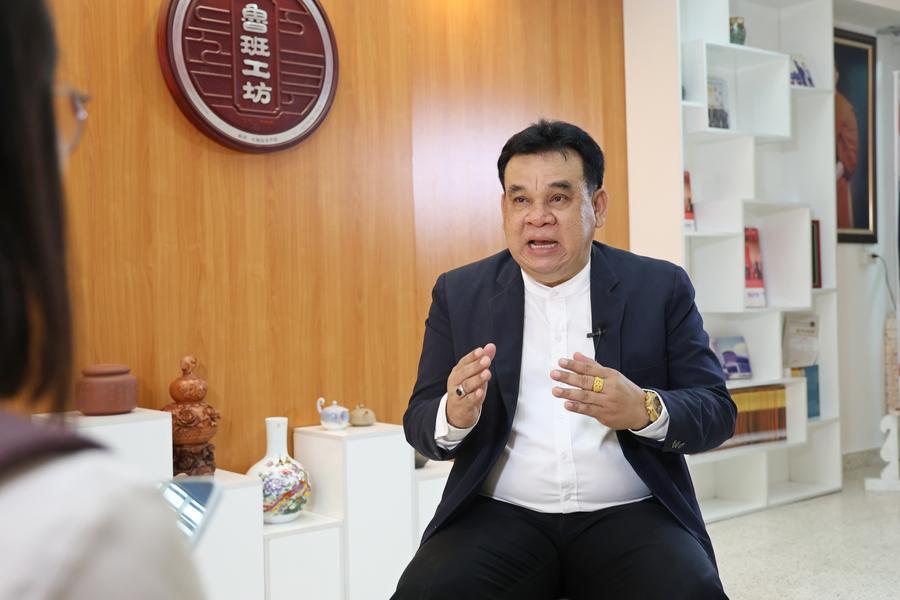
Statistics from Ayutthaya Technical College show that over the past decade, Luban Workshop has cultivated more than 2,600 local students pursuing academic degrees and sent over 500 students to China for further study. Meanwhile, the Chinese and Thai colleges have jointly trained nearly 100,000 people through their partnership.
A new milestone was reached in September, when Ayutthaya Technical College inaugurated the world's first EPIP Center, jointly established with Tianjin Bohai Vocational Technical College. The center features practical training modules in artificial intelligence, IoT, intelligent manufacturing, and other fields.
"Luban Workshop has established a cooperation network spanning multiple vocational colleges, providing students from these institutions with opportunities to study in China," said Chaowarit Umboon, deputy director of Ayutthaya Technical College.
Looking ahead, Chaowarit hopes to see more branch centers established across northern, southern, and northeastern Thailand, making it easier for students in these regions to pursue further studies and receive practical training. ■