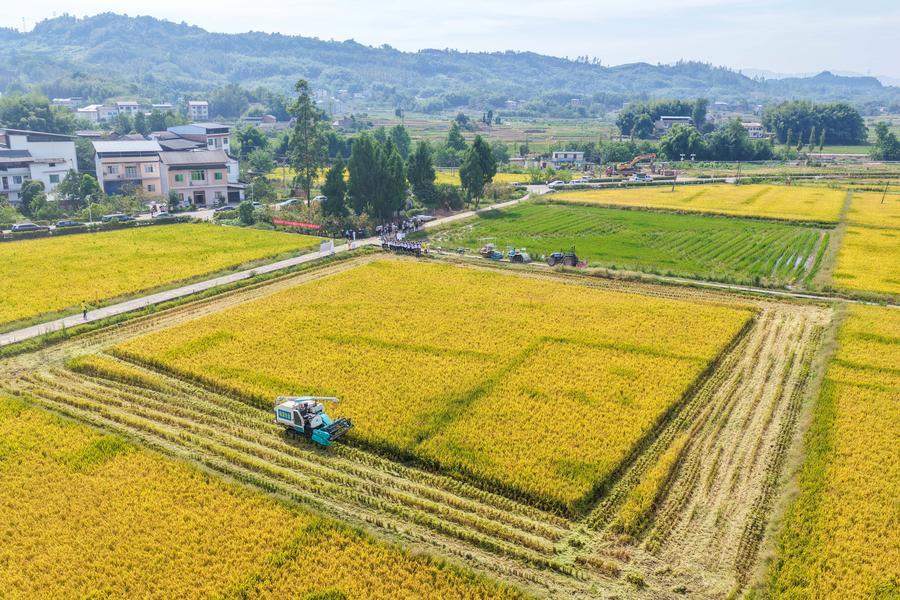
* China's autumn grain harvest has withstood the test of disasters this year, with more than 90 percent of the crop gathered by early November and full-year output expected to exceed 700 million tonnes for a third consecutive year.
* Technology has carried more of the load. Recent years have seen sustained efforts to raise per-unit yields through integrating improved farmland, seed, machinery and methods, with techniques such as rational close planting, precision sowing and integrated water-fertilizer irrigation.
* More than 95 percent of villages have 5G coverage, rural internet penetration has reached 69.5 percent, and the share of farming guided by digital information is rising about 2 percentage points a year in China.
BEIJING, Nov. 12 (Xinhua) -- China's autumn grain harvest has withstood the test of disasters this year, with more than 90 percent of the crop gathered by early November and full-year output expected to exceed 700 million tonnes for a third consecutive year.
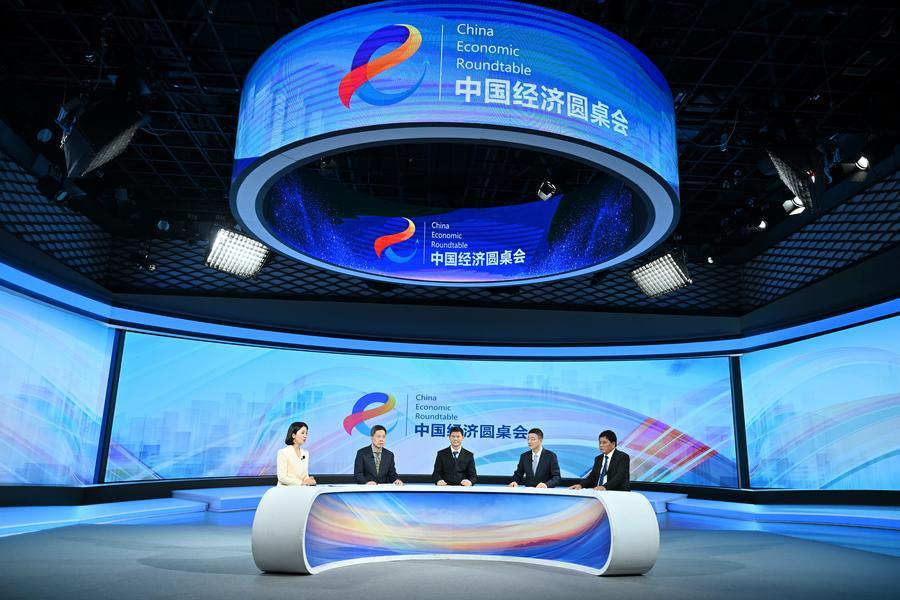
That was the assessment delivered on the latest episode of China Economic Roundtable, an all-media talk show hosted by Xinhua News Agency, where guests discussed how technology is changing not just how much China farms, but how it farms.
HARVESTS WITHSTANDING DISASTERS
"Nationwide, autumn grain production has withstood the test of disasters, the overall situation is fairly good, and the foundation for a good harvest is solid," said Zhao Changbao, director of the Rural Economy Research Center of the Ministry of Agriculture and Rural Affairs.
The approach to disasters has shifted, he noted. Rather than responding after damage occurs, agricultural departments moved work ahead of the weather, organizing a 100-day campaign to strengthen field management and combat disasters, and holding regular consultations with meteorological, water resources and emergency management authorities.
Technology has carried more of the load. Recent years have seen sustained efforts to raise per-unit yields through integrating improved farmland, seed, machinery and methods, with techniques such as rational close planting, precision sowing and integrated water-fertilizer irrigation.
Northeast China's Heilongjiang Province, the country's largest grain producer, has maintained output above 80 million tonnes for two successive years and expects a record harvest this year, said Zhu Huasheng, deputy director of the province's agriculture department.
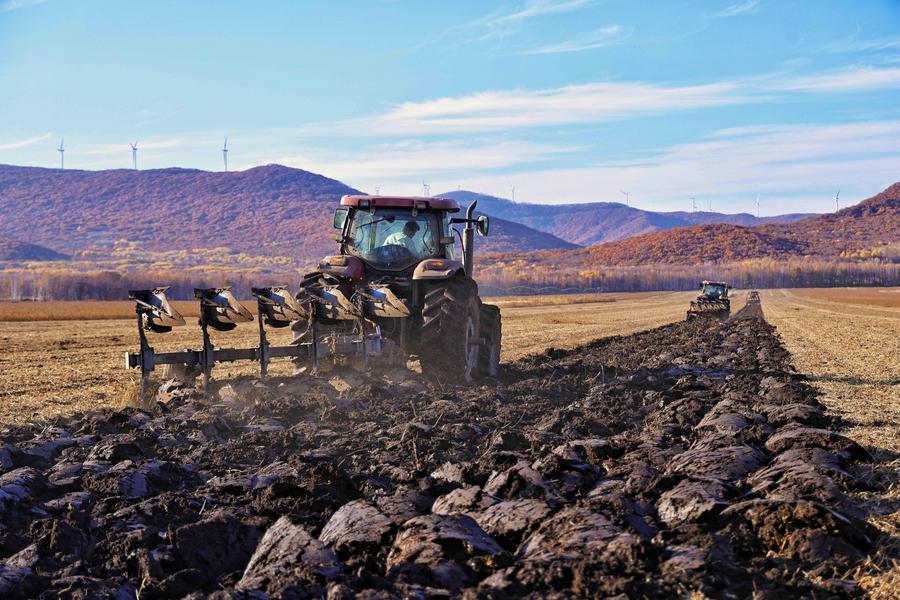
This province has developed 125 million mu (about 8.3 million hectares) of high-standard farmland, achieved near-full coverage of improved seed, and reached a mechanization rate of 99.34 percent for ploughing, sowing and harvesting, with 88,000 new types of agricultural business entities bringing smallholders into the effort.
In Dongjiao Village, in the central Chinese province of Hubei, meanwhile, where villagers once suffered from acute drought, ponds and embankments have improved water management efforts, while a heat-tolerant, lodging-resistant rice variety yielded more than 13.5 tonnes per hectare this year, said Hu Aiguo, Party secretary of the village.
Mechanization and specialized services have also helped cut losses. In north China's Inner Mongolia Autonomous Region, more than 19,000 farm machines and 1,710 service providers were deployed for the autumn harvest this year.
"Agricultural production is shifting from a single focus on raising field yields to raising yields, cutting losses and improving quality at the same time," Zhao said.
SCIENCE & TECHNOLOGY AS SUPPORT
The change starts at the seed. In Wuchang, a rice-growing county in Heilongjiang known for its premium rice, a scan of the code on a bag traces where the seed was sown, how the field was managed and when the grain was milled.
Local firms have worked with the Chinese Academy of Sciences to purify and rejuvenate Daohuaxiang No. 2, the variety behind Wuchang's reputation, and have built breeding centers, a 333-hectare propagation base and a multiplication base in south China's Hainan Province.
Machinery carries this change into the field. China's first tractor rolled off the line in 1958, ending the era of farming behind oxen. First Tractor Company Limited, a leading agricultural machinery provider, now builds 320-450 horsepower tractors with continuously variable transmission, and its Dongfanghong tractors hold straight-line accuracy within 2.5 centimeters using BeiDou positioning.
In October, this company, notably, unveiled an onboard AI agent at an agricultural machinery exhibition in north China's Tianjin that advises operators as they work.
"Domestic smart machinery makes sowing faster and more precise," said Wang Dongqing, deputy chief engineer of First Tractor. Mechanization, he added, is the link that connects people, machines, land and services.
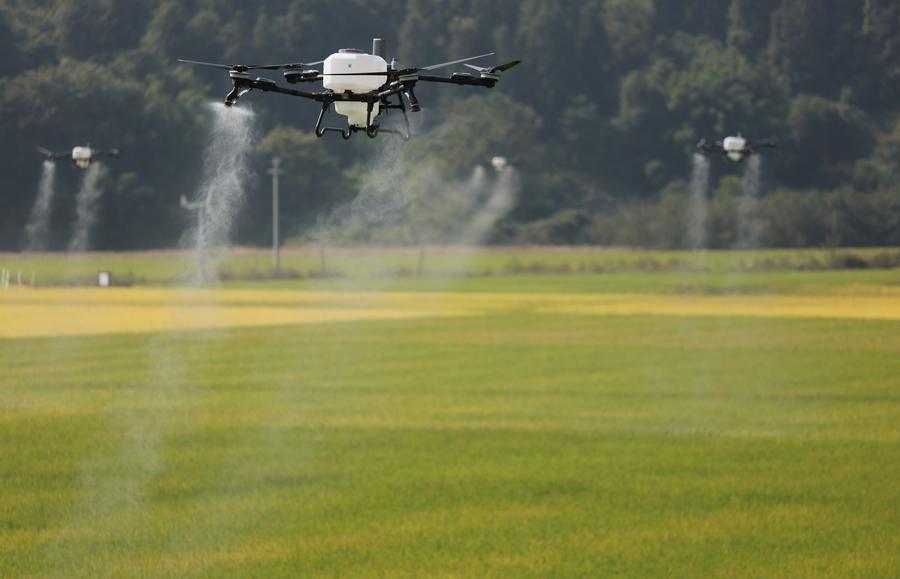
Digital tools are spreading at the same time. "In the past we farmed largely by watching the sky, the land and our experience," Zhao said. "What is changing now is that we are starting to watch data, algorithms and screens."
More than 95 percent of villages have 5G coverage, rural internet penetration has reached 69.5 percent, and the share of farming guided by digital information is rising about 2 percentage points a year in China.
The country's "No. 1 central document" for 2026 calls for integrating AI with agricultural development, and an action plan for 2026-2030 sets smart farms, intelligent breeding and AI application scenarios as priorities for the 15th Five-Year Plan period (2026-2030).
"Digital villages and AI are no longer an optional question," Zhao said. "They are a required one for agricultural modernization."
In Dongjiao, young people who returned from cities now use smart machinery and sensor networks, and grain growers have formed cooperatives to grow organic rapeseed for premium buyers.
"Village development depends on young people putting down roots," Hu said. Zhao stressed wider channels for bringing talent to villages, more concrete services for keeping them, and a thicker foundation for training local farmers.
INTEGRATION FOR DEVELOPMENT
Technology's effect on incomes is clearest where it meets the market. Heilongjiang has built a provincial brand for black-soil produce and promotes contract farming under which buyers order before planting. "In the past we planted whatever we could and then looked for buyers," Zhu said. "Now we plant what has been ordered."
Dongjiao has established 67 hectares each of cropland, peach orchards and fish ponds, and has also developed its rural tourism. Per capita income in the village reached 30,123 yuan (roughly 4,484.32 U.S. dollars) last year.
"Goods that used to be sold by the basket at low prices are now sold by the box or by the piece, at several times the old price," Zhao said, crediting livestreaming, e-commerce and branding.
Wang said the next five years are both an opportunity and a responsibility for farm machinery makers, and that First Tractor will help rural young people use machinery as a platform for starting businesses.
For a country producing around 700 million tonnes of grain a year on a fixed land base, the key, as Zhao put it, is "putting technology into real agricultural production scenarios," as technologies are speeding up the modernization of agriculture and rural areas.■