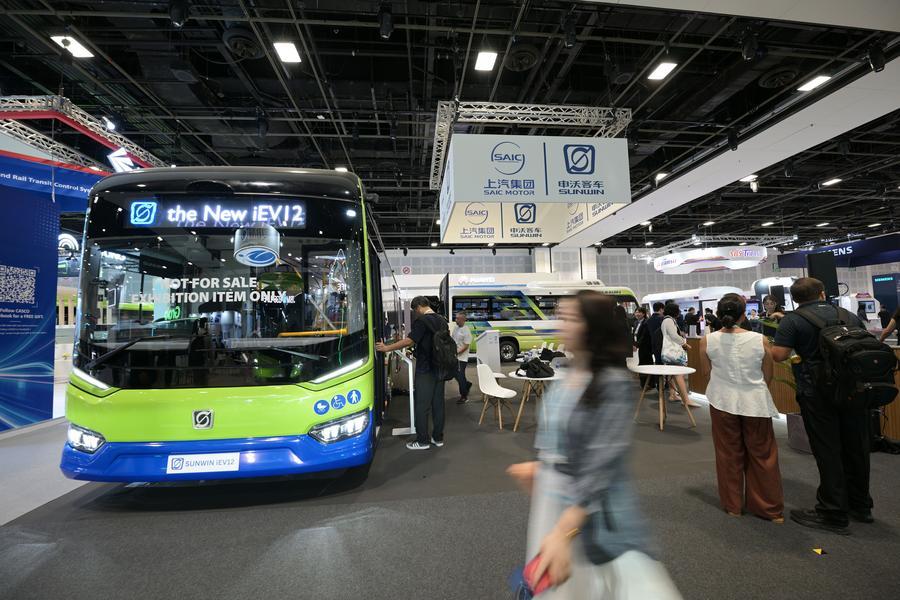
SINGAPORE, Nov. 6 (Xinhua) -- What problems can driverless technology solve? One possible answer has less to do with technology than with a practical problem facing public transport: a shortage of bus drivers.
"Many young people in Singapore are no longer interested in driving buses. A lot of the drivers come from overseas," Harold Teng, chief project coordinator at Singapore technology firm MKX Technologies, said during the Singapore Urban Mobility Week 2026, held from Wednesday to Friday.
Government figures released in July showed that Singapore had 9,900 bus captains. Fifty-seven percent were between 41 and 60, 13 percent were above 60, and foreign workers made up 60 percent of the workforce.
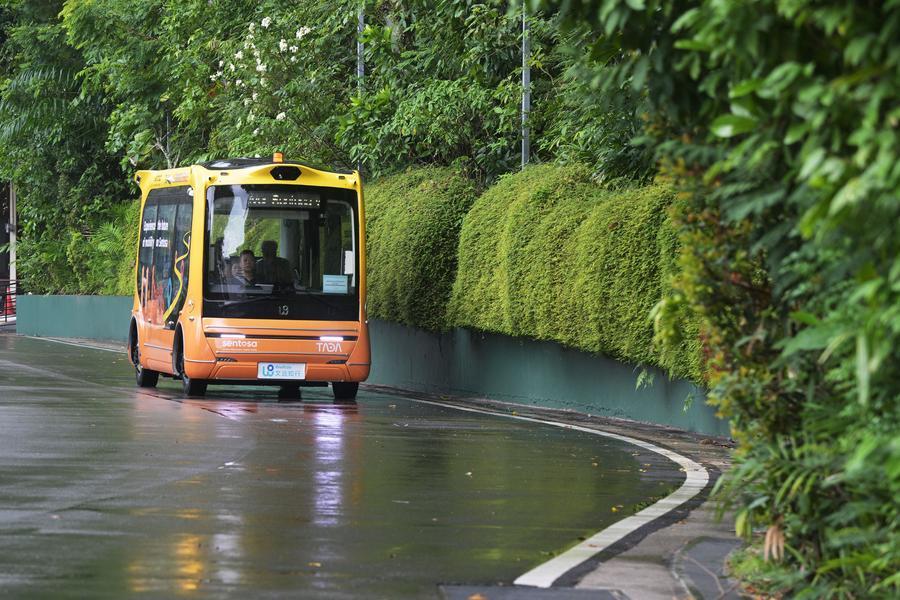
MKX Technologies, together with China's autonomous driving company MOGOX and carmaker BYD, has won an autonomous-bus pilot project awarded by Singapore's Land Transport Authority. Six buses previously procured by the authority have already arrived in Singapore.
At the event, the three companies unveiled a new 8.5-meter right-hand-drive Level 4 autonomous electric bus. Lyu Bin, vice president of MOGOX, said the vehicles had been adapted to Singapore's climate and traffic rules, using locally collected road data to train their systems.
Rain, in particular, presents a challenge. "It rains frequently in Singapore, and the rainfall can be quite unpredictable," Lyu said. The latest model uses rain sensors to adjust its speed to changing conditions. In extreme weather, such as torrential rain, it can disengage autonomous driving and hand control back to the safety operator.
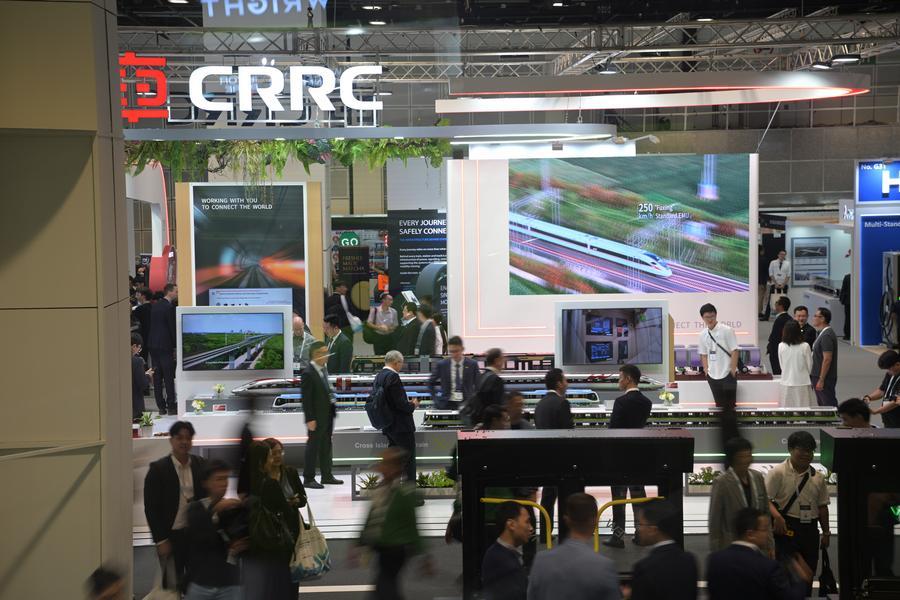
More than 200 companies took part in the exhibition, 30 of them from China. Their displays ranged from autonomous vehicles to rail systems and artificial intelligence (AI)-powered traffic management, offering a glimpse of how technology might address some of the everyday pressures facing urban transport.
Experts said that China is at the forefront of intelligent-driving technology, pointing to an approach known as "vehicle-road-cloud integration," in which vehicles, road infrastructure and cloud platforms exchange information to improve traffic management.
Chinese video surveillance provider Hikvision demonstrated one application. Its Guanlan large-scale AI models analyse traffic conditions using data from roadside cameras. Lin Hongxun, product manager at Hikvision Singapore, said cameras mounted on lamp posts could monitor vehicle speeds and traffic density.
On a highway, for instance, the system might flag an unusual number of vehicles appearing in the same camera frame within a short period, he said.
The system can then suggest ways to ease congestion: advising drivers to take another route, changing the direction of a reversible lane, or adjusting road barriers to redirect traffic. Human traffic managers decide whether to act on the recommendations.
At an intersection, Lin said, the system might detect congestion in the east-west direction while the north-south lanes are nearly empty. It could suggest extending the east-west green light by ten or 20 seconds.
Parts of the system are already in use on some roads in Singapore, Lin said. Components have also been deployed in the Philippines, Malaysia, Indonesia, Vietnam and several Central Asian countries.
While road traffic management is concerned with responding to changing traffic conditions, rail systems face a different set of challenges: keeping trains punctual and rides smooth, while reducing passenger waiting times.
Casco, a rail transit control system integrator, presented its Tranavi signaling system, which uses communications-based train control (CBTC). Casco engineer Zhang Xuan said the system can reduce the interval between trains from 120 seconds to 90 seconds, allowing a following train to enter the line sooner.
Zhang said Casco had worked on urban signaling projects for more than 120 lines in China and overseas, including 32 fully driverless lines operating at Grade of Automation 4 (GoA4), the highest automation level available.
Efficiency is only part of the experience of traveling by train. Passengers may know little about the technology that controls trains, but they notice when a train brakes abruptly as it approaches a station or accelerates too sharply after leaving one.
The system's Automatic Train Operation (ATO) subsystem controls the train's acceleration, speed, and braking. Zhang said a smooth ride depends on the details: when to accelerate, when to slow down, and by how much. "There are no drivers anymore. Everything is controlled by software."
The software also helps manage energy use. After accelerating, a train can cut traction power and continue moving under its own momentum, a process known as coasting. By allowing the train to coast for longer while keeping to its schedule, the system can reduce energy consumption, Zhang said.■