* The 7th World Media Summit addresses a core question: amid the era when "seeing is no longer believing," how can media harness AI without compromising credibility, and move beyond competition toward greater cooperation?
* Global media leaders recognize AI is more than an upgrade to traditional news workflows; it fundamentally reshapes the global communication landscape. Speakers repeatedly argue that AI's limit lies exactly where journalistic professionalism takes over.
* Technological opportunities and associated responsibilities call for global collaboration. Notably, delegates from the Global South and small nations are shifting from passive recipients of narratives to co-shapers of tech governance rules.

BEIJING, Nov. 6 (Xinhua) -- As artificial intelligence (AI) rewrites how news is produced, distributed and consumed at almost "machine speed," media organizations worldwide find themselves at a shared crossroads.
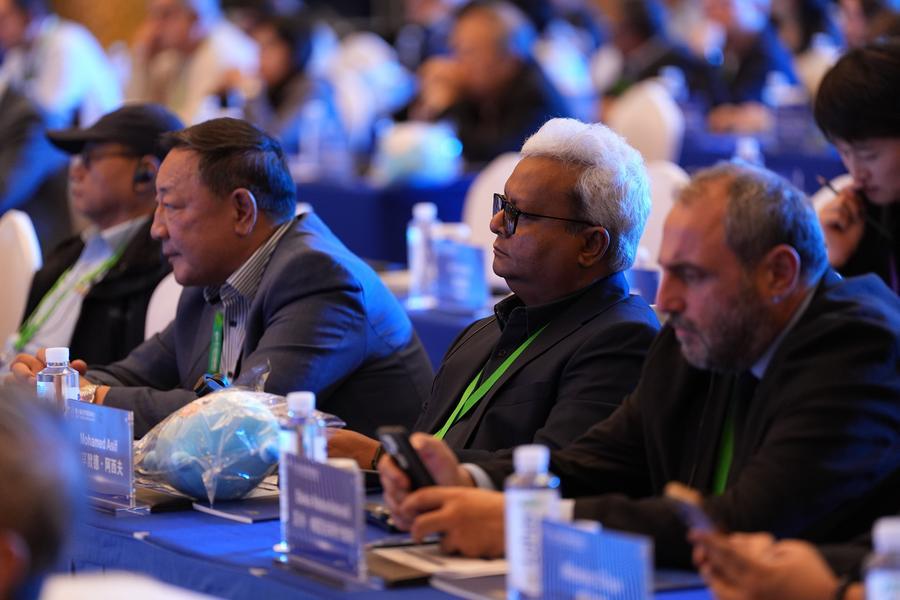
The 7th World Media Summit is being held in Beijing from Nov. 5 to 9, drawing nearly 500 representatives from close to 330 mainstream media outlets, think tanks, government bodies, the United Nations and other international organizations across 112 countries and regions.
Under the theme "Media in the Intelligent Age: From Consensus to Action," and jointly organized by Xinhua News Agency and the Beijing Municipal People's Government, the summit is grappling with a defining question of the era: in a world where "seeing is no longer believing," how can media harness AI without compromising credibility, and move beyond competition toward greater cooperation?

RESHAPING THE MAP
Across the summit's sub-forums, media leaders shared a growing realization that AI is not simply "upgrading" old systems of news production. It is fundamentally reshaping the global communication landscape.
Hervé Azoulay, professor at the Silk Road Business School in France, said technology is transforming not only how images are made, but how people narrate themselves and understand each other's cultures. A country's capacity to produce and distribute digital cultural content, he argued, has become an important source of international influence.
Pointing to the global rise of Chinese web novels, drama series and video games, he observed that China now engages with the world not only through products and infrastructure, but through its stories, its cultural imagination and creative works.
Mobile imaging and AI, he added, are democratizing content production, making it more accessible. A smartphone now lets a journalist, an independent creator or an ordinary citizen document an event and potentially reach an international audience, while AI makes editing, translation and subtitle production much easier, giving voice to those who were once rarely heard in international media.
While Azoulay highlighted the "multipolarization" of cultural narratives, Per Markus Andersson, CEO of Sweden's Aeon Media Group and editor of The Nordic Times, offered a firsthand account of how technology has enabled a small newsroom to reach a wider audience.
"We didn't start with a printing press. We started with a website," Andersson said.
In a highly concentrated media market, new voices are often shut out of mainstream information channels. Yet AI, he said, has allowed a small team to do what once required hundreds of people -- deep research, multilingual translation and content production.
"Mobile imaging changed what can be captured. AI is changing who can produce," Andersson said. He saw parallels between his own outlook and China's approach to AI. "China's AI strategy relies on open models and open source. That matches our philosophy: technology that lets more people publish, not fewer."
Tian Weigang, professor at the Communication University of China, said AI is assisting smartphone photography on every front -- enriching colors, refining technical parameters and boosting performance across every stage of the process, from shooting to content production and even live-streaming. With smartphones' powerful chips, computing capacity and even their language corpora, using phones and algorithms to capture the news is becoming increasingly important tools for news gathering and production, he said.
The promise of greater access, however, is not without risks. Ofiul Hasnat, editor-in-chief of Daily Finland, cautioned that, while AI breaks down linguistic barriers and reshapes the distribution of communicative power, it also brings misinformation, privacy breaches, algorithmic bias and digital inequality.
In his own newsroom, AI speech-to-text still stumbles over accents and uncommon names, demanding careful human verification. Hasnat stressed that media should embrace technological development "very cautiously." His warning pointed to a deeper question the summit's discussions kept returning to: how can the media harness AI while safeguarding the credibility of journalism?
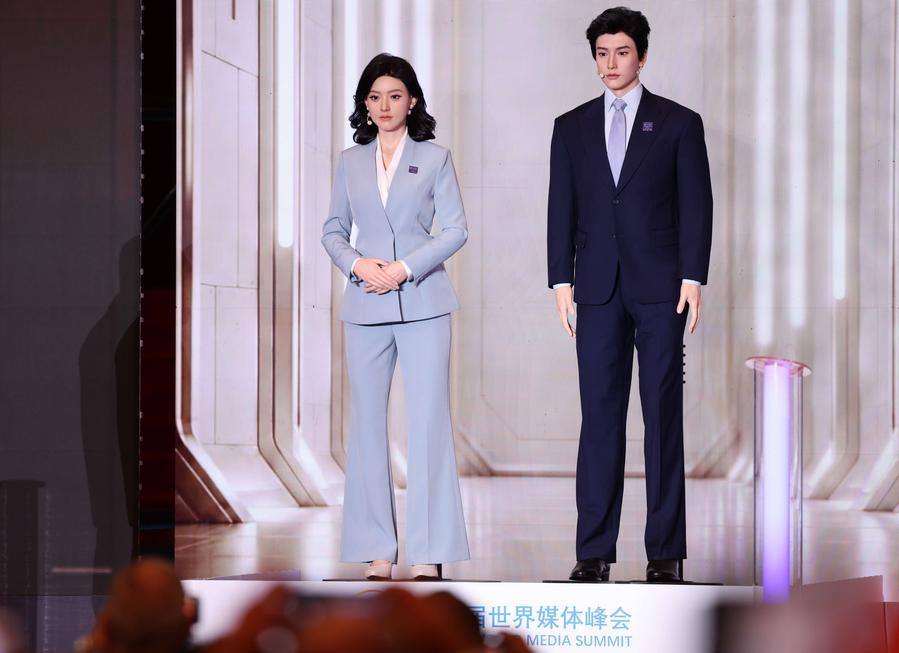
GUARDING THE TRUTH
If the "transformation" brings opportunity, responsibility has emerged as one of the summit's most pressing concerns. Across the podium, speakers repeatedly stressed the same conviction: the boundary of AI is precisely where journalistic professionalism begins.
The co-editor-in-chief of Germany's Junge Welt said the issue comes down to a fundamental question: "Who owns and controls this technology, and whose interests does it serve?" In the West, he argued, much of the powerful AI infrastructure is controlled by private corporations and tech giants, whose pursuit of profit increasingly shapes how information is produced and distributed.
The paper, founded in 1947 and owned by its readers through a cooperative, has set a simple and firm principle: "At Junge Welt, human beings write for human beings." AI, he said, cannot replace personal encounters between journalists and the people they report on -- being physically present on the ground, listening to workers, and verifying facts.
That emphasis on human oversight was echoed by Bridgid Nzekwu of the Press Association Academy in Britain. She said the Press Association, a national news agency serving the United Kingdom, as well as the island of Ireland, has "an uncompromising position on AI." It uses the technology to support and enrich journalists' work, "but never to generate content." AI handles transcription, archive retrieval and data screening, while on-the-ground reporting, fact-checking and editorial judgment remain human.
Nzekwu also cited a warning from the outlet's editor-in-chief Jack Lefley, that the biggest threat to journalism is "a degraded information environment where audiences struggle to distinguish verified journalism from synthetic noise."
When images, recordings and seemingly authentic testimony can all be fabricated, credibility becomes the media's only currency that endures. Marek Traczyk, chairman of the Polish Media Association, defined the journalist's role in the age of synthetic images as "the eyes and ears of the world." He posed another fundamental question: "Speed is not accuracy, everyone can broadcast, but who takes responsibility?"
AI, he acknowledged, "can assist verification, but cannot replace source-checking, scrutiny of evidence or distinguishing facts from interpretation." He said it was the responsibility of news agencies, publishers and journalists to uphold standards for accurate, reliable information and that this should be written into the summit's emerging "Beijing Consensus."
The discussion also extended to questions of ownership and human agency in the development and use of AI. Diego Bolson Ruzzarin, partner director of Mexico's MPV Management, asked who owns the tools, infrastructure and knowledge that make these capabilities possible, and who owns the value they produce.
He warned that if people routinely delegate judgment to machines, they risk weakening the very capacities that allow them to judge the results. "AI can assist thought, but assistance should preserve opportunities to exercise judgment," he said.
Kamel Mansari, editor-in-chief of Algeria's Le Jeune Indépendant, put it more bluntly. Faced with deepfakes and generative disinformation, "unconditional reliance on automated content is editorial suicide." He urged that every piece of AI-assisted data, image, or text undergo rigorous human verification before publication. "Transparency and labeling are not just ethical choices; they are our defensive shield against algorithmic poisoning," he added.
BRIDGING THE SOUTH
The opportunities created by technological transformation and the responsibilities that come with it, ultimately point to one imperative, that of collaboration. Perhaps the most striking feature of the summit is that voices from the Global South and smaller nations are moving from being "narrated" to co-deciding the rules governing emerging technologies.
Viasen Soobramoney, CEO of South Africa's Independent Media IOL and the African News Agency, said Africa's stories have too often been told through outside perspectives, while African languages and lived experiences remain underrepresented in global information systems.
AI, he said, offers a chance to change this, by empowering rural journalists to reach international audiences and giving young African reporters a global stage. But opportunities, he stressed, can only be translated into reality by investing in skills, infrastructure, partnerships and governance.
"The Global South must not simply consume technologies developed elsewhere," Soobramoney said. "We must participate meaningfully in their development, governance and ownership. We must help shape the rules of the digital future, not merely inherit decisions made elsewhere."
Aminath Namza, chairperson of Public Service Media in the Maldives, brought the question of inclusion down to the level of every ordinary person.
"Are we equally preparing our people?" she asked. In her view, "the true measure of intelligent technology is not how much it can do, but how much good it can do for humanity."
Abdul Hakim, president director of Indonesia's Antara News Agency, placed trust above efficiency: "Technology makes media faster. Intelligence makes media smarter. But trust makes media matter."
The call for greater collaboration and trust was also reflected in participants' appreciation of the summit as a platform for international dialogue.
Sarwar Kashmeri, founder and host of Polaris-Live.com in the United States, observed that, while AI brings unprecedented capability, it also carries risks, such as fabricated images that erode public trust and even affect international relations. "I think it's very important to hold this media summit, especially at this moment."
(Video reporters: Wei Ying, Yang Zhigang, Ma Xiaodong and Meng Jing; Video editors: Yang Zeyi, Roger Lott and Li Qin) ■