
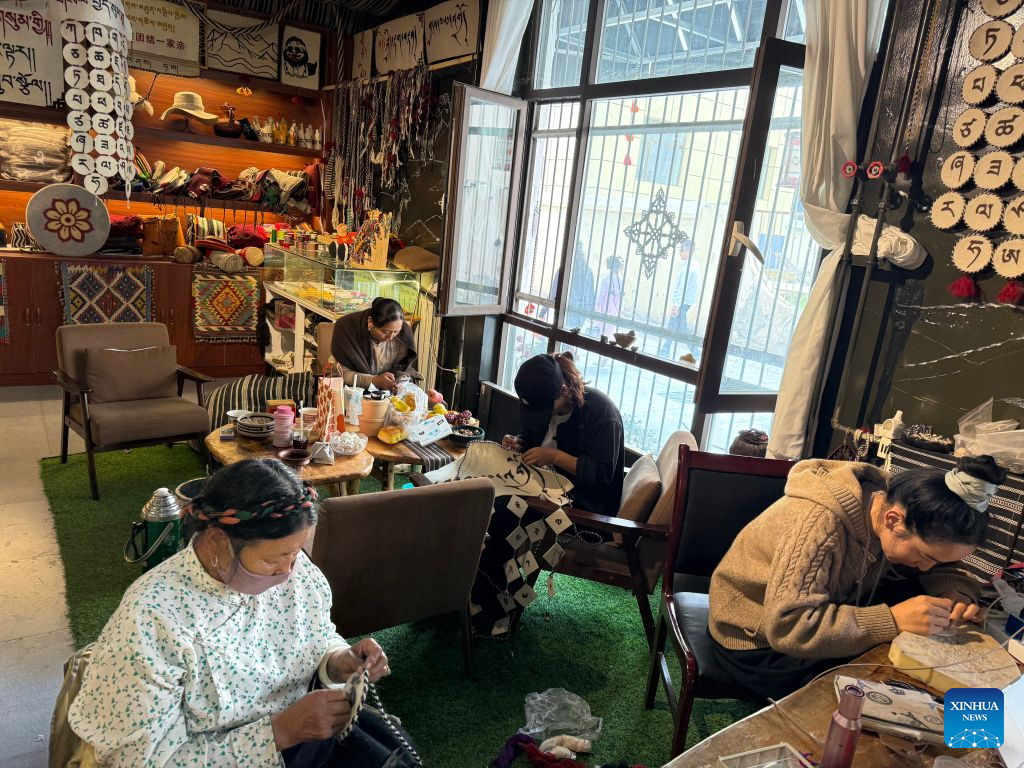
Women work at Kunga Chogyi's workshop in the Tibetan Autonomous Prefecture of Yushu, northwest China's Qinghai Province, July 26, 2026. (Xinhua)
XINING, Nov. 5 (Xinhua) -- Instead of carrying perfume or cosmetics, 36-year-old Tibetan Kunga Chogyi always tucks a bundle of yak-hair cord in her handbag whenever she travels away from home.
On a flight to Beijing for a trade fair earlier this year, Kunga Chogyi was inspired by the sunlight piercing through the clouds and wove two colorful bracelets using this cord. She sold both to the flight attendants onboard for 166 yuan (about 25 U.S. dollars) each.
"That was my first time doing business on a plane," she recalled with a smile.
Kunga Chogyi is an inheritor of Tibetan hand-weaving, an intangible cultural heritage item in the Tibetan Autonomous Prefecture of Yushu, northwest China's Qinghai Province.
Through ancient yak-hair weaving and modern livestreaming e-commerce, she has sold her crafts nationwide, attracting young customers via innovative products and empowering local women with skills and income.
LEGACY WOVEN IN THREAD
Born into a herding family in rural Yushu, Kunga Chogyi originally studied Tibetan medicine under her father. From her grandmother, she learned to weave Tibetan woolen fabric and craft traditional yak-hair tents.
Her grandmother, who raised six children, often left them at home to trek across mountains, weaving tents for other herders to make ends meet.
"When a single thread turns into a physical object, that feeling of happiness and anticipation makes you feel reborn," Kunga Chogyi said.
Before passing away, her grandmother urged her to carry on the craft. "As long as you have this skill, you won't starve," her grandmother told her.
While burying her grandmother's ashes at their family's ancestral pasture, Kunga Chogyi encountered a snow leopard -- an endangered species that Tibetan people regard as auspicious. She named it Drolma.
"I was so excited. I felt it was a sign of my grandmother's encouragement. That's when I made up my mind to carry forward this heritage."
INNOVATION TAKES FLIGHT
Initially, her work was limited to daily necessities like tents and herding slings. Sales were sluggish, and she was considering giving up when an unexpected trip to Sichuan Province in southwest China changed everything.
Living near the township government, she mastered Mandarin better than her peers at home. While accompanying a relative to Sichuan for medical treatment, she visited the Leshan Giant Buddha, a renowned scenic area in the province. There, she saw an elderly woman weaving and selling bracelets as cultural products.
"Seeing those patterns, I thought, I can do that too."
Kunga Chogyi began innovating, creating bowl covers, bracelets, jewelry boxes and earphone cases. She incorporated gemstones like turquoise, coral and dzi beads into her weaves, making them increasingly exquisite.
Her turning point came when she saved a tourist from north China's Tianjin Municipality who had fainted from altitude sickness at a gemstone market in Yushu, using her Tibetan medical knowledge in doing so. The grateful tourist became her friend and partner, helping her open an online store.
At its peak, the store processed orders worth 40,000 to 50,000 yuan per hour. Kunga Chogyi slept only four hours a day and hired two employees.
However, when the business cooled and her father passed away, the pressure of supporting her family as the eldest of three siblings became overwhelming.
Then, once again, she spotted not one, but two snow leopards on her pasture. She believed they were Drolma and her son.
"Even a snow leopard fights with all its might to feed its family. I can do it too," she said, drawing immense courage from the encounter.
The snow leopard became both her spiritual totem and creative muse. She began weaving yak-hair snow leopard artworks for hanging on walls, which became a hit both online and offline.
She also applied her father's Tibetan medical knowledge to dyeing, using herbal dyes to create threads in the colors of "wind, water, black tents and deer." She even embeds herbs into her crafts, creating herbal sachets.
After shifting her focus to platforms like Rednote and Douyin for livestreaming e-commerce, she saw her business boom again. To stay competitive, she forces herself to launch new products weekly, and has expanded her range to over 300 varieties, including snow leopard brooches, lamb bag charms and wallets.
In 2024, she founded a cultural art product and trade company called Guba, meaning "a strand of cord" in Tibetan. She employs local women, providing them with raw materials and buying back finished products. To date, she has helped 28 households increase their income, with women earning an extra 2,000 to 4,000 yuan per month without neglecting their family duties.
GOVERNMENT SUPPORT
Wangde Norbu, deputy director of the prefecture's bureau of culture, sports and tourism, noted that Yushu is empowering rural revitalization via intangible cultural heritage. By setting up booths at festivals like horse racing events and soccer matches, and organizing the inheritors to attend national fairs and expos, the government is helping broaden the reach of these crafts.
With government assistance, Kunga Chogyi has taken her products to exhibitions across China, where demand often exceeds supply. Last year alone, her company's revenue exceeded 700,000 yuan.
Kunga Chogyi's story reflects a broader national drive. In September, China issued a 15th Five-Year Plan (2026-2030) on Cultural Heritage Protection and Inheritance, which calls for solid progress in safeguarding intangible cultural heritage, revitalizing traditional crafts, upgrading related workshops, and using heritage to renew historic classic industries. Across the country, the emphasis has shifted from preservation alone to turning "skills at the fingertips" into sustainable livelihoods.
Kunga Chogyi is not content with just weaving and selling. With more tourists visiting her shop for hands-on experiences, she plans to develop her pasture into an immersive experience base. Visitors will be able to try hand-weaving, milking yaks, churning butter and grazing cattle, while also having the chance to spot a snow leopard.
"I hope more tourists can deeply experience the life of Tibetans and help convey the concept of harmonious coexistence between humans and nature," she said. ■
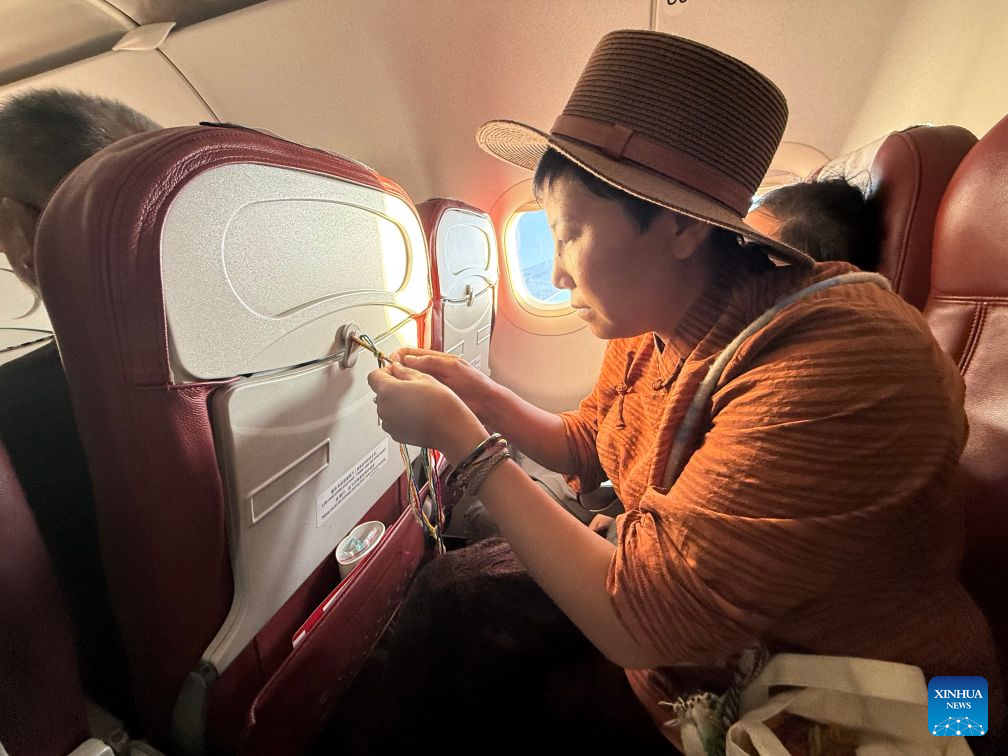
Kunga Chogyi weaves a bracelet onboard a flight from Xining, capital of northwest China's Qinghai Province, to Beijing, capital of China, June 4, 2026. (Xinhua)


