by Xinhua writers Yang Shilong, Xu Jing
NEW YORK, Nov. 3 (Xinhua) -- Chicago resident Sam Liu works 40 hours a week across two part-time jobs, has no health insurance and has not seen a dentist in about two years. After five or six months of searching, the recent urban planning graduate has landed a full-time job.
"A lot of people are hurting, especially a lot of people who are working class," said Liu, who earned his master's degree in May. "Even middle class is getting squeezed."
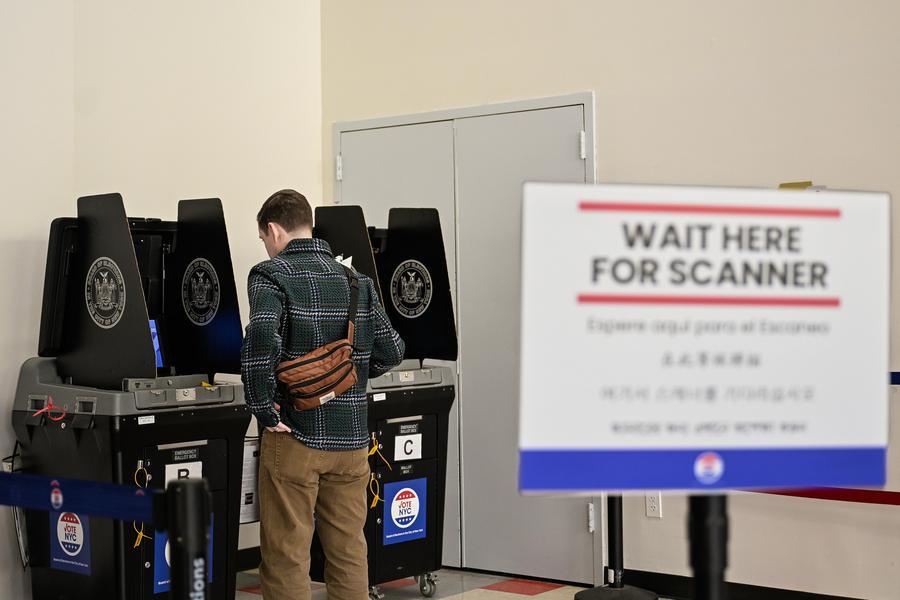
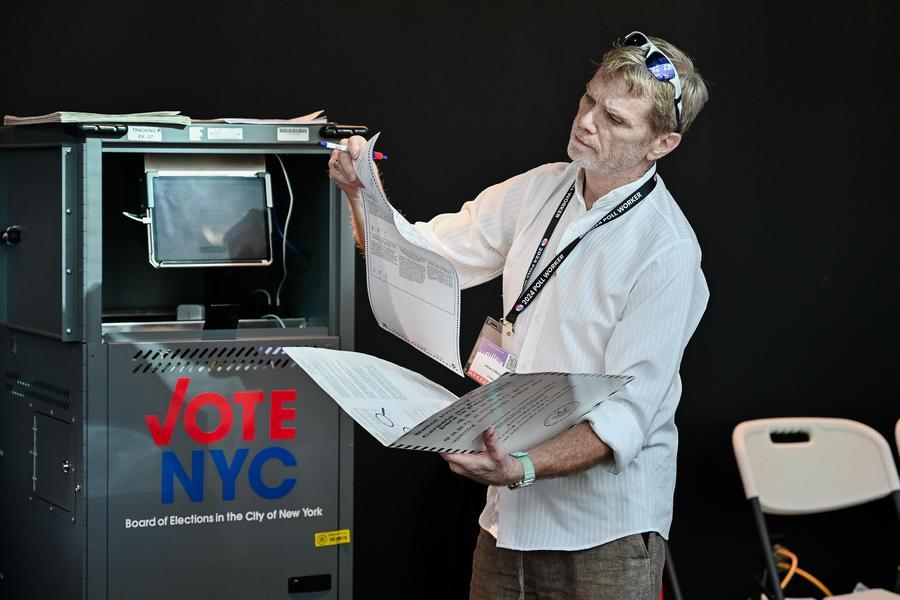
Ahead of the Nov. 3 midterm elections, interviews Xinhua conducted in Chicago, the San Francisco Bay Area and New York show young people confronting similar questions about establishing their careers -- and reaching different conclusions about participating in politics.
Some want to elect Democrats to check President Donald Trump. Some conservatives have soured on the president. Others distrust both parties or have decided not to vote.
National polling suggests Democrats have an opening with young voters, but cautions against mistaking discontent for broad enthusiasm or guaranteed turnout.
In the Harvard Youth Poll released Oct. 22, Democrats led Republicans 63 percent to 26 percent among 18- to 29-year-olds who said they would definitely vote. The survey interviewed 2,024 young adults from Sept. 30 to Oct. 7. Yet only 33 percent of young Americans said they would definitely participate, down from 40 percent before both the 2018 and 2022 midterms.
Among rural young people who said they would definitely vote, Harvard found an essentially even split, 43 percent for Democrats and 42 percent for Republicans.
TRYING TO GET ESTABLISHED
Liu previously received food assistance through the Supplemental Nutrition Assistance Program. Those benefits ended in the summer after he began working. He credits Chicago's relatively low cost of living with helping him cover his expenses, but he still struggles to save or invest for retirement. When he borrows his partner's car, he helps pay for gas. He has been trying to drive less, taking public transportation or his bicycle instead.
Both part-time jobs now pay 30 U.S. dollars an hour, an improvement that he said has made daily life easier.
"I can have some room to breathe," he said.
He sees the pressure on households as a question of how wealth is distributed.
"We continue to see this upward transfer of wealth from the bottom to the top, and our government and our elected officials facilitate that transfer," he said.
In Silicon Valley, Maya Orsi, a 22-year-old philosophy student, also prioritizes living costs. Her concerns span housing, groceries, gasoline and tuition.
"It's really high here in Silicon Valley, and as a student, I think that's a top concern," she said.
Harvard's survey found that 25 percent of young Americans expected to be financially better off at their parents' age than their parents are now, while 27 percent expected to be worse off.
In New York, Kaleigh Kelly, 20, described similar doubts about his future. He had taken real estate classes, yet housing costs had left him questioning his prospects in the field and his own chances of buying a home.
"I'm never gonna be able to buy a house the way the prices are," he said. "Why would we be worse than the generation before us? That doesn't make any sense."
Leela Strong, Newhouse director of Tufts University's Center for Information & Research on Civic Learning and Engagement, known as CIRCLE, named living costs, health care and housing as leading concerns for young people coming into the midterms in a Sept. 22 interview with Tufts Now.
She also cautioned against assuming that young people share a single political identity. Their choices depend more on issues and candidates than on party, she said, noting that politicians need to learn to ask young people questions rather than tell them what to think.
A PREFERENCE IS NOT AN ENDORSEMENT
Orsi is a registered Democrat, but her party preference coexists with dissatisfaction over the available choices.
"I don't agree with the two-party system, but it's what we got for now," she said. "Between the two, I feel like the blue party tends to be the lesser of two evils."
Orsi said she cares about reproductive health and "my freedoms as a woman to make choices about my body," as well as the treatment of immigrant communities. She objects to immigration raids.
A Democratic preference does not necessarily signal satisfaction with the party. Harvard's survey found that 66 percent of registered young voters disapproved of congressional Democrats and 74 percent disapproved of congressional Republicans, despite Democrats' advantage in voting preferences.
Cameron Huff, a public health student at San Jose State University, approaches the election from a conservative perspective, but draws a distinction between local and national politics.
"In terms of less spending, I support voting red," he said.
He still backs Trump on "shutting down the border," while objecting to what he described as immigration agents targeting mainly innocent people rather than focusing on criminals. But the Iran war and tariffs have cost Trump his support, he said.
"Even if people did support Trump in the past, I feel like the Iran war was a turning point," he said. "And then with all the tariffs and the trade war stuff for no reason, he definitely lost my support also."
His dissatisfaction has not extended equally to every Republican. "In terms of local stuff, I still definitely support Republicans, but on the federal level, I support very few Republicans anymore."
Harvard's poll also found that 48 percent of young Republicans disapproved of Trump's handling of the economy.
"A lot of people are disappointed with the way that things are going," said Liz Eisenlohr, 29, youth and communications manager at the Coalition for a Better Chinese American Community in Chicago. "What's pushing people to vote is that frustration with the way that things are currently going."
She sees greater participation as a way to give young people more influence over legislation.
Whether that frustration reaches the polls is still an open question. A CIRCLE analysis of voter files from 42 states found that the number of registered voters aged 18 to 29 was 3 percent higher than at a comparable point before the 2022 midterms, although changes varied considerably by state. Its analysis used voter files available as of Oct. 19. Registration figures do not establish eventual turnout.
WHETHER A BALLOT CAN MAKE A DIFFERENCE
For Jordan Collins, a 23-year-old business administration student at San Jose State University, political conflict is a reason to stay away from politics.
"I just never really grew into politics," he said. "I don't have a whole lot of knowledge on it, and it just gets messy."
He described a climate in which almost any political position invites disagreement and the news seems persistently negative. He has chosen not to vote.
Collins also feels the financial strain of gasoline prices as a student. However, despite sharing concerns with more politically engaged interviewees, he has not been motivated to participate.
By contrast, Kelly, the 20-year-old interviewed in New York, described himself as "not big on politics" but said he plans to vote this year.
"I'm gonna vote. I'm gonna figure it out, and I usually don't," he said. "But this year, I feel like I have to."
He did not name a preferred party or candidate. "Honestly, I don't even know where I stand," he said. "It's just somebody's gotta do something."
Della and Stephanie Wallace, sisters in their 20s, pointed to Bay Area ballot measures that would raise local taxes to keep the region's transit systems running.
Stephanie considered the extra tax worthwhile, while Della said her brother's girlfriend, who does not usually vote, is voting this time because she relies on public transit. Stephanie also backed a wealth tax on California's ballot, hoping its passage would inspire other states to follow suit.
In New York, Ximena Ortiz also argued for participation, noting public decisions affect everyday life, from transportation and food to education.
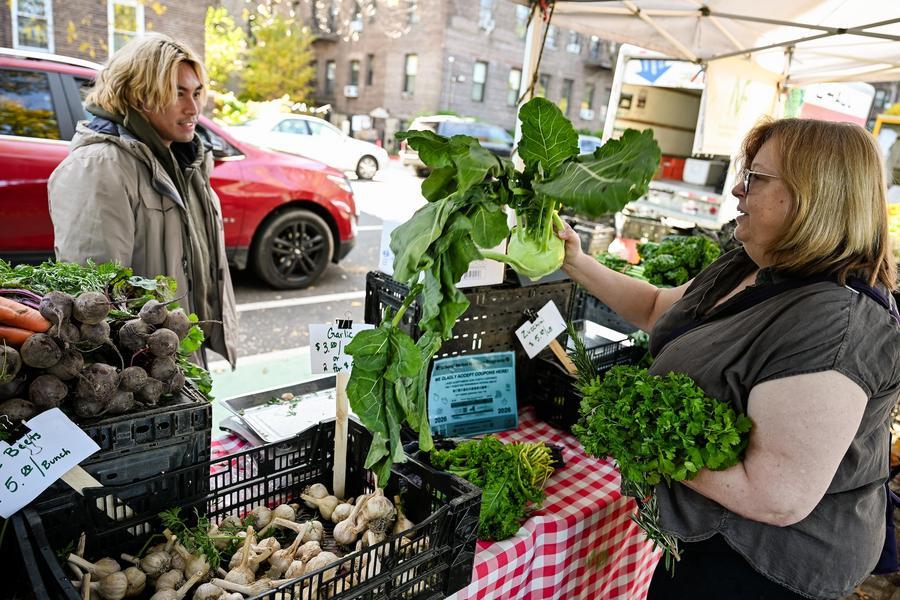
For her, seeking change also means taking responsibility for choosing community representatives. "You can't just sit around and wait for everybody to do the work for you." Enditem
(Vivien Liu in New York, Xirui Li in San Francisco, Zhiqiao Yao in Chicago contributed to the story.)■