* The 9th Silk Road (Dunhuang) International Cultural Expo opened in Dunhuang on Tuesday, gathering around 1,200 delegates from home and abroad with a focus on cultural exchanges and mutual learning among civilizations.
* Conservation technologies developed in Dunhuang have been rolled out to more than 150 heritage sites across China, and introduced to other countries including Kyrgyzstan and Myanmar.
* While heritage guardians tend to Dunhuang's ancient roots, creative innovators breathe new life into its timeless culture.
LANZHOU, Nov. 3 (Xinhua) -- Dunhuang, famed for its Mogao Caves, was a meeting place for diverse cultures along the ancient Silk Road. Today, it still draws people from far and wide, attracted by its renewed charm.
The 9th Silk Road (Dunhuang) International Cultural Expo opened in Dunhuang on Tuesday, gathering around 1,200 delegates from home and abroad with a focus on cultural exchanges and mutual learning among civilizations.
Yet the tales of cultural convergence stretch far beyond the expo's forums and exhibition halls, reaching into the daily rhythm of this oasis city, located in northwest China's Gansu Province. For many, Dunhuang is not merely a tourist attraction, but a second home where they build careers inspired by its age-old heritage. They, in turn, inject new energy into heritage preservation and cross-cultural exchange.
Some foreign guests at the expo remarked after touring the city that Dunhuang itself stands as a living example of dialogue between different cultures. Zoey Ashlyn Koehl, a student from Oklahoma City University in the United States, was impressed by the welcoming and dynamic vibe of Dunhuang: "I think it's a city open to all different kinds of people to come."

SAFEGUARDING HERITAGE
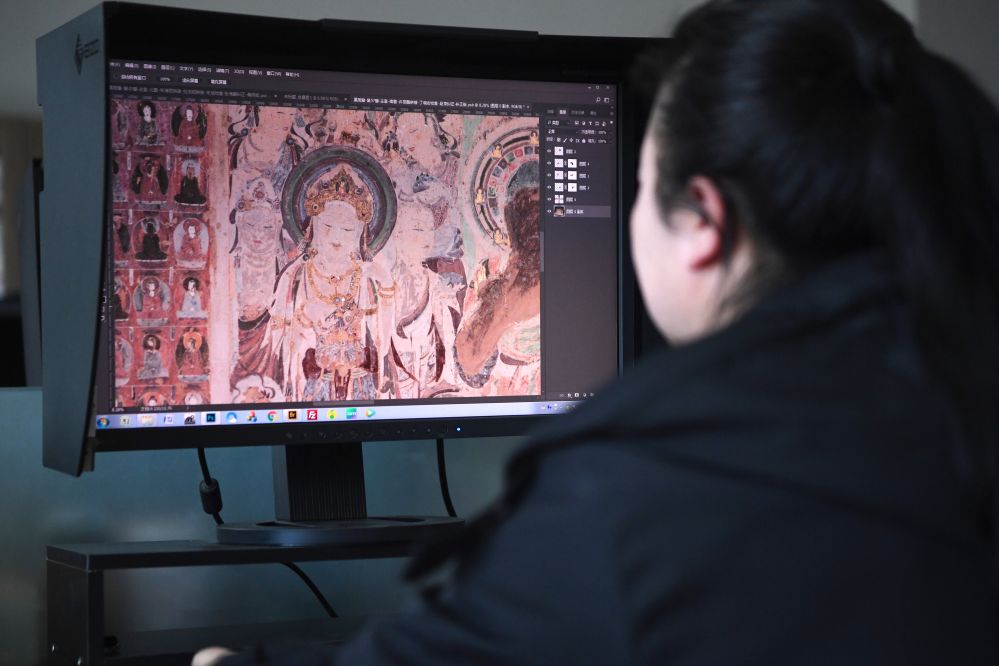
Wu Shaoxia adjusted her equipment inside a cave as morning sunlight spilled over the cliff faces of the Mogao Caves. As a cultural relics photographer, she has been based in Dunhuang for 11 years.
Now 35 and originally from Shaanxi Province, also in northwest China, Wu is part of the Dunhuang Academy's digital team, featuring many young members from across China.
Wu regularly works inside the dim caves, repeating high-precision image capturing endeavors. Notably, she believes that "conservation is not only about rescuing endangered relics, but also racing against time to pass on the millennia-old beauty to future generations."
The young cultural workers in Dunhuang carry forward a mission begun decades ago. Over 80 years ago, a batch of heritage workers trekked into the Gobi Desert in a grottoes' conservation and research quest.
While their forerunners initially cleared sand from caves by hand and restored relics with simple tools, later generations have witnessed the evolution of conservation approaches.
So far, the academy has completed high-precision digital documentation of 323 caves, while its online digital library reunites Dunhuang manuscripts scattered around the world. Notably, as part of the Mogao Caves visitor experience, a dome film that immerses viewers as if inside the real grottoes draws on the academy's digital records.
Conservation technologies developed in Dunhuang have been rolled out to more than 150 heritage sites across China, and introduced to other countries including Kyrgyzstan and Myanmar.
"Earlier generations safeguarded the physical grottoes. We strive to preserve the look of this 1,000-year-old treasure," said Wu.
REIMAGINING TRADITIONS
While heritage guardians tend to Dunhuang's ancient roots, creative innovators breathe new life into its timeless culture.
Chen Lisong first visited Dunhuang ten years ago, instantly captivated by the depth of its ancient history.
Previously based in Shanghai in east China, she relocated to Dunhuang the following year and opened a souvenir shop. The designs of her products draw on iconic Mogao motifs, including the nine-colored deer and flying apsaras.
Chen later developed a Silk Road-themed dining space, where visitors can taste signature dishes from different regions along the ancient trade route.
For her, Dunhuang culture is not limited to cave murals. It can be woven into dining, accommodation and travel experiences. "Through modern design, it can be transformed into items people can take home," she said.
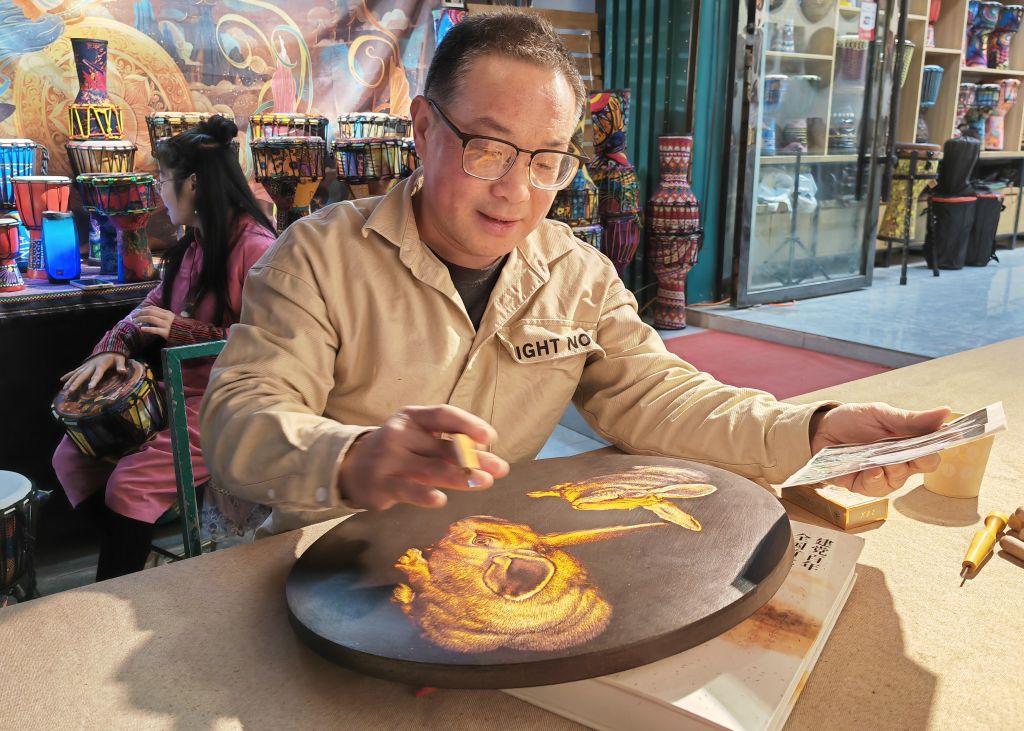
Shen Hongjie, a wood-carving artist, moved from central China's Hunan Province to Dunhuang in 2004, attracted by murals in the Mogao Caves and the local desert landscapes. He set up a studio, blending oil painting and traditional Chinese painting techniques with wood carving to recreate classic Mogao imagery.
In the early years of his venture, Dunhuang's cultural tourism sector remained nascent, with limited sales channels for his artworks. As local cultural tourism flourished in recent years, more visitors have poured into Shen's studio, while young apprentices have traveled from afar to learn the craft.
Dunhuang received some 24.39 million visitors in 2025, 3.7 times the number recorded in 2020. Cultural and creative products, immersive experiences and intangible heritage workshops are flourishing, appealing to culture-craving young Chinese.
BRIDGING CONTINENTS
Among those who fell for Dunhuang's charm are some cultural enthusiasts from overseas.
Ukrainian dancer Romanovych Inna and Georgian dancer Vaja Bukia settled in Dunhuang in 2024, and have performed in the dance drama "Ancient Sound of Dunhuang."
Discovering parallels between Georgian traditional dance and ancient Central Asian whirling dance movements depicted in Dunhuang's murals, Bukia incorporated his native dance elements into the show. "Both Georgia and Dunhuang carry ancient civilizations passed down for generations," he said.
For American researcher Neil Schmid, the first full-time foreign scholar at the Dunhuang Academy, his connection with Dunhuang began in the 1980s after reading a book on it.
He joined the academy in 2018 and has since shared Dunhuang's heritage globally via lectures, documentaries and publications. "The amazing thing about Dunhuang materials is that there is such a wealth," said Schmid.
The ongoing Dunhuang expo, first launched in 2016, further expands such exchanges. Referring to the ancient legacy of Dunhuang, Daren Tang, director-general of the World Intellectual Property Organization, said at the expo: "It reminds us that culture does not grow in isolation, but through exchange, new ideas and creativity."
Attending the expo for the second time, Hasebe Tsuyoshi, a professor from Japan's Kansai University who has been studying ancient Dunhuang music scores, said both the ancient and modern Dunhuang are crossroads of world cultures.
"Different civilizations have interwoven with one another since ancient times," he said, adding that it is important to continue such exchange and interaction.
(Video reporters: Zhang Zhimin and Zhao Tianlin; Video editors: Li Ziwei, Zhang Mocheng and Hong Liang) ■