
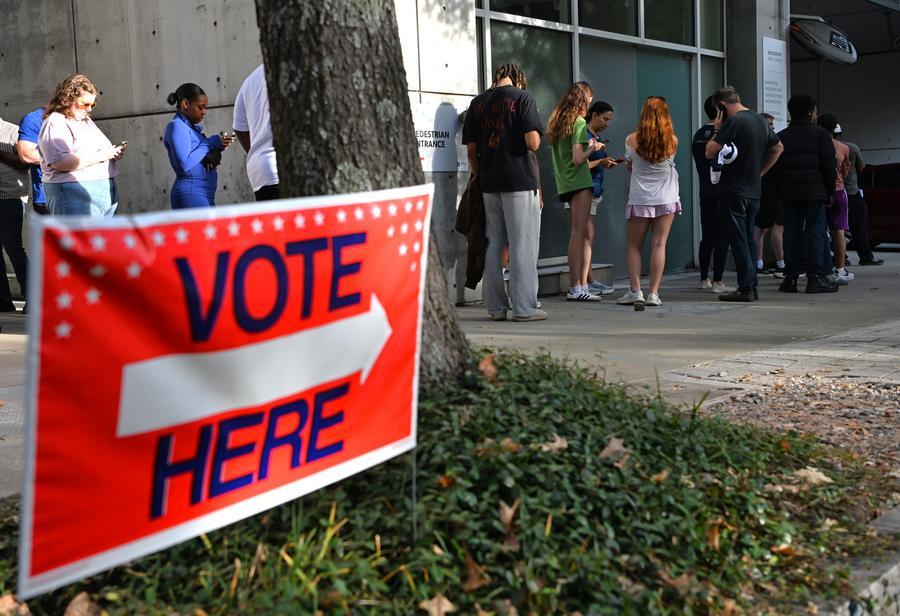
WASHINGTON, Nov. 3 (Xinhua) -- With more than 50 million Americans having already cast their ballots, the Nov. 3 midterm elections are entering the final stretch. Republicans and Democrats are locked in fierce contests for multiple seats in both the House and the Senate, with certain races remaining extremely tight.
To boost their prospects, both parties have pulled out all the stops in recent weeks: the alleged recruiting of a candidate to confuse voters, offering monetary incentives, featuring an opponent's estranged mother in a political ad, and wielding government power to investigate political rivals.
In the pursuit of victory, both parties seem determined to push the boundaries of political conduct ever further. Is this a farewell to political decency?
On the Republican side, Vivek Ramaswamy, Republican nominee for Ohio governor, sparked fierce controversy by using a video featuring the mother of his Democratic opponent, Amy Acton. In the ad, Acton's mother accused her daughter of lying and urged voters not to support her. Acton said she was sexually abused by her stepfather at the age of 12 and has been estranged from her mother ever since, saying her mother failed to protect her.
The backlash came not only from Democrats but also from within the Republican Party. Ohio Governor Mike DeWine, a Republican, called for the ad to be pulled, while Republican Senator for Ohio Jon Husted also criticized it. But President Donald Trump and Vice President JD Vance publicly defended Ramaswamy. His team eventually stopped airing the ad.
Axios reported that some Republicans worried that using a candidate's childhood sexual abuse as a political weapon could lead voters to believe the campaign had crossed an ethical line, potentially turning voters off.
Meanwhile, a heated controversy over ballots in California has also drawn widespread attention. The U.S. Justice Department sued California election officials on Oct. 15, claiming that more than 20,000 people who may not be U.S. citizens were registered to vote in the state. It asked California to verify the names on the list and refrain from counting their mail-in ballots until it could confirm citizenship status. Several federal judges rejected the department's demands, ruling them as unconstitutional.
The Los Angeles Times reported that the Justice Department's list lacked a sufficiently transparent verification methodology, making it impossible for California election officials to reject ballots based solely on unverified records.
Meanwhile, California Governor Gavin Newsom, a Democrat, warned that the federal government could go further by seeking search warrants to obtain ballots and other election materials, potentially disrupting the state's vote counting and certification process.
The Washington Post recently reported that the Trump administration was using lawsuits and investigations to cast doubt on the integrity of the midterm elections, exclude certain ballots from being counted, and prevent the final results from being certified. The report raised a broader question: Is the Trump administration laying the groundwork for post-election disputes?
Democrats, meanwhile, came up with an unusual tactic of their own. According to a recent report by The New York Times, the campaign team for Mary Peltola, the Democratic Senate candidate in Alaska, allegedly began looking as early as the summer of 2025 for a candidate sharing the same name as incumbent Republican Senator Dan S. Sullivan. The team eventually identified Daniel J. Sullivan, a retired teacher, in what was reportedly an effort to split the Republican vote and influence the election outcome.
The revelations sparked widespread criticism. Peltola and her campaign team denied any involvement in the alleged arrangement, while Alaska Governor Mike Dunleavy said an investigation would be launched. Trump responded to the report on Truth Social on Wednesday, claiming "election fraud" and that "the Democrats cheated."
In Kansas, Democrats were hit by a campaign scandal. On Saturday, Kansas Attorney General Kris Kobach issued a cease-and-desist order to Bluestem Kansas, a political advocacy and voter mobilization group, after a voter alleged that one of the organization's canvassers had offered voters 5-dollar gift cards. Kobach said offering monetary incentives such as gift cards in exchange for votes could violate the law. The allegations remain under investigation.
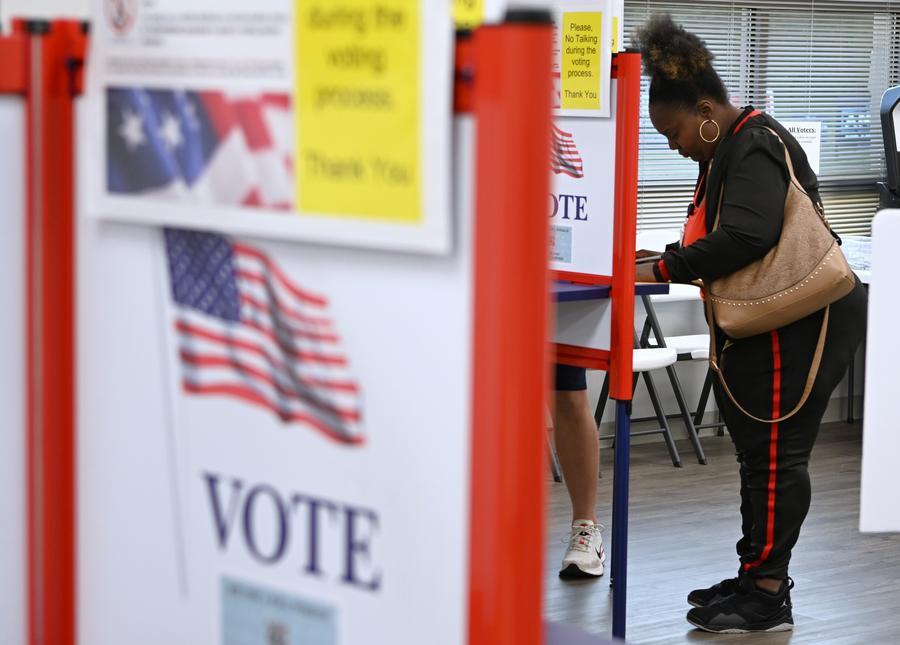
On social media, Trump described the organization as a "Radical Left PAC" and accused it of engaging in what he called a "criminal offense."
The gift card incident is familiar. Ahead of the 2024 U.S. presidential election, billionaire Elon Musk used his pro-Trump political action committee, America PAC, to offer 100 dollars to registered voters in the key battleground state of Pennsylvania in exchange for signing a political petition.
Money has long played a significant role in American elections. But as monetary incentives become a direct tool of voter mobilization, the boundaries of money politics in the United States appear to be expanding.
Behind these controversial tactics lies an increasingly polarized American political landscape, in which both parties are competing for political advantage with seemingly little regard for the costs. The sole aim is to destroy the opposing side, the despised enemy.
"Under this administration and with the composition of today's Congress, new lows have become the norm," Greg Cusack, who served in the Iowa state legislature from 1973 to 1981, told Xinhua.
"Elections need not be conducted this way, of course, but the kind of reforms necessary to change them cannot come as long as the current crowd is in control," he said.
The growing polarization between the two parties has also become a source of concern for voters. Brian Chandler, a Texas resident, told Xinhua that his family had traditionally supported the Republican Party, but he gradually shifted his support to the Democrats in recent years. "There's no middle common ground" between the two parties nowadays, he said, adding that divisive and confrontational rhetoric is becoming increasingly widespread.
The multi-state redistricting battle, initiated by Republicans and followed by Democrats, further illustrated deepening partisan polarization in the United States. After Republican-led Texas moved to redraw its congressional districts, Democratic-led California quickly followed suit. Seven other states are also set to adopt new congressional maps, as both parties prioritize partisan advantage above all else.
Looking back on this election cycle, some of the tactics employed by both parties to win votes have been far from noble. They bring to mind First Lady Michelle Obama in 2016: "When they go low, we go high." Sadly, rather than go higher, the campaign has become a race to see who can sink lower.■