
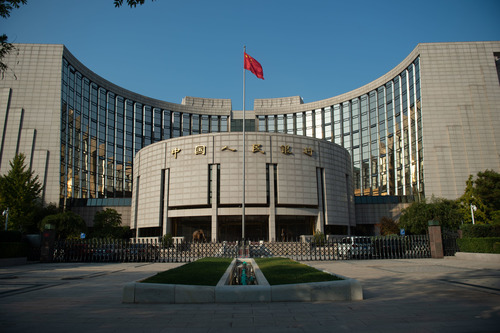
BEIJING, Nov. 3 (Xinhua) -- China's central bank on Tuesday announced that it will raise the foreign exchange (forex) reserve requirement ratio for financial institutions by 2 percentage points, the first increase in nearly five years, in a move that is expected to ease the upward pressure on the Chinese currency renminbi and stabilize market expectations.
The People's Bank of China (PBOC) said in a statement that it will raise the forex reserve requirement ratio from 4 to 6 percent from Nov. 15 this year.
A macro-prudential management tool in the forex market, the forex reserve requirement ratio refers to the share of foreign currency deposits that financial institutions must hold at the PBOC. An increase tightens U.S. dollar liquidity and eases upward pressure on the renminbi, or the yuan, and a cut eases downward pressure on the yuan.
The latest move comes as the yuan has broadly strengthened this year. In the first nine months of this year, the yuan appreciated by a cumulative 4.2 percent against the U.S. dollar. The pace has accelerated since October, with the onshore yuan exchange rate strengthening for 14 consecutive trading days from October 14.
Wen Bin, chief economist at China Minsheng Bank, said that the increase in the ratio will help promote supply-demand balance in the forex market and curb a self-fulfilling cycle in which expectations of yuan appreciation drive further gains in the yuan.
He noted that raising the ratio is an open and transparent market-based measure, and that the adjustment sends a policy signal to the market that the central bank will stabilize market expectations and keep the yuan exchange rate basically stable at a reasonable and balanced level.
The PBOC has adjusted the ratio multiple times. In 2021, it raised the ratio twice to 9 percent. From 2022 to 2023, it lowered the ratio three times to the current 4 percent.
Following the announcement, the offshore yuan exchange rate fell against the U.S. dollar. Data from the China Foreign Exchange Trade System showed that as of 4:30 p.m., the onshore yuan spot exchange rate closed at 6.6765 against the U.S. dollar, weakening by 307 pips from the previous trading day.
In October, the PBOC issued its policy stance on the yuan exchange rate, saying that it will focus on preventing sharp short-term fluctuations in the exchange rate, especially sharp short-term depreciation that could affect financial stability.
The PBOC does not preset a target level for the exchange rate, but if the exchange rate fluctuates sharply in the short term and the market shows herd behavior and irrational expectations, it will introduce market-based measures to prevent short-term disruptive overshooting of the exchange rate, it said.
Ming Ming, chief economist at CITIC Securities, said the PBOC's move will freeze about 20 billion to 25 billion U.S. dollars of forex liquidity at the bank level and promote supply-demand balance in the domestic forex market. ■