
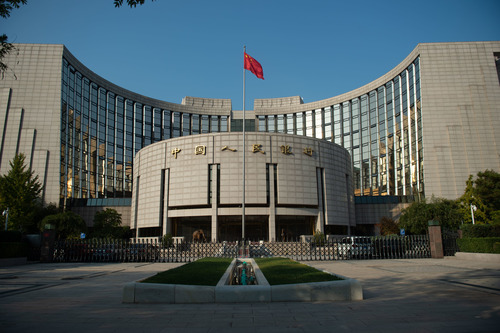
BEIJING, Nov. 2 (Xinhua) -- China's central bank on Monday changed its main policy rate from the seven-day reverse repo rate to the overnight reverse repo rate as it conducted 541 billion yuan (about 80.6 billion U.S. dollars) of overnight reverse repos.
The People's Bank of China (PBOC) conducted this operation at an interest rate of 1.25 percent through fixed-rate, quantity-based bidding. It was the first operation under a revised mechanism announced late last month.
An overnight reverse repo is a transaction in which the central bank purchases securities from financial institutions with an agreement to sell them back the next day. The operation provides liquidity to the financial system.
Under the revised mechanism, the PBOC will now conduct overnight reverse repo operations every working day, with overnight operations becoming its main open market instrument.
Other tools previously priced relative to the seven-day reverse repo rate, such as temporary repo and reverse repo operations, will instead be linked to the overnight reverse repo rate, with existing spreads unchanged.
Analysts said the adjustment marks another step toward strengthening price-based monetary policy regulation, with a shorter-term main policy rate and more consistent benchmarks across policy tools.
The change is in line with the PBOC's emphasis on paying less attention to quantitative targets and giving greater weight to interest rates and other price-based tools, according to analysts.
PBOC Governor Pan Gongsheng said at a forum in October that the central bank would consider shifting the tenor of its main open market operations to overnight at an appropriate time to improve the precision of interest rate regulation. The overnight repo rate would then become its principal policy rate.
Pan said the PBOC will continue to assess and refine its monetary policy framework and give greater weight to interest rate-based regulation.
Zhang Xu, an analyst at Everbright Securities, said establishing the overnight rate as the main policy rate would provide a clear benchmark for the market, reduce irrational interest rate fluctuations, and improve the transmission of monetary policy signals.
Wang Jian, an analyst at Guosen Securities, said the adjustment goes beyond simply shortening the tenor of the operations from seven days to overnight.
It will help streamline the transmission of policy rate changes via money market rates to borrowing costs in the real economy, allowing interest rates to respond more promptly to funding supply and demand while facilitating a steadier shift from quantity-based to price-based monetary policy regulation, Wang explained.
Dong Ximiao, chief economist at Merchants Union Consumer Finance, said conducting overnight reverse repo operations every working day would help reduce disruptions to policy rate signals during tax payment periods and at month-ends.
The operations would also shorten the transmission chain from the policy rate to money market rates, bond yields and lending rates, thus improving the efficiency of monetary policy regulation, Dong said. ■