NEW YORK, Oct. 28 (Xinhua) -- The U.S. Federal Reserve on Wednesday kept its target range for the federal funds rate unchanged at 3.75 to 4 percent, less than a week ahead of the 2026 midterm elections.
"Economic activity is expanding at a strong pace. While uncertainty remains elevated owing, in part, to geopolitical developments, domestic spending has been resilient. Productivity growth is strong, and capital investment is robust. Job gains have kept pace with the workforce, and the unemployment rate has changed little," said the Federal Open Market Committee (FOMC) in a statement.
Nevertheless, inflation remains elevated. In support of the Federal Reserve's dual mandate, "the Committee decided to maintain the target range for the federal funds rate at 3-3/4 to 4 percent," the FOMC said.
The committee reaffirmed "its policy of maintaining ample reserves in the banking system" and "price stability," saying the accumulation of more information will help the committee "determine the policy stance appropriate to ensure a timely return of inflation to the Committee's 2 percent goal."
Of the 12 FOMC members, 10 voted to keep the rate unchanged, while two favored a rate hike.
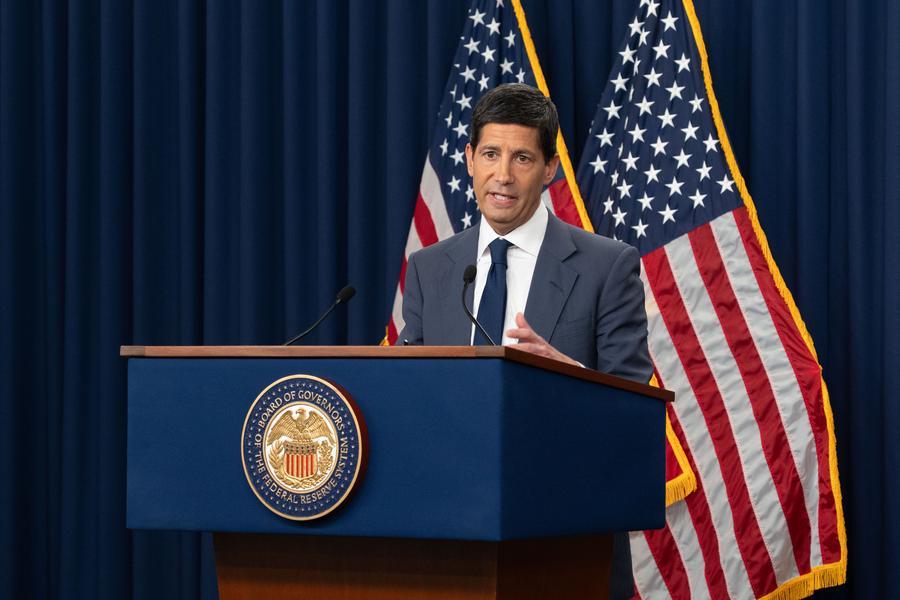
"Since our policy action in September, we have started to see some changes in financial and credit conditions. They have tightened for some businesses and households, much as we would expect," Fed Chair Kevin Warsh said at a press conference after the FOMC meeting. "Market participants are becoming somewhat more discerning in their capital allocations."
Financial conditions broadly are helping create a path toward price stability. But with the near-term inflation picture still too high, "it's our responsibility to get inflation down," Warsh said, adding that the Fed's discussion over recent days "focused mainly on the price stability side of our remit."
Warsh announced that the Fed will change its meeting schedule in coming years. The FOMC will still meet eight times a year.
"But in 2027, one meeting will focus exclusively on broad monetary policy strategy, with neither a vote on the federal funds rate nor a policy statement anticipated," he said, adding that he expects there will be two strategy sessions in 2028.
The change in the meeting schedule will allow the Fed time to think about "big questions," Warsh said.
Responding to a question about U.S. President Donald Trump's assertion that other board members want to see the country "do badly," Warsh said he will not respond to quotes from public officials.
Following the Fed's decision to keep the rate unchanged, major U.S. stock indexes kept steady, while U.S. bond yields and the U.S. dollar index rose slightly.
The Fed's pause is within market expectations after its first rate hike in three years in September. Chris Hodge, chief U.S. economist at Natixis, said in a research note earlier in the week that pausing would allow more time to determine whether recent high inflation readings were part of a larger trend.
"Inflation is still the No. 1 problem in the U.S. economy, and there are a lot of signs it is getting more broad-based," Heather Long, chief economist at Navy Federal Credit Union, told CNBC. However, "given that it's right before an election, they won't hike in October."
U.S. midterm elections fall on Nov. 3. To avoid impacting the power held by each political party, the Fed has mostly maintained its charted course in previous election cycles, except in 1978, 1982, 2018 and 2022, when inflation ran high.
The Federal Reserve's decision to hold rates steady at the October meeting suggests its prior hawkish stance was a matter of empty showmanship, Cem Karsan, founder and CIO at Kai Wealth, told CNBC. "At the end of the day, they're trying to gain credibility." Karsan said the only way to respond to what is important is through more dovishness from the Fed.
Nevertheless, it is widely expected that a hike in December is still in the cards. ■