
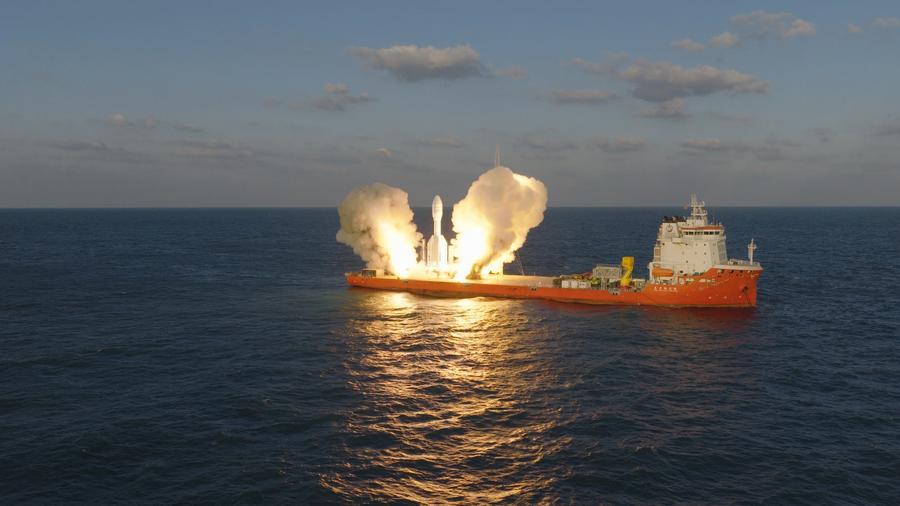
BEIJING, Oct. 29 (Xinhua) -- China is expanding and diversifying its launch infrastructure to meet the growing demand from the commercial space industry, with its offshore launch platforms, commercial spaceports and dedicated launch pads opening up new avenues for private rocket makers to send spacecraft into orbit.
A typical example is a commercial rocket carrying nine satellites that lifted off from a ship in the East China Sea near Shanghai in September this year. Although the densely populated economic hub has no traditional rocket launch site, sea-based launches are able to connect Shanghai to the country's growing space industry.
China's first sea launch took place in 2019, off the coast of Haiyang in east China's Shandong Province. The coastal city has since built a spaceport for rocket assembly, testing and launch operations. Teng Yao, chief engineer of the spaceport, said sea launches offer greater flexibility in choosing launch locations and trajectories, and allow rocket debris to fall into waters that are unpopulated.
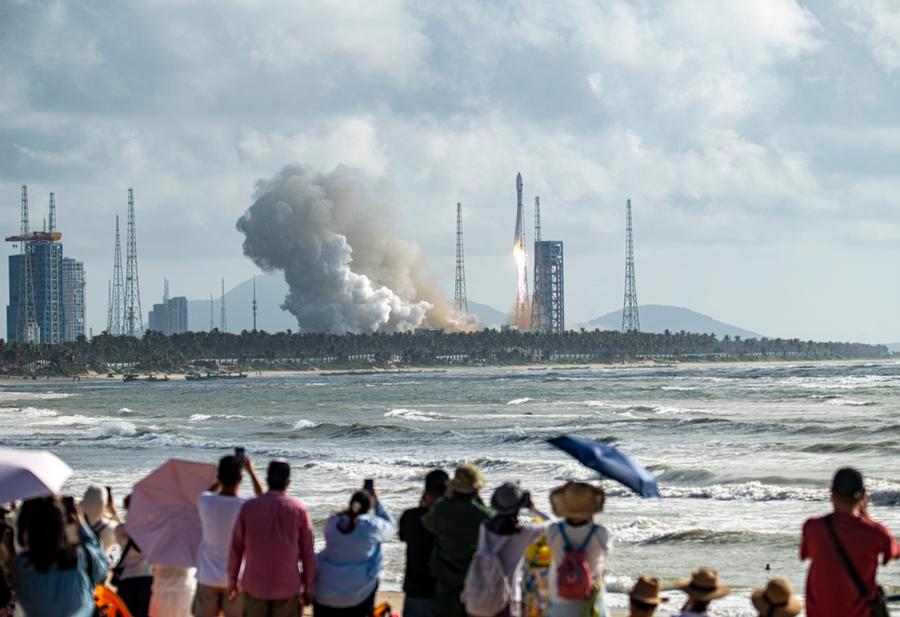
Wenchang in south China's Hainan Province, which hosts a launch site tasked with missions of launching space station modules and lunar probes, has added facilities specifically for commercial rocket and satellite launches since 2024.
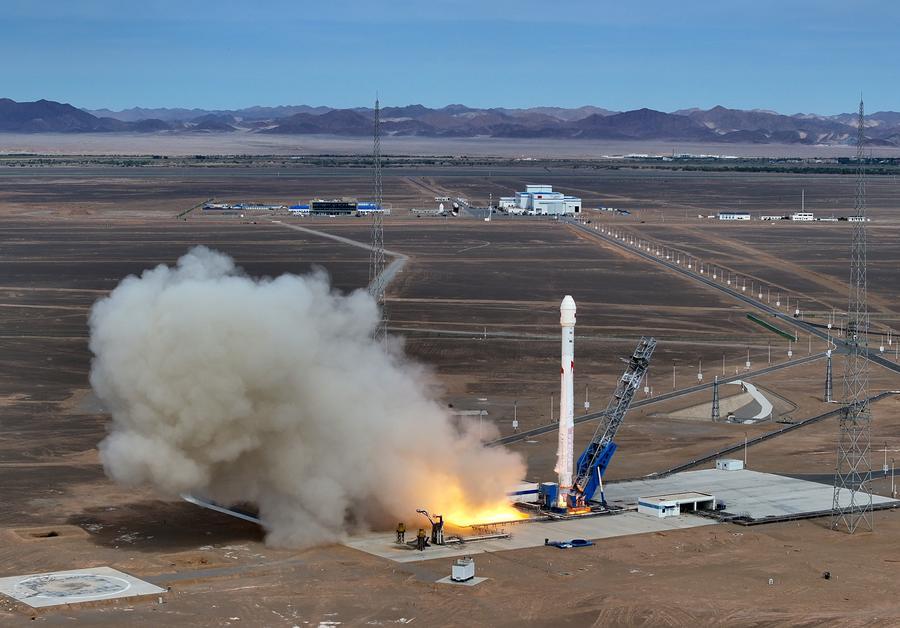
Meanwhile, the Dongfeng commercial space innovation pilot zone near the Jiuquan Satellite Launch Center in northwest China has developed launch pads tailored to private rocket makers.
Access to launch pads has been a challenge for China's commercial space sector. Wang Lifeng, a professor at Nanjing University of Aeronautics and Astronautics, cited limited launch capacity, tight schedules and long distances between launch sites and rocket assembly facilities as constraints on growth.
Large satellite networks like Qianfan (or Spacesail) and GW constellations, which each have more than 10,000 satellites, further increase the need for a steady flow of launches.
Diversified facilities not only boost launch numbers but also make launch operations more efficient.
Wenchang's commercial spacecraft launch site has put its first two pads into regular service. The second pad alone can accommodate more than 20 rocket types and can be prepared for another launch in 66 hours. The third and fourth pads in the second phase are scheduled to be operational by the end of the year. Upon full commissioning, the site is able to handle about 60 launches annually.
Haiyang offers another route to greater efficiency. Peng Haomin, co-founder of Orienspace, said the private company's facilities are clustered in Haiyang's spaceport, allowing rockets to be assembled, tested and loaded onto a launch ship within 5 km.
"This has replaced usual transportation over more than 1,000 km, drastically cutting logistics time and cost," Peng said.
Dedicated facilities can also streamline rocket operations. Meng Xiangfu, deputy chief commander of Lijian-1 rocket of commercial spaceflight company CAS Space, said that with its tailored launch pad and technical facilities at the Dongfeng commercial space innovation pilot zone, the company can complete the testing and preparation of a rocket in 10 days.
The expansion of launch infrastructure not only benefits the space industry, but also helps boost local economy through investment.
With more than 30 aerospace projects landed, Haiyang has attracted 33.5 billion yuan (around 5 billion U.S. dollars) in related investment. Wenchang's space industry park hosts over 700 companies, while Shanghai is developing a commercial spaceport-related terminal to link rocket assembly with port logistics and sea launch services.
These developments fit into a broader global trend of investing in space capabilities to support the sector's growth, as the United States aims at expanding its space transportation capabilities and Russia calls for efforts to upgrade its industrial and ground-based space infrastructure.
A 2025-2027 action plan issued by the China National Space Administration calls for coordinated development of commercial space launch sites and supports new types of commercial launch systems, including sea-based launch and recovery facilities.
At the same time, China is pressing ahead with the development of heavy-lift and reusable launch vehicles to further expand launch capacity and improve cost efficiency.
Analysts note that efficient operation of these facilities could equip China's commercial space sector with the launch capacity and operational flexibility it needs. ■