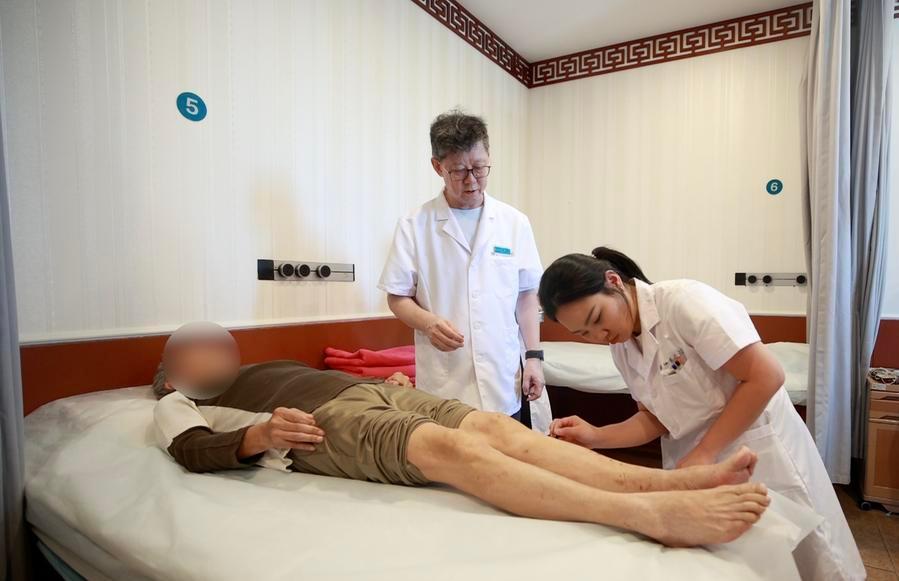
TIANJIN, Oct. 29 (Xinhua) -- A Thai intern gently slid a fine silver needle into an acupoint on a hemiplegic patient's leg. She lifted, thrust and twirled it -- and the motionless leg twitched.
Salocha Techawanwanitchakorn, an intern at the First Teaching Hospital of Tianjin University of Traditional Chinese Medicine (TCM) in north China, had just felt what she came to China to learn. "At that moment," she said, "I knew I had made the right choice to study TCM."
Techawanwanitchakorn grew up around the herbal shops of Bangkok's Chinatown, where the air was thick with the scent of Chinese medicine. Her Chinese grandmother was a regular there, buying herbs, and the family relied on TCM to stay healthy.
As a child, Techawanwanitchakorn saw TCM as little more than bitter brews and needles. She didn't understand it, but a seed had already been planted.
Later, Techawanwanitchakorn came to Tianjin for high school. A class visit to the First Teaching Hospital of Tianjin University of Traditional Chinese Medicine gave her a first close look at TCM.
"I was struck," she said. "TCM doesn't just ease symptoms. It treats the root cause." That visit convinced her to study TCM there, and later she entered Tianjin University of Traditional Chinese Medicine.
Getting to grips with TCM was not easy. In her first year, concepts like meridians and "qi," or vital energy -- invisible and intangible -- left Techawanwanitchakorn baffled. Classical texts full of traditional characters read like a book from another world. None of it deterred the Thai student, however.
The following year, Techawanwanitchakorn began studying acupuncture, practicing on herself first. "I felt soreness, numbness, distension and an electric-like tingle at acupoints on my own limbs," she said. "Only then did I know how to put a patient at ease."
"Even if a patient's symptoms improve by half, I'm happy," said Techawanwanitchakorn, who specializes in acupuncture as a graduate student.
During her clinical internship, Techawanwanitchakorn kept a notebook in her white coat pocket, filled with Chinese and Thai notes on acupoints, prescriptions and the key points her teachers stressed. She came to understand that needling is not just about finding the right acupoint, but about feeling the needle sensation under her hand. Since patients differ in build, the angle and depth of insertion must be adjusted accordingly.
The longer she studied under her Chinese teachers, the more she realized that hands-on skill was only the first step. "A good doctor sees not only the disease but also the person," her mentor told her.
At first, patients took her accent as a sign that she was from southern China. When they learned she was Thai, some greeted her with "Sawasdee kha (hello)," and said "Khob khun kha (thank you)" after she removed the needles. Others said she was the best foreign student at needling they had ever seen. "Experience is built needle by needle," Techawanwanitchakorn said.
In clinical practice, Techawanwanitchakorn has seen more and more patients recover through acupuncture, and has come to appreciate TCM's unique strength in treating the whole patient. Her resolve to study TCM has only grown firmer.
TCM, she believes, remains full of vitality after being passed down for thousands of years. In Thailand, too, many hospitals have TCM departments, and more young Thais are willing to try it.
Techawanwanitchakorn, being one of them, has brought TCM home. Last summer, back in Thailand, she administered acupuncture to her sister, who had back pain. Though afraid of needles at first, her sister later said she felt "much more relaxed." Techawanwanitchakorn also used cupping equipment brought from China to treat her mother. In her daily life, she has adopted TCM-inspired habits, drinking chrysanthemum tea and paying more attention to her routine.
The student is now interning while preparing for China's physician licensing exam. She hopes to stay in China first to gain clinical experience, then return to Thailand to promote TCM.
"China has more patients and more complex cases, so there is more to learn," she said. "I will bring what I learned in China back to Thailand and let more people see the charm of TCM." ■