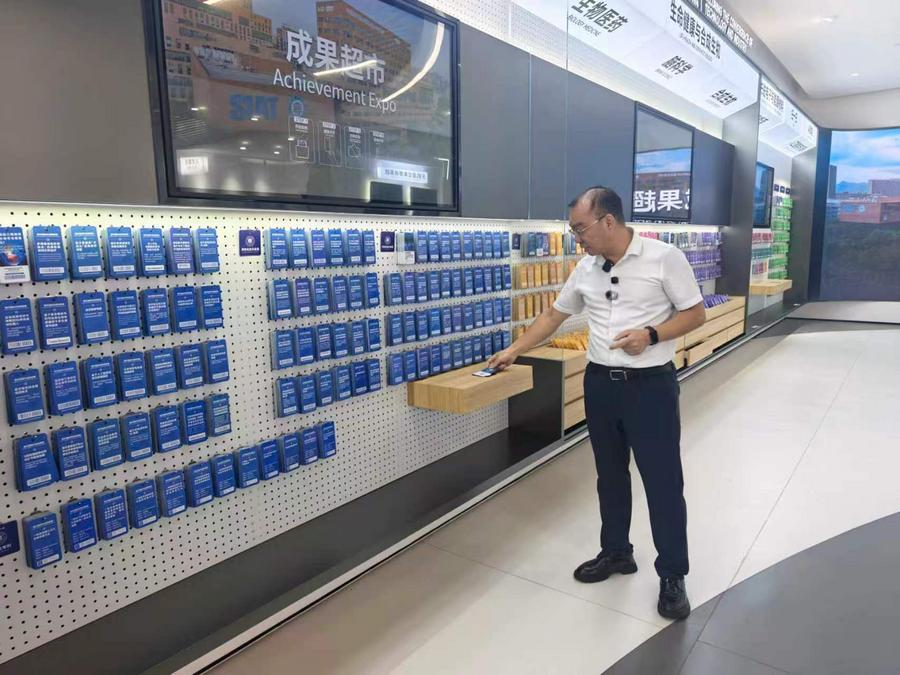
SHENZHEN, Oct. 27 (Xinhua) -- At a special supermarket in Shenzhen, Guangdong Province in south China, shelves are stocked not with fruits or vegetables, but cards featuring cutting-edge scientific achievements and top research talent.
The cards at the supermarket in the Shenzhen Institutes of Advanced Technology (SIAT) of the Chinese Academy of Sciences represent more than 1,000 frontier achievements arranged by track, covering medical equipment and scientific instruments, artificial intelligence (AI) and robotics, advanced electronics and energy materials, and synthetic biology.
Every card carries a unique QR code, which helps entrepreneurs gain access to the technology's highlights, application scenarios, potential collaboration directions, together with the developer's contact information. If something catches their eye, they can connect directly, with no more wading through thick archives of research files.
In the past, researchers' achievements often lay dormant in academic papers and patent offices, while companies desperate for new technologies had nowhere to turn. Today, with the results stocked on supermarket shelves, complex academic papers are transformed into "visual products" that companies can grasp at a glance. Supply and demand finally meet face to face, and the commercialization of research achievements is put on the fast track.
The supermarket's entire inventory comes from the SIAT's 10 research divisions. Over the past five years, SIAT has produced an average of 6.6 patents per day, with new achievements hitting the shelves every month.
FROM LAB TO PRODUCTION
The supermarket is re-imagining the way scientific and technological achievements are commercialized: connecting frontier laboratory technologies precisely with industrial needs, so that more research results can travel from the lab bench to the production line more efficiently.
Huang Xiaohua, who is in charge of the Industrial Development Center at SIAT, said: "Through this matching platform, companies find technologies of interest, and technologies are directly exposed to real corporate needs."
Jiangsu Apon Medical Technology Co., Ltd., which has been deeply engaged in the brain-computer interface field for many years, is a "treasure seeker." The company urgently needed new technological breakthroughs in the neural regulation domain, particularly in non-invasive deep brain stimulation. The platform helped connect the company's technological request with relevant research from SIAT.
In 2025, the company precisely matched with SIAT's non-invasive brain regulation technology, and the two sides quickly reached a consensus, establishing a "brain-computer interface" innovation consortium in early 2026 to jointly tackle temporal interference stimulation technology, exploring diagnostics and treatments for epilepsy, Parkinson's disease, Alzheimer's disease and emotional brain disorders.
Since opening in February 2025, the supermarket has facilitated the commercialization of research achievements worth more than 200 million yuan (about 30 million U.S. dollars). In 2025, the SIAT's average achievement conversion rate exceeded 29 percent, and the success rate of technology matchmaking through the supermarket has risen by more than 10 percent, according to Huang.
The achievement supermarket has expanded beyond Shenzhen, taking root across China in cities including Zhuhai, Jiangmen, Ningde, Wenzhou and Wuhan.
INTEGRATED INNOVATION
The supermarket model is a vivid snapshot of the growing integrated innovation between Chinese research institutions and enterprises in recent years. Companies have moved beyond simply buying technologies to co-developing them with scientists, unleashing a stronger combined force for innovation.
Carbon dioxide emitted from industrial processes used to be taken as waste gas in many people's eyes. But as a result of the cooperation between SIAT and China Merchants Group, it has become a treasure.
The two sides have jointly developed a remarkable technological pathway: electrocatalytic processes powered by renewable electricity convert carbon dioxide into organic carbon feedstocks, which are then used in fermentation to sustainably produce flavors and fragrances, protein feed, bulk chemicals and other products, supporting food security and China's dual carbon goals of peaking carbon dioxide emissions before 2030 and achieving carbon neutrality before 2060.
A joint laboratory for green conversion of carbon dioxide and biorefining has been established by the two sides, with cooperation funding approaching 100 million yuan. A 100-tonne-scale demonstration facility has already been commissioned, and a 1,000-tonne-scale platform has completed design verification.
The SIAT has also teamed up with China Nuclear Power Engineering Co., Ltd. to conduct research on and apply multimodal human-machine interaction systems for nuclear power plants, developing solutions oriented toward human-machine interaction needs in plant operations to reduce operator workload.
Cooperation with the Shenzhen Research Institute of the China National Coal Group Corporation focuses on another key technical frontier. The two parties are jointly developing high-performance proton exchange membranes based on ordered subnanochannels. The technology holds huge potential for long-duration energy storage, with promising prospects for further expansion into semiconductor, biomedical and environmental applications.
SIAT's research team has also partnered with China Resources Mixc Lifestyle to bring AI into property inspections, service dispatching, on-site handling, and operational evaluation. The system has been deployed in more than 1,000 property projects, improving overall operational efficiency by 35 percent.
China has recently released a set of guidelines on promoting the deep integration of scientific and technological innovation and industrial innovation.
Issued by the General Office of the Communist Party of China Central Committee and the General Office of the State Council, the guidelines require efforts to deepen the implementation of the innovation-driven development strategy, with the goals of developing new quality productive forces and building a modern industrial system, and with a focus on establishing an enterprise-led, multi-stakeholder collaborative system for integrated industry-academia-research innovation, so as to form a new pattern in which sci-tech innovation and industrial innovation promote each other. ■