BELGRADE, Oct. 24 (Xinhua) -- Serbia is scheduled to hold parliamentary elections on Oct. 25, marking another major political event following Aleksandar Vucic's resignation as president on Sept. 27.
Why are the elections attracting widespread attention? How will the vote proceed with the presidency vacant? And can Vucic become prime minister through the parliamentary election?
WHY IT MATTERS
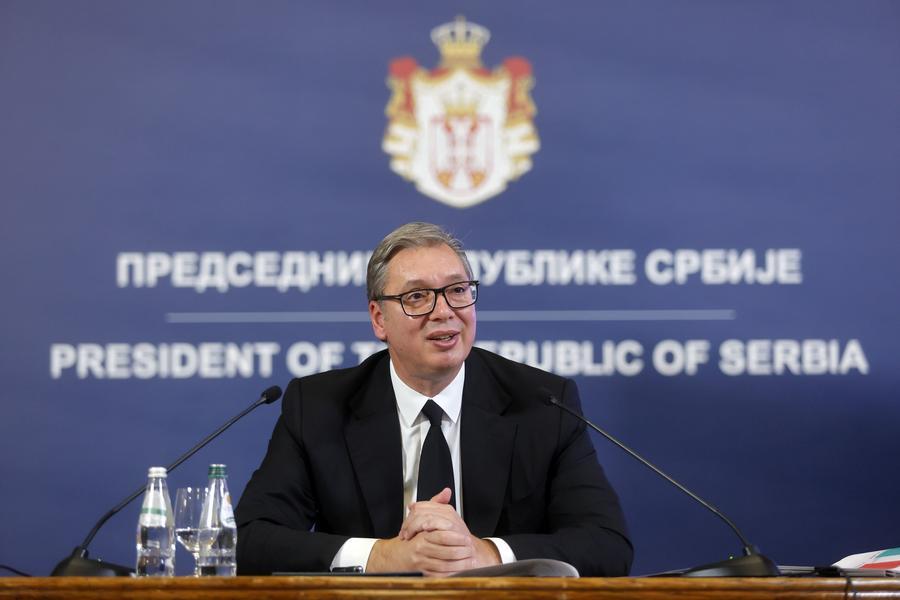
Before formally resigning as president, Vucic accepted the Serbian Progressive Party's (SNS) nomination on Sept. 5 to head its electoral list and serve as its candidate for prime minister. On Sept. 9, he signed a decree dissolving the National Assembly and calling snap parliamentary elections for Oct. 25.
Under Serbia's Constitution, the election of a new National Assembly will set in motion the process of forming a new government. After lawmakers elect a new parliamentary speaker, the speaker, acting as president, will nominate a candidate for prime minister. The nominee must present a government program and a proposed list of cabinet members and secure the support of a majority of National Assembly deputies to form a new government.
The parliamentary election therefore marks the beginning of a new political cycle in Serbia and has attracted considerable international attention.
Vucic has long prioritized economic development, infrastructure construction and improvements in people's livelihoods, helping him build a base of political support. In recent years, however, his government has also faced sustained challenges from opposition forces and disruption from some protests.
Analysts say that the election will be a test of the governing performance of Vucic and his political allies while directly affecting the power structure in the new parliament and the formation of the next government. The outcome will also influence Serbia's domestic and foreign policy direction to some extent in the coming years.
HOW IT PROCEEDS
Under Serbia's Constitution, when the president resigns, the speaker of the National Assembly assumes the duties of acting president and is responsible for setting the date of a presidential election. Although the National Assembly has been dissolved, Speaker Ana Brnabic continues to serve as acting president until a new parliament is elected.
Serbia uses a proportional representation system for parliamentary elections. Voters cast their ballots for electoral lists submitted by political parties, coalitions and other eligible political groupings. The 250 seats in the National Assembly are allocated proportionally according to the votes received by each list.
The competing lists encompass Serbia's main political forces. They include "Aleksandar Vucic - United Serbia" led by the SNS; "Student List - Students Win" backed by student groups; and "Ivica Dacic-Stability Factor!" formed by the Socialist Party of Serbia and its allies.
A total of 8,392 polling stations have been established for the election, with approximately 6.45 million registered voters. Polling stations will be open from 7 a.m. to 8 p.m. local time (0600 to 1900 GMT) on Oct. 25. The Republic Electoral Commission is required to announce the nationwide election results within 96 hours of the close of polling.
CAN VUCIC BE ELECTED?
Whether Vucic can become prime minister and continue his political career will have implications for Serbia's domestic politics and foreign policies.
Vucic was elected president in April 2017 and re-elected in May 2022. Under Serbia's Constitution, the president serves a five-year term and may serve a maximum of two terms. Before becoming president, Vucic served as Serbia's first deputy prime minister in 2012 and became prime minister in 2014.
According to official Serbian statistics, the unemployment rate fell from about 24 percent in 2012 to around 9 percent in 2025, while nominal gross domestic product measured in euros more than doubled over the same period. In 2024, Serbia attracted approximately 5.2 billion euros (about 5.84 billion U.S. dollars) in foreign direct investment, a record high.
An Ipsos poll conducted from Oct. 20 to 22 put the "Aleksandar Vucic - United Serbia" list, led by Vucic, at 47.4 percent, compared with 40 percent for "Student List - Students Win".
Unlike traditional electoral lists associated with established political parties, the one of "Student List - Students Win" brings together figures from a range of professional backgrounds, including doctors, university professors, actors, athletes and financial professionals.
Jan Nowinowski, a researcher at the Centre for Eastern Studies in Poland, wrote in an analysis that the student-backed electoral list was one of the main challengers to the electoral list headed by Vucic and its supporting political forces.
He noted, however, that while the student groups' calls for anti-corruption measures and other demands had broad mobilizing appeal, their policy positions remained relatively general, lacking a systematic reform blueprint, clear implementation pathways, and detailed plans for carrying reforms forward. ■