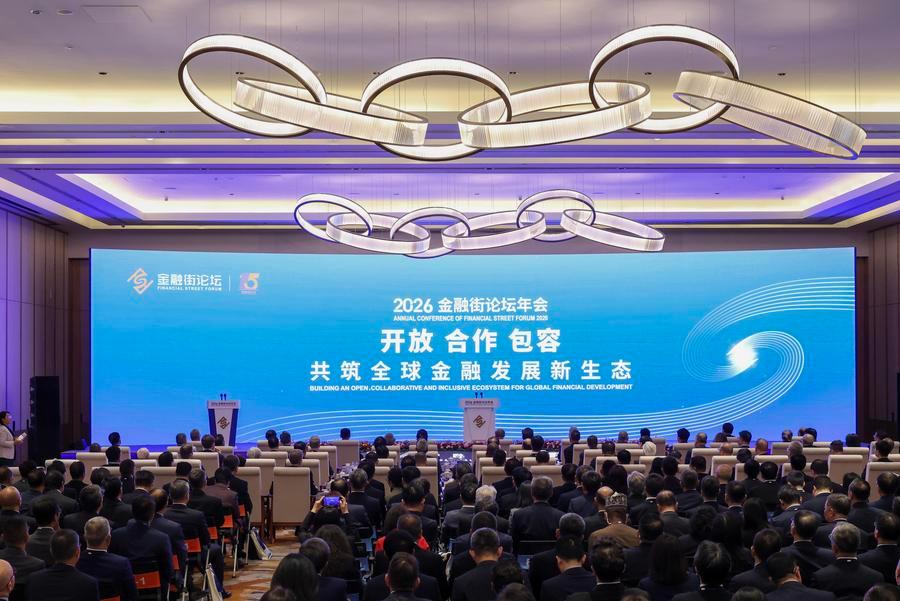
BEIJING, Oct. 23 (Xinhua) -- China's integration of digital technologies with green finance is opening up new opportunities for global cooperation on the low-carbon transition, participants said at the Annual Conference of Financial Street Forum 2026 in Beijing.
Under the theme "Building an Open, Collaborative and Inclusive Ecosystem for Global Financial Development," the four-day event concluded on Thursday. It brought together participants from both home and abroad, online and offline, to discuss financial development and cooperation in the face of global economic challenges.
"Over the past few years, we've seen China's green finance market grow several-fold," said Ma Jun, president of the Institute of Finance and Sustainability in Beijing. "The integration of digital and green finance has created many growth opportunities and helped boost cross-border investment."
The growth has won international recognition. "China has improved air quality by developing a circular economy and building an environmentally friendly society," said Yaseen Anwar, former governor of the State Bank of Pakistan, at a parallel forum.
He added that the country's installed wind and solar power capacity continues to grow, while green products such as new energy vehicles (NEVs) are leading globally.
Data released by the Ministry of Ecology and Environment shows that the country's installed capacity of renewable energy power generation reached 2.455 billion kilowatts in the first half of this year, accounting for 60.7 percent of its total installed power generation capacity. China has ranked first worldwide in both the production and sales of NEVs for 11 consecutive years.
In recent years, China has offered broad opportunities for global green investment and low-carbon transition by applying technologies such as big data, blockchain and AI to improve green finance governance, upgrade industrial structures and enhance the ecological environment.
The Bank of China has issued green bonds under the Belt and Road Initiative to support major green projects such as large-scale photovoltaic power stations in partner countries. These projects are expected to provide local communities with long-term, stable supplies of clean renewable energy.
The carbon market is an important policy tool for addressing climate change through market mechanisms and for accelerating the comprehensive green transformation of economic and social development.
The cumulative trading volume of carbon emission allowances in China's national carbon market has exceeded 1 billion tonnes, according to data from the Ministry of Ecology and Environment. China's experience in developing its carbon market also offers lessons that other countries can learn from.
"China's carbon emission commitments and the development of its carbon market have made a tremendous contribution to global climate action," said Charles Bowman, co-chair of the UK-China Green Finance Taskforce. "Green finance cooperation between China and the United Kingdom has promoted economic transformation, biodiversity conservation and sustainable development in both countries," he added.
Such cooperation is also extending to Belt and Road partners. Many of them are actively implementing green and sustainable policies while mobilizing capital. "China tailored services for different regions, including promoting the application of green finance instruments and market development, conducting in-depth research on green policies, and advancing carbon market mechanisms," said Cheng Lin, head of the Secretariat Beijing Office for the Green Investment Principles for the Belt and Road.
Experts noted at the conference that as digital and intelligent technologies have profoundly reshaped the financial sector in recent years, empowering green finance with such technologies is a key pathway toward global sustainable development.
"Digital and intelligent technologies can provide important support for green finance by overcoming bottlenecks in data collection, analysis, risk monitoring and assessment," said Zhang Bei, deputy head of the research bureau of the People's Bank of China.
As extreme weather events become more frequent, technologies such as geographic information systems, satellite remote sensing and large language models can help assess more accurately how different regions and population groups are coping with climate change, identify priorities for adaptation and guide funding toward areas with the greatest needs, Zhang said.
The expanding role of digital technology in China's green finance is poised to benefit more global partners in their sustainable development efforts.
Mari Elka Pangestu, vice chair of Indonesia's National Economic Council, said China is a leader in clean technologies. She expressed hope for deepening cooperation with Chinese partners beyond capital investment by establishing more joint ventures, increasing local production and enhancing technology transfer.
China's 15th Five-Year Plan (2026-2030) calls for expanding green financial products and services and encouraging greater investment in green and low-carbon development. ■