
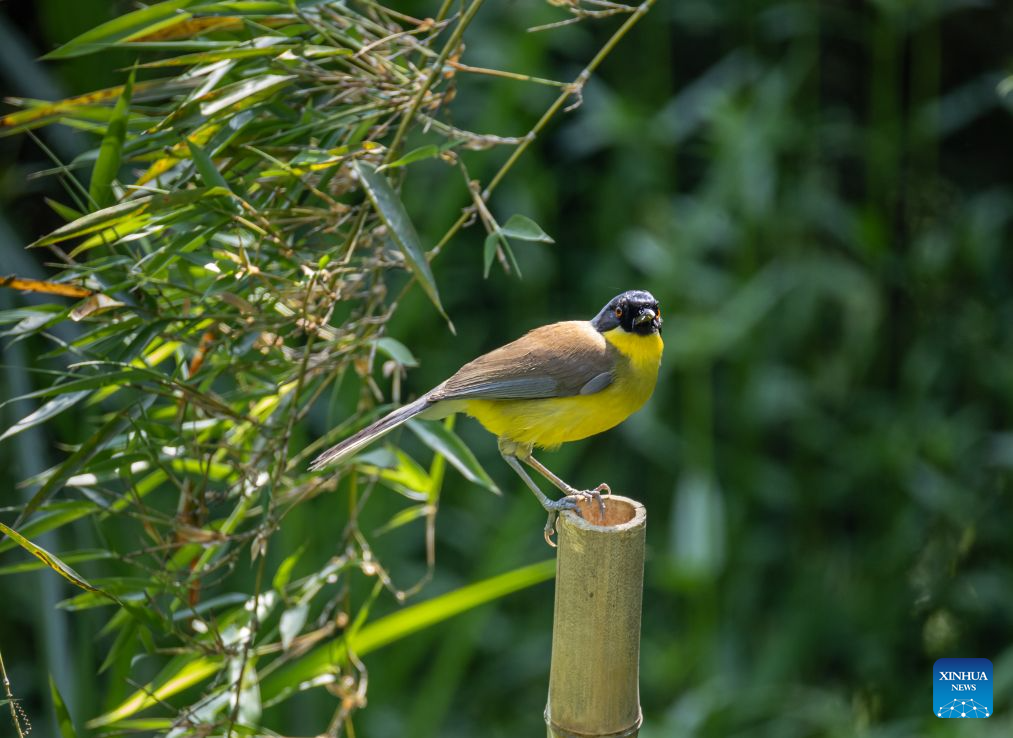
A blue-crowned laughingthrush is pictured at Banqiao Village in Dexing City, east China's Jiangxi Province, April 20, 2026. (Photo by Zhan Fawen/Xinhua)
NANCHANG, Oct. 23 (Xinhua) -- In the wooded hills around villages in east China's Jiangxi Province, a critically endangered songbird is being seen in growing numbers.
The blue-crowned laughingthrush, distinguished by its blue crown, black facial mask and yellow throat, numbered fewer than 200 in the wild in 2006. Its population has since risen to about 660, with roughly 320 living in Jiangxi's Dexing City, according to conservation authorities.
Earlier this week, volunteer bird protector Hong Taiping was walking near Banqiao Village in Dexing when a burst of calls made him stop. Several of the birds were moving through the branches, feeding on wild persimmons. He raised his camera and waited.
"They spend so much time feeding in the bushes that they blend into their surroundings," Hong said. For him, listening is often more useful than looking.
Blue-crowned laughingthrushes often breed in trees near villages and rivers, where food is plentiful and predators may be fewer. Their preference for habitats close to human settlements makes protecting these areas particularly important.
In Dexing, local authorities have hired seven dedicated bird guards to patrol breeding areas, mobilized village officials and volunteers to remove trapping nets, and planted fruit-bearing trees, including mulberries and bayberries, to improve feeding habitats.
Researchers from Jiangxi Agricultural University and other institutions are studying the birds' breeding habits, habitat preferences and responses to human disturbance. Dexing established a local conservation center in 2024. When the species was first recorded in the city, only a handful of breeding sites were known. Today, its local numbers have grown to about half of the global wild population.
The species was first documented in neighboring Wuyuan County by a French collector in 1919 and formally named in 1923. After decades without confirmed sightings in Wuyuan, it was rediscovered in the wild there in 2000.
Despite its recovery, the bird remains classified as critically endangered on the International Union for Conservation of Nature's Red List. Its limited distribution and vulnerability to habitat disturbance make continued protection essential.
Conservation efforts have extended overseas. The blue-crowned laughingthrush is covered by a Global Species Management Plan approved in 2012 by the World Association of Zoos and Aquariums. In North America, zoos have expanded their captive populations partly by importing birds from European institutions, according to the association. At France's Mulhouse Zoological and Botanical Park, staff have kept in touch with Jiangxi Agricultural University professor Zhang Weiwei, seeking information about the wild population and ways to improve captive breeding.
More than 300 blue-crowned laughingthrushes are now kept in captivity across Europe, Asia and the Americas.
At a scientific exchange meeting held in Wuyuan in October 2023 as part of the Franco-Chinese Month of the Environment, the two countries discussed closer cooperation on captive conservation and the development of ecological communities.
In August, China's National Forestry and Grassland Administration reported stable or growing populations among 19 nationally protected bird species.
In Dexing, a birdwatching competition in June recorded 162 bird species, including the blue-crowned laughingthrush and the crested ibis, both under China's highest level of state protection.
The latest monitoring has brought another surprise.
"In previous years, we rarely spotted them after late July. But this year, we're still seeing them in late autumn," said Xie Zhihua, head of the local conservation center. "We didn't expect that." ■
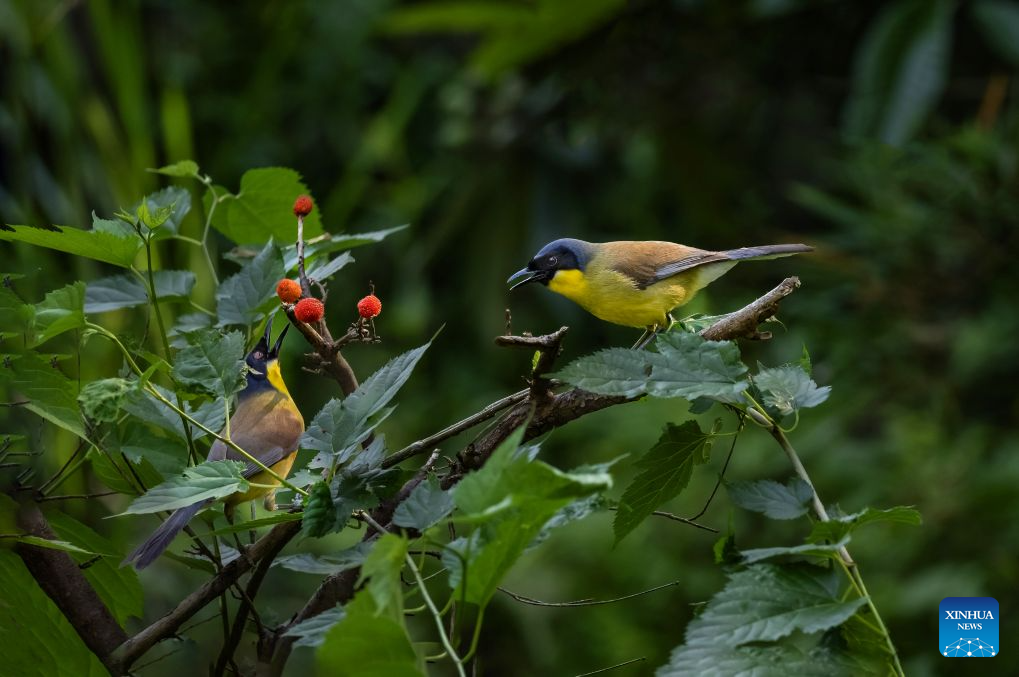
Two blue-crowned laughingthrushes forage at Banqiao Village in Dexing City, east China's Jiangxi Province, April 20, 2026. (Photo by Zhan Fawen/Xinhua)


