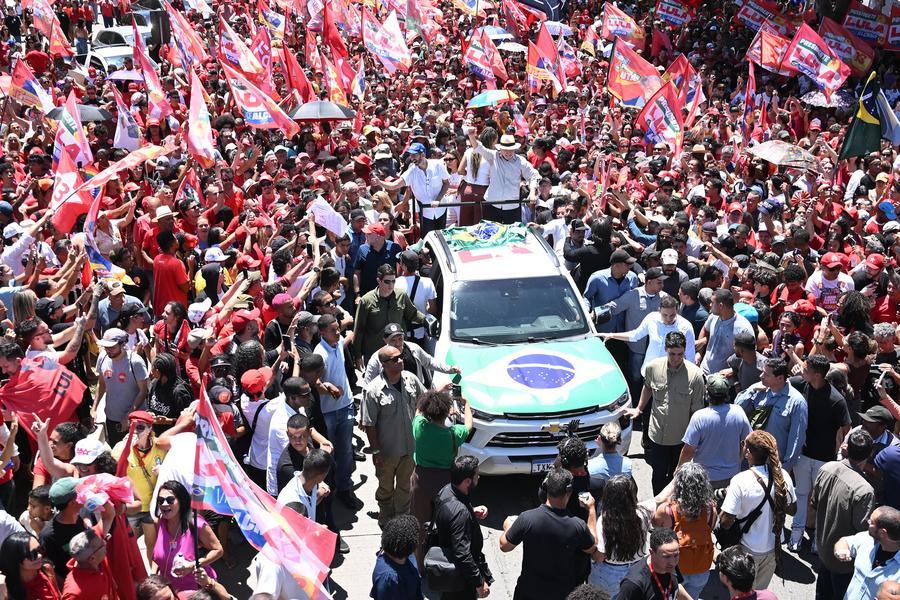
RIO DE JANEIRO, Oct. 22 (Xinhua) -- Brazil's presidential runoff, scheduled for Sunday, Oct. 25, will pit incumbent Luiz Inacio Lula da Silva against Flavio Bolsonaro in a closely fought contest that could shape the country's policy direction over the next four years and influence Latin America's political balance.
Lula, of the Workers' Party, is seeking to overcome a first-round deficit against Bolsonaro, the Liberal Party candidate and son of former President Jair Bolsonaro.
Bolsonaro won 47.03 percent of valid votes in the first round, against Lula's 45.16 percent. Neither secured more than 50 percent of valid votes, the threshold required to win outright.
A Quaest poll released on Wednesday put Bolsonaro at 45 percent and Lula at 44 percent, with the gap within the poll's two-percentage-point margin of error. The survey interviewed 2,154 people between Oct. 17 and 20.
Both campaigns are courting supporters of eliminated candidates and voters who stayed home in the first round, when abstention reached 21.08 percent.
Lula has stepped up his digital campaigning, drawing on younger politicians and influential online supporters. Since Oct. 7, he has posted selfie-style videos urging supporters to take their campaign onto the streets and speak directly to voters.
Bolsonaro has consolidated support among conservative politicians and business leaders while seeking a more moderate public image, emphasizing policy proposals and steering clear of controversies that could alienate undecided voters.
At their televised debate on Sunday, Lula pledged to sustain economic growth, strengthen public security and defend Brazil's sovereignty in international affairs. He also proposed a public security ministry to coordinate federal, state and municipal action.
Bolsonaro emphasized tougher measures against organized crime, including classifying criminal factions as narco-terrorist organizations and expanding prison capacity. He also pledged to reduce public debt, support debt restructuring for businesses and individuals, and improve public healthcare by bringing in specialists and adopting advanced technology.

The contest has also moved into the courts. Bolsonaro's campaign filed a case on Tuesday seeking to disqualify Lula's ticket, and Lula's coalition filed a similar request against Bolsonaro's ticket on Wednesday. The allegations remain subject to judicial examination.
The congressional results will also shape the next government's room to maneuver. The Liberal Party won 121 of the Chamber of Deputies' 513 seats, compared with 88 for the Workers' Party-led federation.
The Liberal Party is set to hold 28 of the Senate's 81 seats starting in 2027, making it the largest party bloc, although it will still fall short of an outright majority. Whichever candidate wins the presidency, building support across party lines will be important to advancing his legislative agenda.
Beyond these domestic challenges, the outcome could influence Latin America's wider political direction.
Zhou Zhiwei, a researcher at the Institute of Latin American Studies of the Chinese Academy of Social Sciences, said Brazil's election offers an important window into the region's changing political landscape.
Conservative forces have gained momentum across Latin America over the past year or two and demonstrated their strength in Brazil's first-round contests, he said.
A rightward turn in Brazil could further weaken the Latin American left, while Lula's re-election would give it a significant boost, Zhou said.
For both candidates, the immediate challenge is to turn support into votes. Their ability to reach beyond committed followers and bring voters to the polls could prove decisive. ■