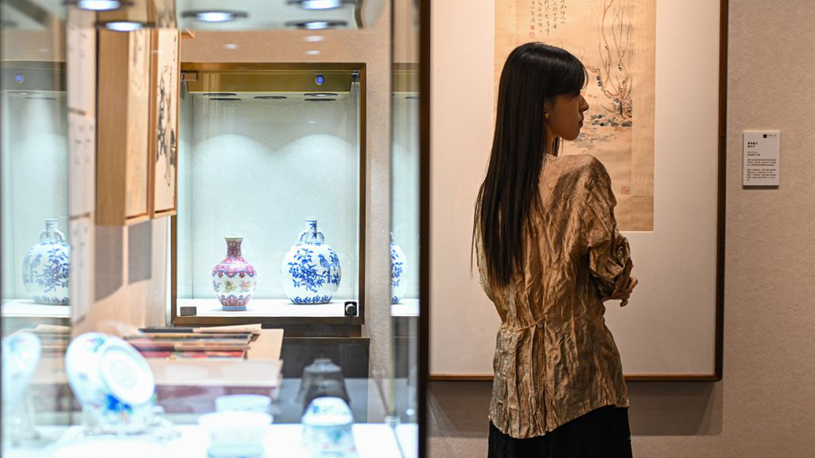
* The 2026 China Jingdezhen International Ceramic Expo was held from Oct. 18 to 22 in Jingdezhen, a city famed as China's "porcelain capital." The five-day event attracted more than 1,000 professional buyers from home and abroad.
* With a porcelain-making history spanning more than 1,000 years, Jingdezhen developed a sophisticated handicraft industry that connected raw materials, specialized artisans and kiln production.
* Today, the city is building on its legacy by bringing together traditional artisans, international artists and young innovators to explore how ancient skills can remain relevant in contemporary life.
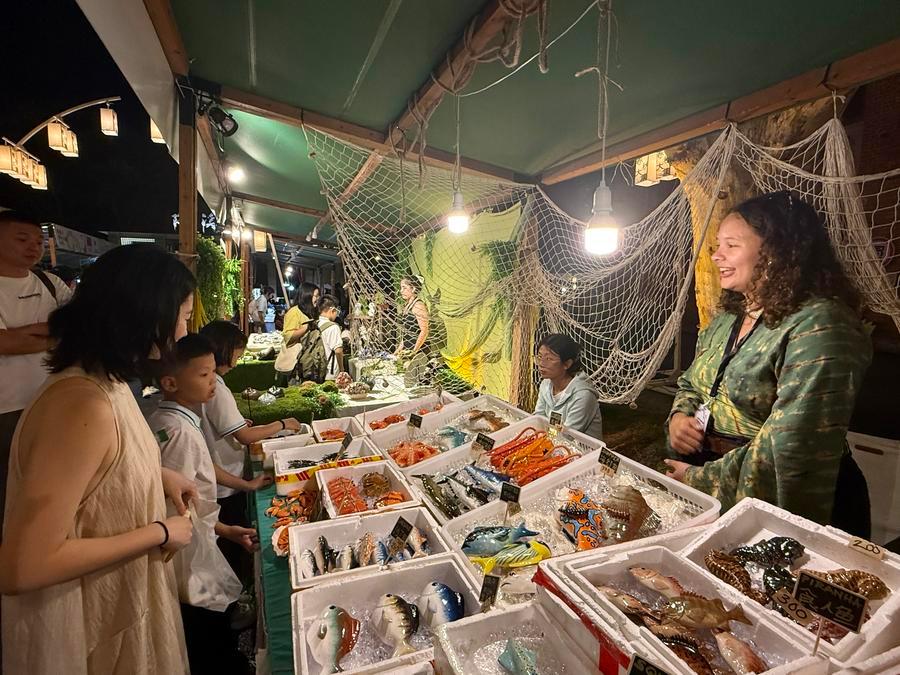
NANCHANG, Oct. 22 (Xinhua) -- Glimmering in appetizing colors, a stall filled with lobsters, crabs and sea urchins stands out among the teaware and decorative pieces at the Spring and Autumn Fair in Jingdezhen, east China's Jiangxi Province.
Created by Kenyan artist Megan White, the porcelain artworks reflect the sights and culture of her coastal homeland, which she has brought to China's famed porcelain hub through the city's centuries-old craft.
"I grew up on the coast of Kenya, so I'm constantly inspired by and drawn to the sea," she said.
She has spent 20 months in Jingdezhen. Using local porcelain and techniques such as slip casting, White transforms familiar marine life into sculptural works that invite visitors to appreciate the ocean from a city far from the sea.
White's stall offers a glimpse into Jingdezhen's evolving ceramic scene, where international artists are drawing on traditional craftsmanship, while introducing new cultural perspectives and creative ideas.
With a porcelain-making history spanning more than 1,000 years, Jingdezhen has developed a sophisticated handicraft industry that connects raw materials, specialized artisans and kiln production.
On July 25, 2026, the Jingdezhen Handicraft Porcelain Industry Sites, representing the city's historic porcelain-making system, were inscribed on the UNESCO World Heritage List.
Today, the city is building on this legacy by bringing together traditional artisans, international artists and young innovators, exploring how ancient skills can remain relevant in contemporary life.
TRADITIONAL TECHNIQUES REFORGED
For White, Jingdezhen's appeal lies not only in its long history but also in the dedication of its craftspeople.
"The dedication and precision associated with the local ceramic craftsmanship are very inspiring," she said, adding that local artisans encourage her to strive for the same standards in her own work.
Unlike the red clay traditionally used for pottery in Kenya, porcelain has become the primary medium for her creations in Jingdezhen. She makes molds from her own designs and produces her pieces by hand, combining her personal artistic language with techniques developed in the Chinese porcelain-making tradition.
White said she values such traditional crafts in a mass-producing era, even though they require considerable time and expertise. "Once these traditions disappear, we can't bring them back."
China is making a tremendous effort to keep traditional techniques alive, she said, adding that this is what has compelled her to learn and innovate in Jingdezhen.
For Dutch artist Antonetta Eilers, meanwhile, Jingdezhen offers room to experiment with new forms and ideas.
Working with porcelain and jewelry, Eilers draws inspiration from nature and the sea, while collaborating with a friend whose artistic concepts explore possible futures shaped by climate change and environmental transformation.
Eilers said she is struck by the local creative atmosphere, where an unexpected result does not need to be discarded but can become part of an artwork. She said the city's artist residency programs are helping visiting artists exchange ideas and develop their own styles and skills.
"Techniques evolve, and I think that evolution is actually a form of preservation in itself," she said.
The growing presence of international creators is part of a broader creative ecosystem in Jingdezhen.
According to Gao Xiaoyun, deputy mayor of the city, Jingdezhen has gathered more than 3,400 inheritors of intangible cultural heritage, over 100,000 young creative entrepreneurs, around 60,000 newcomers from other parts of China, and more than 5,000 foreign residents at peak times engaged in its ceramic community.
This mix of experienced artisans and emerging creators is helping traditional techniques find new practitioners and new applications, ensuring that heritage is not confined to workshops and exhibition halls.
TECH-INFUSED CREATIONS
While handcraft remains central to Jingdezhen's identity, technology is opening up new possibilities for ceramic production.
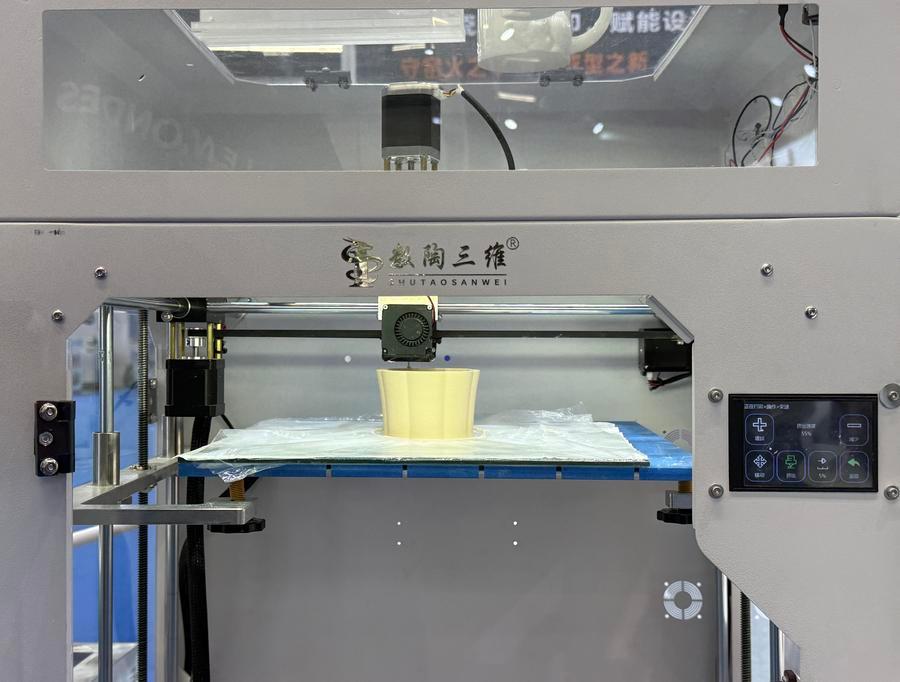
At a local porcelain enterprise, 65 industrial-grade ceramic 3D printers demonstrate how digital design can be translated into intricate forms. The technology enables the production of customized vases featuring complex curves, hollow structures and textures that can be difficult to achieve through conventional techniques.
"3D printing allows for a wider variety of ceramic forms and more intricate textures," said Hong Ziyu, the company's general manager. The technology, he added, has helped meet growing demand for customized decorative products.
The company's 3D-printed porcelain products have gained traction in overseas markets, generating annual sales of more than 5 million yuan (about 750,000 U.S. dollars), according to Hong.
Such developments reflect a wider transformation in Jingdezhen's ceramic industry. From 2021 to 2025, the industry's output value rose from 51.6 billion yuan to 102.7 billion yuan, while the number of major industrial enterprises above the designated size increased from 140 to 298, according to local statistics.
For young creators, the convergence of traditional craftsmanship, digital tools and commercial opportunities is also creating new career paths.
Digital modeling and advanced manufacturing can help artists test ideas and produce distinctive designs, while the city's network of workshops and specialized suppliers supports the transition and commercialization from concept to finished product, supporting a booming creative industry.
Xu Wan, manager of Chentian Ceramics company in Jingdezhen, said the firm is collaborating with numerous pop culture IPs to draw Gen-Z customers, which is boosting the firm's sales.
Xu said the company has collaborated with the hit animated film "Nobody" in launching a series of intangible cultural heritage-themed ceramic blind boxes in 2025, with the product quickly becoming a sought-after hit among young collectors after its release.
"Young consumers today are more than willing to pay for creative products highlighting emotional value," Xu said, adding that they have released dozens of innovative products beyond trendy toys, including ceramic speaker boxes and night lanterns.
SUPPORTING GLOBAL CRAFTSMANSHIP
With talented artists and a booming creative ecosystem, Jingdezhen's international appeal has extended beyond the works created within its workshops.
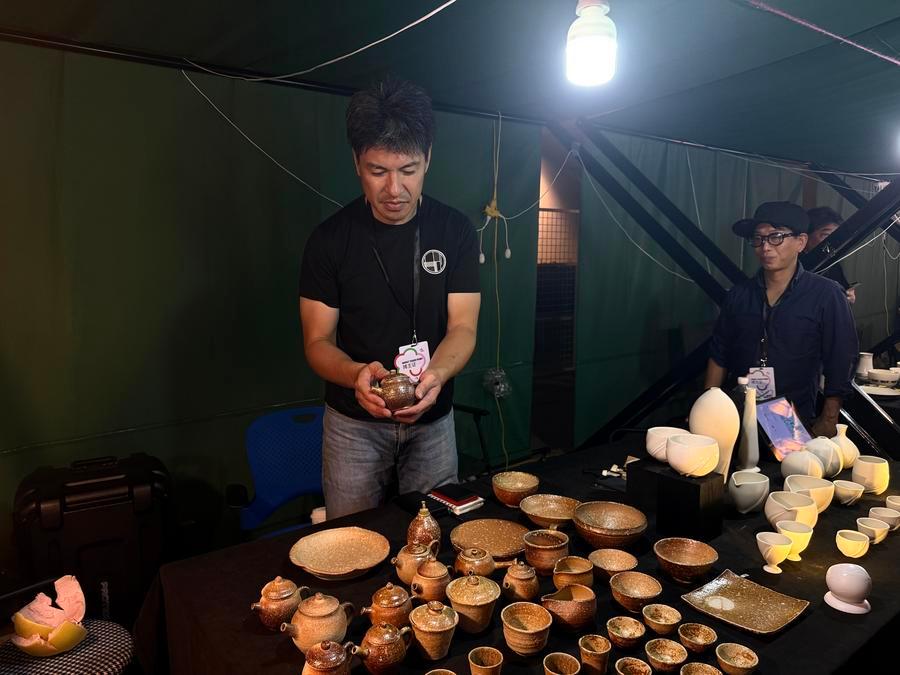
Japanese ceramic artist Shusaku Kanzaki, who has visited the city three times, said Jingdezhen has helped him find a larger audience for his artworks.
Drawing on historical techniques and aesthetics, some of Kanzaki's pieces use no glaze, relying instead on the effects of wood firing to create their color and texture. Such Karamono-styled creations have won the hearts of many connoisseurs during the 2026 China Jingdezhen International Ceramic Expo held from Oct. 18 to 22.
Kanzaki said that combining tradition with new ideas is essential to creating compelling works of art.
Simply reproducing old objects, he argued, is not enough to sustain the craft. The abundant ceramic inspirations and support from local friends and authorities have made Jingdezhen an appealing place for him to explore, he said.
Beyond artists, the city's experience is also attracting interest from other ceramic-producing regions, which are confronting challenges in passing on traditional skills.
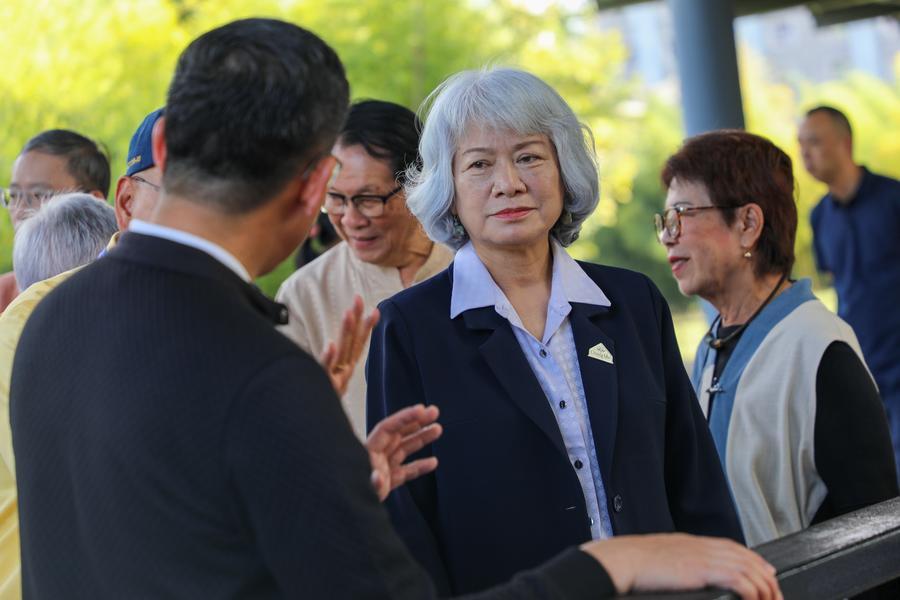
During a visit to the expo, Witthayalak Samjai, a senior deputy administrator of Chiang Mai, a city in northern Thailand, said she is learning from Jingdezhen's experiences to vitalize Chiang Mai's traditional Lanna ceramic arts.
Some experienced Lanna ceramic artisans remain reluctant to depart from traditional styles, and their products are often made as decorative gifts rather than everyday objects, making it difficult to reach modern consumers, she said.
Jingdezhen's integration of tradition, contemporary design and market applications offers lessons for northern Thailand, she said.
Ilada Junjiresrassamee, vice president of the Lampang Province Chamber of Commerce in Thailand, said a local university's ceramics program in Lampang, which had run for 35 years, was suspended for three years amid waning interest among young people.
Inspired by Jingdezhen, local stakeholders plan to revive the program and introduce hands-on workshops for children, she said.
Jingdezhen has established friendly ties with more than 180 cities in 72 countries, using international exchanges to promote dialogue and cooperation in ceramic culture, according to Gao, the vice mayor.
Following the inscription of the Jingdezhen Handicraft Porcelain Industry Sites on the UNESCO World Heritage List, the city has also called for stronger global cooperation on heritage conservation.
In concurrence, a multilateral initiative issued at the 2026 Jingdezhen Forum has called for respect for cultural diversity, the use of digital tools for preventive conservation, the integration of traditional techniques with contemporary design, and closer collaboration in talent development and research.
For a city whose porcelain once traveled across continents, its global connections now encompass not only finished products but also creative ideas, technical expertise and shared approaches to heritage protection.
In the view of Tim Winter, a professor at the National University of Singapore and president of the Association of Critical Heritage Studies, the challenge is to keep the exchanges alive, preserving the skills that give porcelain its character while allowing new generations, from Jingdezhen and beyond, to shape what the craft can become. ■