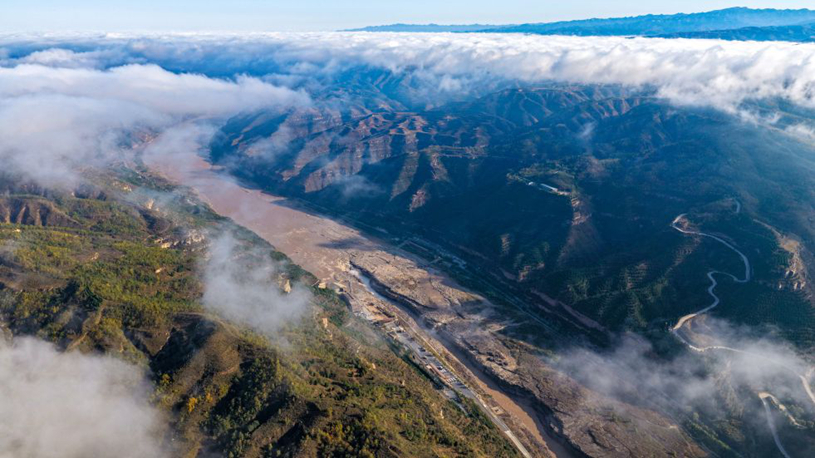
HOHHOT, Oct. 18 (Xinhua) -- In the core zone of a wetland in Ulanqab, north China's Inner Mongolia, a smart ecological supervision center deploys drone patrols and AI-powered wildlife tracking technology to help restore a lake that had once dried up.
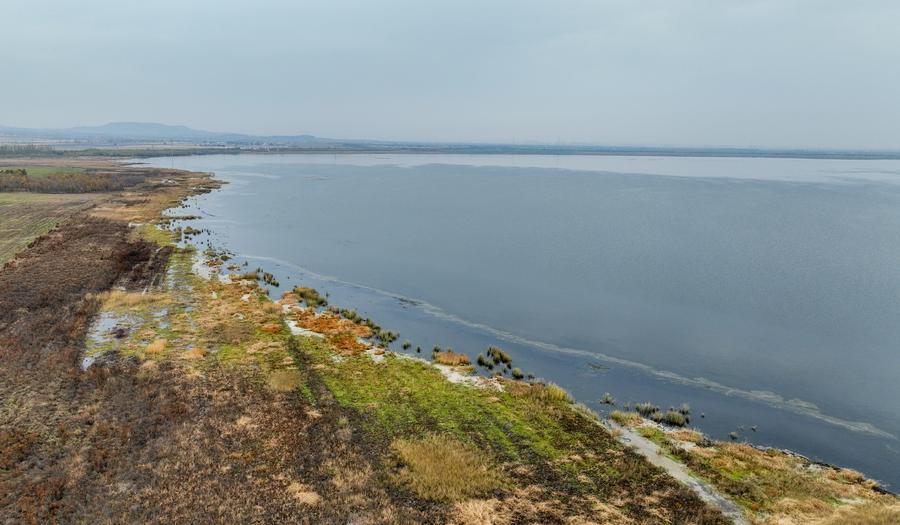
Autumn envelops the Huangqihai Lake with quiet vibrancy. Birds such as white-naped cranes wade across the muddy shallows in search of food.
The lake spans 85.22 square km, according to the center's September figures. This vibrant landscape is almost unrecognizable from 2006, when the water dried up, and most of the lakebed was exposed.
Even after water partially returned in 2012, the lake's size rarely exceeded 25 square km in the wettest months, and it shrank to less than 5 square km in dry seasons.
The lake once ranked among eight major lakes in the Inner Mongolia Autonomous Region, forming a critical wetland in northern China.
Back in the 1950s, it stretched across some 130 square km and sustained a thriving fishery. Its local specialty, Guancun crucian carp, once graced state banquets. But rising human activity and persistent drought reduced its size.
"Huangqihai is coming back to life. Fish have returned, giving migratory birds a safe haven on their migrating journeys," said Wang Shaojun, with the administrative office of the Huangqihai Wetland Nature Reserve. He attributes the recovery to decades of targeted restoration efforts.
The smart ecological supervision center launched in 2024 as the first of its kind in Inner Mongolia has transformed conservation work that once depended solely on human rangers. The system now generates over 100,000 monitoring data points each month, supplying scientific evidence to guide restoration decisions.
Wildlife offers the most telling barometer of the lake's ecological recovery. In May 2025, schools of fish reappeared in the lake. The scene had not been seen for 27 years. Wang said this milestone signals the restoration of the lake's natural self-purification capacity and a functional aquatic food web.
The center's AI-driven biodiversity system automatically identifies bird species from camera footage. This spring, the system captured images of a relict gull, a rare national Class-I protected species. The valuable footage provides conservation teams with important evidence to support field surveys and protection planning. So far, researchers have recorded 168 bird species within the reserve.
Sensors linked to the smart system also track water levels, stream flow and pest density. Conservation staff use this data to run targeted pest control, keeping migratory birds safe.
"The data-driven approach provides solid scientific grounding for targeted ecological management of the lake," Wang said.
Inner Mongolia, home to four major deserts and four extensive sandy lands, is among the most severely desertified areas in China. The region has taken a leading role in the country's push to restore damaged ecosystems.
Local farmer Lian Sixiong saw his irrigation practices shift in 2024. That year, local water authorities introduced irrigation water quotas for every village and household in the lake basin. Smart meters installed on irrigation wells track water use round the clock.
"In the old days, all farmers here used flood irrigation to get the soil completely soaked," Lian recalled. "With new regulations on the water use, farmers are far more conscious about saving water," he said.
Since 2021, local authorities have launched 44 restoration projects across the lake reserve, including riverway dredging, wildlife habitat rehabilitation, agricultural pollution mitigation, waste treatment and sewage-treatment infrastructure upgrades.
As a result, the lake receives no industrial or domestic wastewater. Residential waste and sewage are fully treated on a daily basis.
"Though the lake has not recovered to its 1950s scale, above-normal precipitation in recent years has improved regional water recharge conditions. Coupled with effective conservation efforts, this will accelerate the lake's recovery," Wang said. ■