
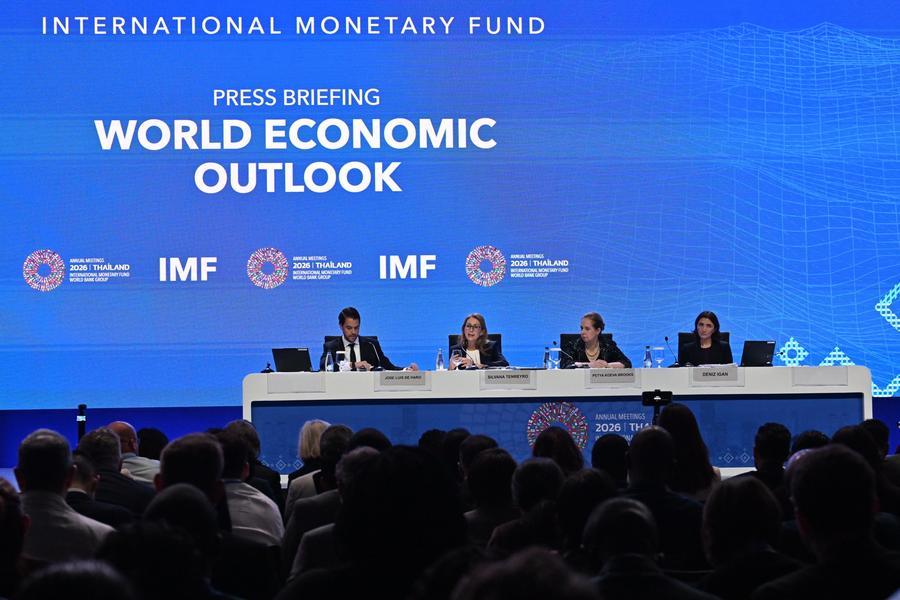
WASHINGTON, Oct. 16 (Xinhua) -- Governments in almost all economies face pressing fiscal challenges, with high debt levels, higher interest rates and growing demands for public spending, an International Monetary Fund (IMF) official has said.
"It's a reality that debt is high. The debt-to-GDP ratio is increasing for the world economy. We have higher interest rates than a few years ago, and there are a lot of demand for more spending," Rodrigo Valdes, director of the Fiscal Affairs Department of the IMF, told Xinhua in a recent interview in Washington D.C., ahead of the 2026 Annual Meetings of the IMF and the World Bank Group, being held in Bangkok, Thailand.
"All those things together make us think that the challenge for fiscal policy is very important," Valdes said.
According to the newly released Fiscal Monitor, global public debt is historically high and is projected to exceed 100 percent of global GDP before 2030, real interest rates on government debt remain above pre-pandemic levels, and spending pressures continue to mount across advanced economies and emerging market and developing economies.
New IMF research shows that when debt is already high, rising policy rates lead to a larger deterioration in fiscal deficits and debt, and high debt also makes market interest rates more sensitive to fiscal developments, according to an IMF blog posted Wednesday.
Higher interest rates "have worsened the scenario for everybody because at the end of the day, interest affects everybody," Valdes told Xinhua.
"Higher interest means that the cost of carrying debt is higher, and therefore is a global phenomenon that implies that we need more efforts, a bigger primary result, just to stabilize debt," he said.
Valdes also noted that defense spending, in particular, has contributed to mounting fiscal pressures. "I would say new defense spending in some countries, particularly in Europe, but also some demand for more spending in the U.S.," he said.
Beyond defense spending, population aging is driving up healthcare and pension costs, while climate change is creating additional investment needs, both of which add to fiscal pressures, Valdes noted.
"We have many sources of more spending pressures," he said.
The IMF official noted that for low-income countries, oil price shocks and extreme weather events are particularly concerning, as they can exacerbate food insecurity. "They have to prepare for that."
On oil shocks, Valdes said that governments worldwide have so far provided subsidies or tax cuts equivalent to an average of around 0.5 percent of GDP to contain oil prices, although the figures vary widely across countries.
If the governments don't allow oil-price increases to pass through to consumers, the cost could be even higher, between 1 and 1.5 percent of GDP, he added, stressing that preventing such price adjustments can affect global prices.
"If prices in some parts of the world do not adjust, that means that consumption doesn't adjust," and the only way to bring global demand and supply back into balance is through higher global prices, he said.
Such policies also have significant spillover effects, Valdes said, underscoring the need to move away from "inefficient and costly" interventions toward measures that are "targeted, temporary and transparent."
He urged policymakers to take a holistic approach in policy design and implementation, recognizing that no single policy instrument can achieve all objectives.
"A holistic approach means that you have to look at revenues and the spending side together," Valdes said. "We recognize fully that conducting fiscal policy is not easy -- it requires a combination of art, politics and techniques."
Building confidence across all stakeholders is essential, he added.
Commenting on China's fiscal picture, the IMF official said China has several characteristics that make it less vulnerable than other countries with comparable debt levels.
"In particular, China has many assets, some of them that are liquid. The financial account or the balance of payments is not fully open, and that also cautions for big movements of capital," Valdes said.
China pays a relatively low interest rate compared with other countries and has a high savings rate, he said. "All these factors, I would say, help reduce the risks."
China is already taking actions to tackle the economic challenges, he said, noting that expenditure should be used carefully to support the economy's ongoing shift toward greater consumption.■