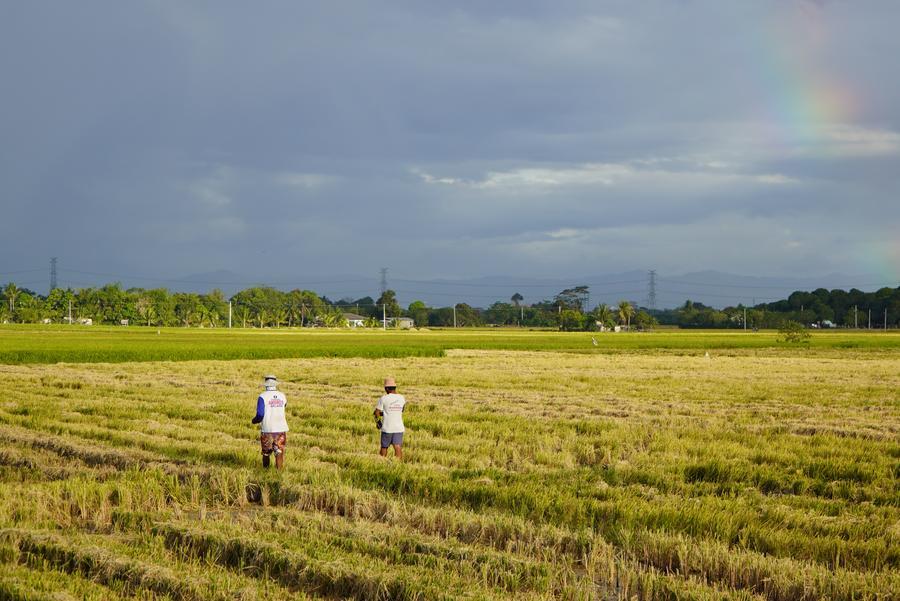
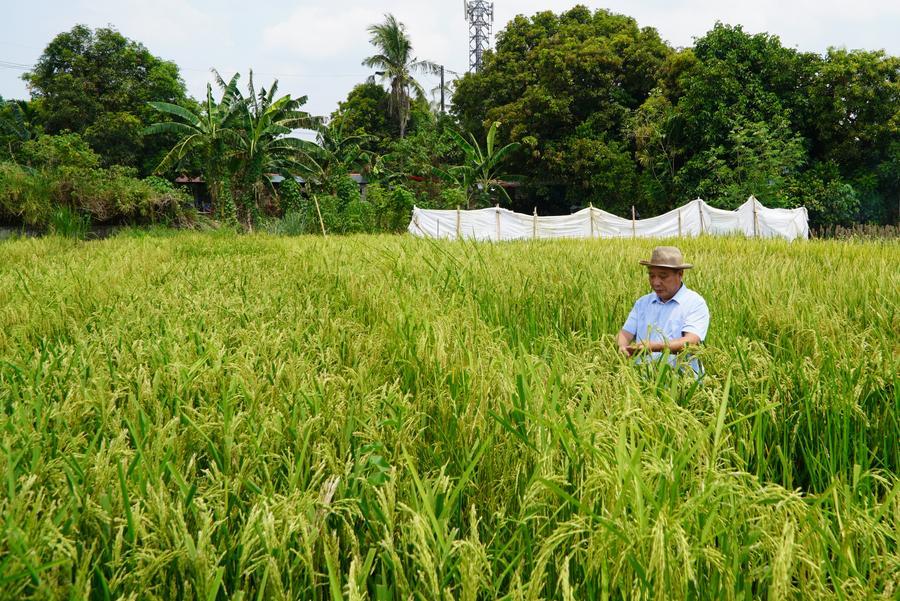
MANILA, Oct. 16 (Xinhua) -- At a hybrid rice experimental field in Nueva Ecija, the Philippines, ripe rice plants spread like a golden carpet, their panicles heavy with tightly packed grains. John Davidson pressed down a sturdy rice stem, and it quickly sprang back upright.
"The Philippines endured persistent heavy rains in August, yet most of our Chinese hybrid rice plants withstood the harsh weather and grew well," said Davidson, 35, a technician at the Longping High-tech Philippine R&D Center, a Chinese agricultural company named after Yuan Longping, affectionately known as the "father of hybrid rice."
Friday marks World Food Day. Rice is a staple in Southeast Asian countries. For decades, Chinese technicians have traveled to farmlands across Southeast Asia to breed hybrid rice varieties adapted to local conditions.
Twelve years ago, Davidson received six months of technical training from Chinese experts, learning hybrid rice techniques including artificial pollination, seed selection and cultivation. "Thanks to China's expertise, we could breed more productive seeds and help more farmers achieve stable harvests," he said.
The Philippines has high temperatures and humidity, and is frequently struck by typhoons and dry-season water shortages. As one of the world's largest rice importers, the country has long grappled with food insecurity, with its rice inflation rising over 20 percent yearly in September.
"To support local people to secure their food supply, we uphold the idea that giving grain feeds hunger for a moment, but supplying seeds and passing on skills brings lasting harvests," said Guo Xiaobo, head of the Longping High-tech Philippine R&D Center.
The center, founded in 2007, operates over 10 hectares of experimental fields in Nueva Ecija. It has tested and bred more than 300 hybrid rice varieties annually in recent years, with nearly 30 varieties having obtained certification from the Philippine authorities cumulatively. Last year, it sold over 6,000 tonnes of seeds locally.
"We are deeply rooted in our tropical farmlands. Luckily, our high-yield and stress-resistant rice varieties earn local recognition," said Guo.
Data from the Philippine Rice Research Institute shows hybrid rice seeds have accounted for 14 percent of total rice seed usage in recent years. Industry estimates put hybrid rice output at 30 to 40 percent of the country's total rice production.
Another Chinese hybrid rice promoter working in the Philippines is 74-year-old Zhang Zhaodong, who received the Award for Promoting Philippines-China Understanding in June. He was also honored with the Philippine Secretary of Agriculture Award in 2021, hailing him as "a pioneer in the development, production, and commercialization of the hybrid rice technology" in the Philippines.
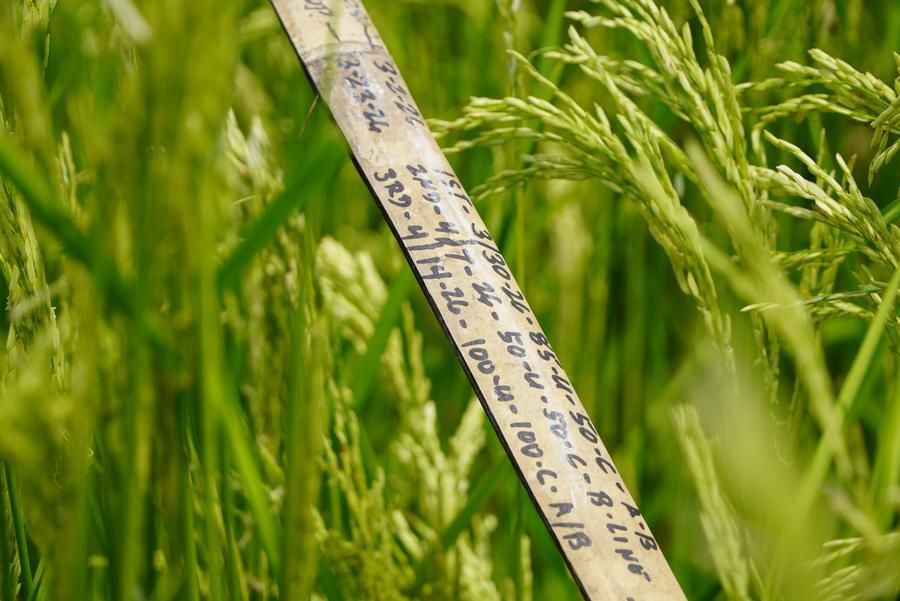
At the breeding base in Laguna province, Zhang walks through the paddies day after day, his trouser cuffs stained with mud and his feet caked in dirt. To cultivate rice, he often erects bamboo poles at the four corners of each one-square-meter test plot, with white woven fabric strung around the perimeter to ensure breeding purity.
In 1999, Zhang was dispatched to the Philippines by Yuan Longping and joined the local firm SL Agritech Corporation. The team later developed SL-8, a high-yield hybrid rice variety suitable for tropical cultivation.
Farmer Ronald de Lima recalled that when he planted local inbred rice about 30 years ago, the yield was just over four tonnes per hectare, while when he later planted SL-8, the output generally reached 10 tonnes per hectare.
"We were amazed by the Chinese technology, and started to plant hybrid rice one after another," said de Lima. "Thanks to hybrid rice, many fellow farmers bought vehicles and built new houses as harvests and lives have been getting better."
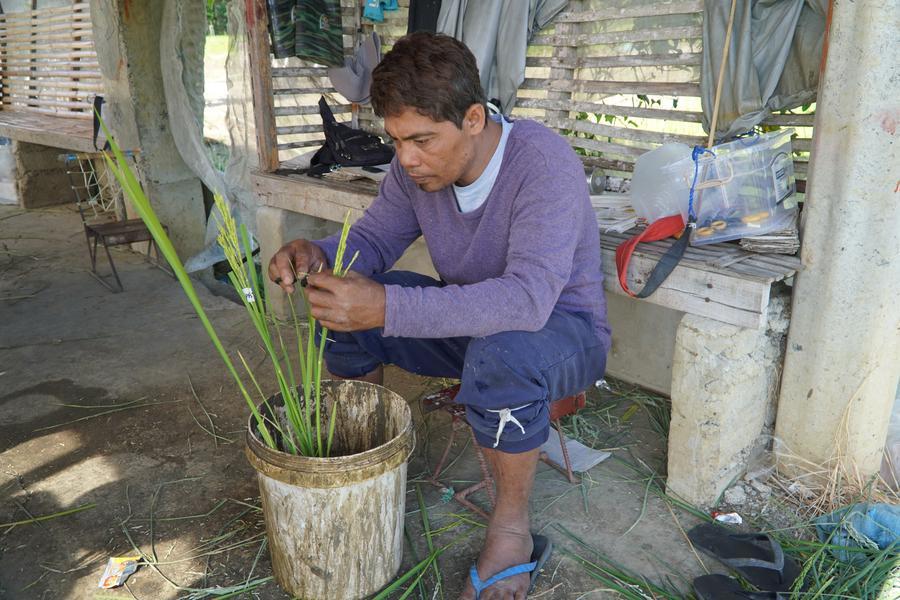
Zhang's team has recruited and trained hundreds of local technicians across the Philippines. After farmers purchase SL-8, these technicians deliver germinated seeds to households and provide guidance on cultivation management and pest and disease control.
"Promoting hybrid rice is far more than distributing seeds. It means visiting rural communities to demonstrate cultivation techniques day to day under scorching sun, and earning trust bit by bit," Zhang said.
Along with the hybrid rice's promotion, Zhang's team has also extended the industrial chain to rice processing and sales. Dona Maria, a rice product of SL Agritech, is frequently seen in local supermarkets at a price above the market average, and is exported to 14 countries and regions including the United States and the United Arab Emirates.
Furthermore, Zhang's team has shared breeding expertise to countries and regions including Malaysia, Bangladesh and Nigeria. In December 2025, Zhang signed a cooperation agreement on hybrid rice with the University of Mpumalanga in South Africa. The university stated that the "landmark partnership aims to revolutionize rice farming in South Africa, boost food security and create jobs."
According to the 2026 edition of The State of Food Security and Nutrition in the World released by the United Nations in July, 7.8 percent of the world's population, or about 645 million people, faced hunger in 2025. Geopolitical tensions and climate-related shocks, among other factors, could jeopardize recent progress.
Against this backdrop, Chinese hybrid rice technology has been trialed or promoted in over 70 countries and regions. China has trained more than 14,000 professional hybrid rice technicians worldwide, steadily lifting food supply capacity and taking concrete action to help address food shortages in the Global South.
"My goal is to bring hybrid rice to suitable lands across the tropics, steadily raise grain yields and contribute to easing global food shortages," said Zhang. ■