
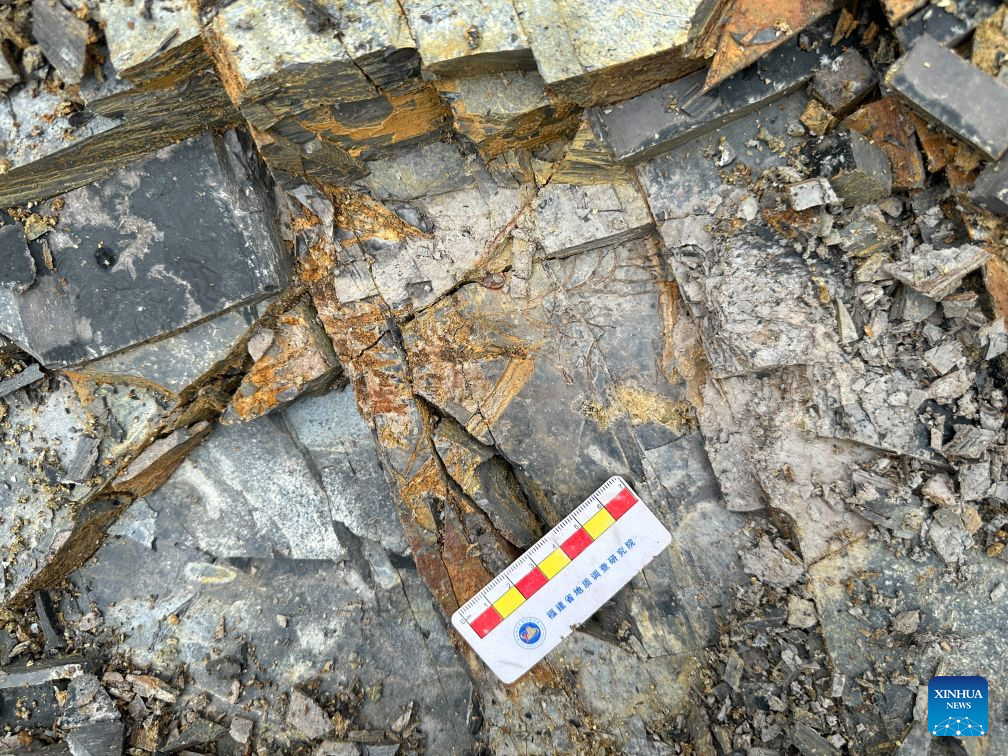
This undated file photo shows the site where the fossilized Yuezhuornis yangyuanensis is discovered, in Zhenghe County, east China's Fujian Province. A newly unearthed Jurassic fossil from east China is prompting scientists to rethink one of the most basic assumptions about bird evolution: that early birds always evolved toward better flight capability. The 150-million-year-old bird, named Yuezhuornis yangyuanensis, was about the size of a crow and lived during the Late Jurassic period. The fossil was found in Zhenghe County, east China's Fujian Province. What makes this bird so surprising is not how well it flew, but the fact that it likely did not fly at all. The fossil was discovered by researchers from the Institute of Vertebrate Paleontology and Paleoanthropology (IVPP) of the Chinese Academy of Sciences (CAS) and the Fujian Institute of Geological Sciences, and has been described in a study published in the journal Nature. (Xinhua)
BEIJING, Oct. 15 (Xinhua) -- A newly unearthed Jurassic fossil from east China is prompting scientists to rethink one of the most basic assumptions about bird evolution: that early birds always evolved toward better flight capability.
The 150-million-year-old bird, named Yuezhuornis yangyuanensis, was about the size of a crow and lived during the Late Jurassic period. The fossil was found in Zhenghe County, east China's Fujian Province. What makes this bird so surprising is not how well it flew, but the fact that it likely did not fly at all.
The fossil was discovered by researchers from the Institute of Vertebrate Paleontology and Paleoanthropology (IVPP) of the Chinese Academy of Sciences (CAS) and the Fujian Institute of Geological Sciences, and has been described in a study published in the journal Nature.
According to the study, Yuezhuornis is the earliest known example of a bird losing the ability to fly. Some parts of its body look like those of a bird, such as its pelvic and hindlimb elements. But it also retained traits from its dinosaur ancestors, including closely packed, serrated teeth and a special second toe that is highly extensible. These features are usually found in deinonychosaurs, not in birds.
Through their analysis, the researchers found that the limb proportions of Yuezhuornis were similar to those of living ground-dwelling birds and some non-avialan paravians, pointing to a terrestrial, flightless lifestyle.
"When we examined Yuezhuornis, we were struck by its extraordinary mix of features," said Wang Min, corresponding author of the study and a researcher at the IVPP. "It shows us that early bird evolution was far more complicated than we previously realized."
To figure out where this puzzling species belonged on the evolutionary tree, the research team ran a series of detailed analyses, using two different methods to compare its traits with those of other early birds and their relatives.
"The results consistently placed Yuezhuornis firmly within the Avialae, the group that includes modern birds and their closest extinct relatives. To put it simply, it sits on the evolutionary tree just above Archaeopteryx, the famous early bird from Germany. This means Yuezhuornis is slightly closer to modern birds than Archaeopteryx is. It is also the sister taxon to Zhengheornis, another early bird found at the same fossil site in Fujian, which means the two share a common ancestor and are each other's closest relatives on that branch," said Zhou Zhonghe, a co-author of the study and an academician of the CAS.
According to Wang, the discovery of a flightless, ground-dwelling bird from the Late Jurassic challenges the idea that flight was the main force driving early bird evolution. Instead, it suggests that some early birds followed evolutionary paths that did not favor flight, highlighting the remarkable ecological and morphological diversity that emerged during the early evolution of birds.
Meanwhile, Wang noted that the continuing discovery of early avialans underscores the potential of the Zhenghe Fauna to shed light on a poorly documented chapter of Jurassic bird evolution.
The Zhenghe Fauna is a terrestrial biota evidenced by a large number of tortoise, turtle, fish and plant fossils that have been unearthed. It is known as the southernmost location globally where avialan fossils from the late Jurassic Period are preserved.
During the late Jurassic Period, frequent volcanic eruptions occurred along the region's southeastern coastline. However, during quiescent periods, lakes and basins formed in the mountainous areas of what is today called Zhenghe County, creating a favorable ecological environment for plant growth and animal habitation.
Experts believe that Zhenghe's unique biological composition and geological background provide important information for the study of the evolution of terrestrial ecosystems in the late Jurassic Period, as well as the origins of birds and other animals. ■
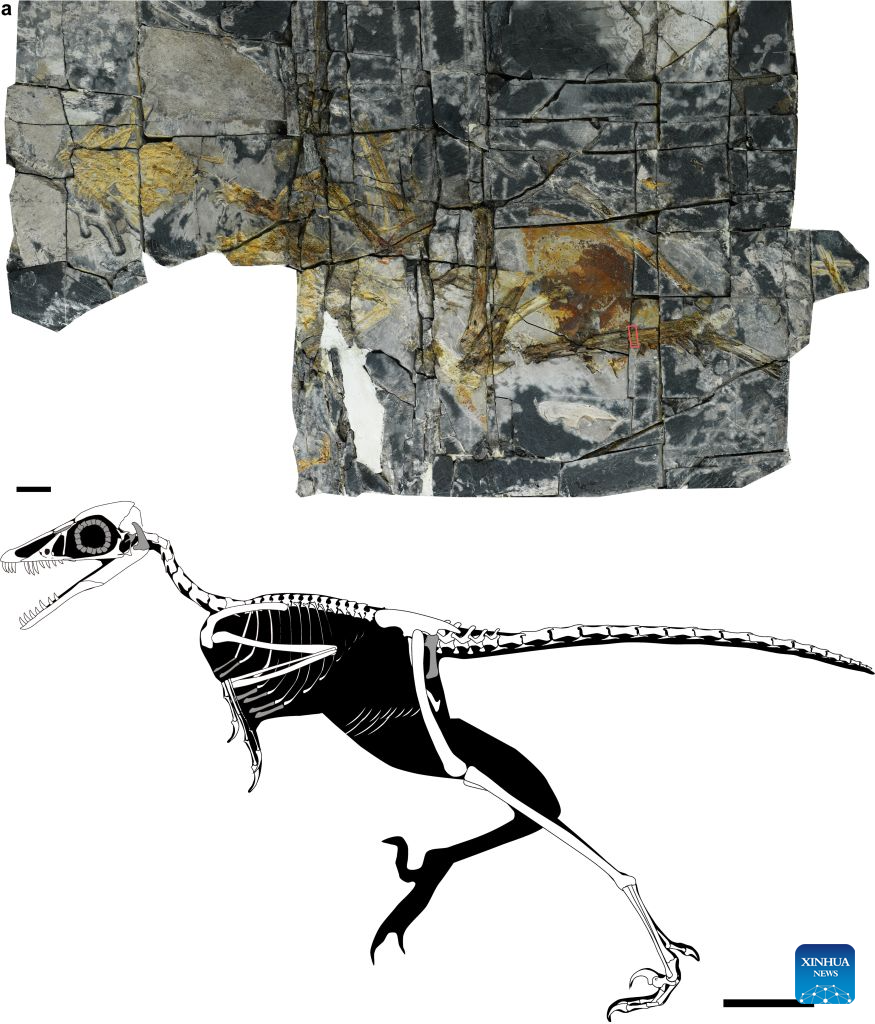
This combo photo shows an image of the fossilized Yuezhuornis yangyuanensis (above) and a restored skeleton diagram. A newly unearthed Jurassic fossil from east China is prompting scientists to rethink one of the most basic assumptions about bird evolution: that early birds always evolved toward better flight capability.
The 150-million-year-old bird, named Yuezhuornis yangyuanensis, was about the size of a crow and lived during the Late Jurassic period. The fossil was found in Zhenghe County, east China's Fujian Province. What makes this bird so surprising is not how well it flew, but the fact that it likely did not fly at all.
The fossil was discovered by researchers from the Institute of Vertebrate Paleontology and Paleoanthropology (IVPP) of the Chinese Academy of Sciences (CAS) and the Fujian Institute of Geological Sciences, and has been described in a study published in the journal Nature. (Xinhua)
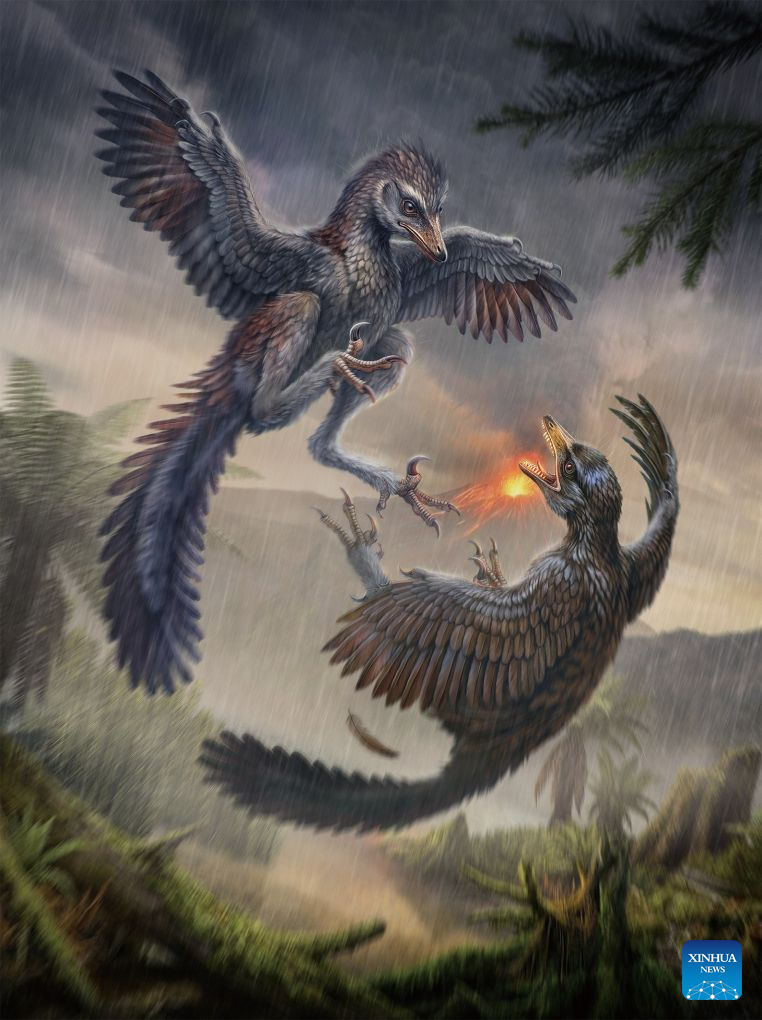
This paleontological reconstruction picture shows the restored image of Yuezhuornis yangyuanensis. A newly unearthed Jurassic fossil from east China is prompting scientists to rethink one of the most basic assumptions about bird evolution: that early birds always evolved toward better flight capability.
The 150-million-year-old bird, named Yuezhuornis yangyuanensis, was about the size of a crow and lived during the Late Jurassic period. The fossil was found in Zhenghe County, east China's Fujian Province. What makes this bird so surprising is not how well it flew, but the fact that it likely did not fly at all.
The fossil was discovered by researchers from the Institute of Vertebrate Paleontology and Paleoanthropology (IVPP) of the Chinese Academy of Sciences (CAS) and the Fujian Institute of Geological Sciences, and has been described in a study published in the journal Nature. (Xinhua)


