Developers across Africa are turning to Chinese open-source AI models to build affordable tools for local needs, from legal services and agriculture to education and insurance. Alongside technological applications, China-Africa cooperation in AI education and skills development is expanding.
NAIROBI, Oct. 15 (Xinhua) -- For Kenyan entrepreneur Sentai Simons, Chinese open-source artificial intelligence (AI) has helped turn an idea into a business.
Using a Chinese AI model, Simons built JibuDocs, a tool that turns paper legal records into searchable databases. He tailored it with about 1 million legal files, spending roughly 25,000 U.S. dollars on development and maintenance.
Using a commercial service such as Anthropic's Claude would have cost more than 1 million dollars, according to Simons. "It's absolutely the difference between having a business and not having a business," he said.
Like Simons, developers across Africa are turning to Chinese open-source AI models to build affordable tools for local needs, from legal services and agriculture to education and insurance.
LOWER COSTS, LOCAL SOLUTIONS
In Uganda, technologist Ernest Mwebaze, a former Google research scientist, has developed Sunflower, an AI system that provides farmers with weather updates and agricultural advice in local languages.
After testing Chinese and American models, Mwebaze chose Alibaba's Qwen, which he found more effective at handling Ugandan languages, less expensive and easier to customize with local data.
Sunflower now supports more than 30 Ugandan languages, helping overcome language barriers that have long limited access to digital services.
Cost and flexibility are also driving adoption among African businesses.
Nigeria-based Curacel, which provides AI-powered insurance claims processing and fraud detection, has integrated GLM models from China's Zhipu AI alongside Western models.
The company found that Chinese models delivered comparable results at lower cost for high-volume tasks such as coding, data extraction, classification and customer support.
Chinese technology is also being applied beyond commercial AI services.
In July, the China Meteorological Administration delivered an upgraded version of its MAZU intelligent early-warning system to Djibouti. It sharpens forecast resolution from 9 km to 3 km and delivers three-day forecasts refreshed every six hours.
China plans to extend MAZU to 30 countries over the next five years.
BUILDING LOCAL TALENT
Alongside technological applications, China-Africa cooperation in AI education and skills development is expanding.
Huawei says its ICT Academy program has partnered with more than 250 Nigerian universities and trained over 100,000 Nigerian students and young professionals since 2018.
Zhejiang Normal University also offers AI training programs for African students and scholars.
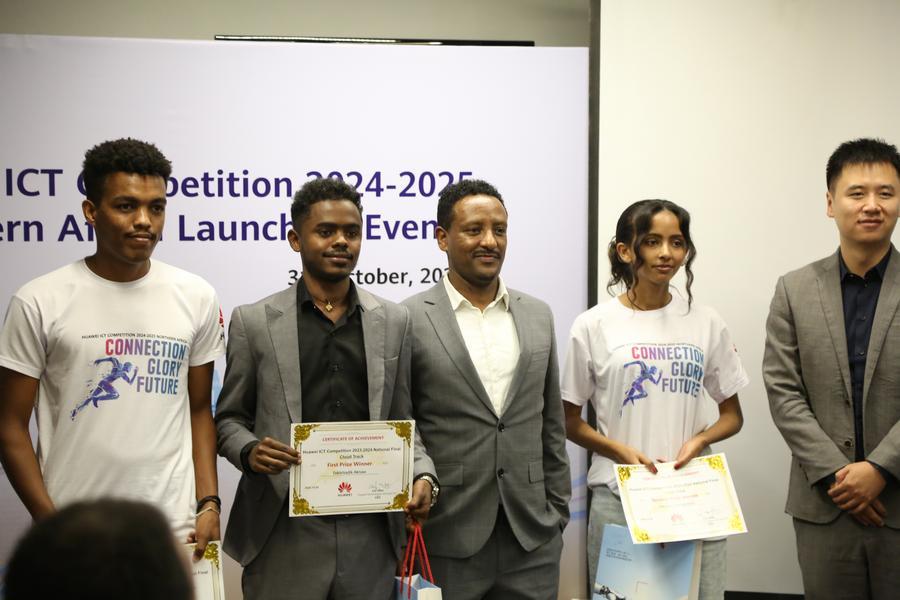
At the 10th Huawei ICT Competition global finals in June, which attracted more than 220,000 participants, a Kenyan team won a grand prize in the cloud computing category. Teams from Nigeria, Egypt and Algeria also claimed top honors in other categories.
In August, a forum in Lagos on people-centered AI governance brought together Chinese and Nigerian institutions to explore cooperation.
Liu Hongwu, dean of Zhejiang Normal University's Institute of African Studies, proposed translating Chinese AI resources into Hausa, Yoruba, Igbo and other Nigerian languages to make technical training more accessible to young people.
The language gap remains a major challenge. Less than 1 percent of internet content is available in African languages, according to Robert Lisinge, director of the Technology, Innovation, Connectivity and Infrastructure Division at the United Nations Economic Commission for Africa.
Lisinge said Chinese open-source models have helped lower costs for African universities and research institutions, enabling local scientists to develop applications suited to their communities.
DEEPENING AI COOPERATION
The growing uptake of Chinese AI technology is part of a wider effort by China and African countries to advance digital cooperation.
The African Union's Continental AI Strategy identifies agriculture, health care and education as priority areas while emphasizing the need for datasets in African languages.
China's AI Capacity-Building Action Plan for Good and for All similarly promotes open-source development and technological cooperation with developing countries.
On July 16, representatives of 29 countries signed an agreement in Shanghai to establish the World Artificial Intelligence Cooperation Organization. Ten African countries were among the founding members.
China's AI industry topped 1.2 trillion yuan (176.7 billion dollars) in 2025, up 40 percent year on year, according to the China Academy of Information and Communications Technology. The country had more than 6,600 AI companies as of June 2026.
Lisinge said closer cooperation with China in AI expertise and capacity building could accelerate Africa's digital transformation and economic development while helping narrow the continent's digital divide.
For African developers grappling with high computing costs, limited infrastructure and scarce local-language data, Chinese open-source models are offering a more affordable way to build AI tools tailored to local needs. ■