

BEIJING, Oct. 14 (Xinhua) -- After "China Travel" draws global travelers to its capital, China is offering the world another way in: the "China Hotline," a 12345 service that lets foreign nationals make their voices heard and help improve the city they reside in.
The service is part of a broader reform that began in Beijing in 2019, when the city, home to over 20 million residents, launched a "swift response to public complaints" initiative. The goal is to address concerns promptly and resolve everyday challenges efficiently. More than 60 hotline services have been integrated into a single number, 12345, which now serves as the main channel for residents to report issues.
Operating 24/7, the hotline is staffed by over 1,700 operators who work in shifts to take calls and handle requests covering nearly every aspect of urban life, including transportation, housing, education, healthcare, employment and business services. Foreign visitors and residents in Beijing are covered by the service, where they are treated not as outsiders but as part of the city.
Official data shows the Chinese capital has handled about 200 million public appeals in just over seven years, with resolution and satisfaction rates both exceeding 97 percent.
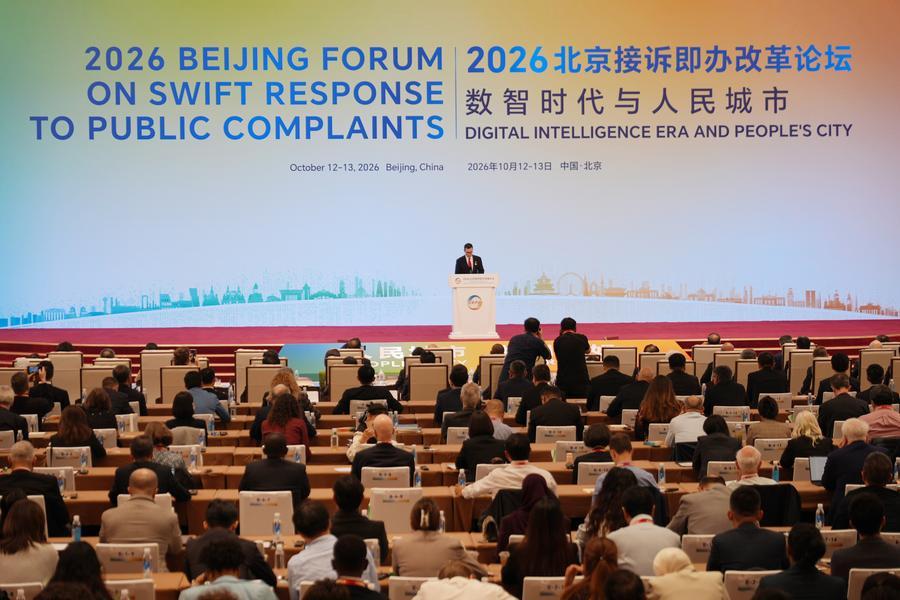
"The experience of Beijing's citizen service system offered valuable lessons for Athens in advancing people-centered urban governance and building a city that listens to its citizens and responds to their concerns," said Georgios K. Giannaros, first deputy mayor of Athens, Greece, during the 2026 Beijing Forum on Swift Response to Public Complaints.
The two-day event, which opened Monday, brought together more than 3,200 participants from over 70 countries and regions to explore new paths for modernizing urban governance, a challenge shared across the world.
OPEN HOTLINE
Marie, an expat living in Beijing, once hit a snag when signing up for a water show on the Grand Canal in Tongzhou District: the online registration form on WeChat only accepted Chinese mainland resident ID cards, leaving no way to enter foreign passport details.
After Marie raised the issue through the 12345 hotline, the case was assigned to Tongzhou authorities, who activated a fast-track mechanism for requests involving foreign nationals. Working with the platform operator and its technical team, they upgraded the registration system within just one working day, adding a field for passports and other foreign ID documents.
The 12345 hotline's foreign-related services are not only efficient, but also expanding in both scope and capacity.
"Foreign callers have all kinds of requests, with visa and entry-exit policies and work permit applications among the most common inquiries," said Wang Dongbo, an English-language operator on the hotline, adding that whether they live in Beijing or are just visiting briefly, foreigners who run into trouble can call 12345, and someone will see the matter through.
"Besides our dedicated English lines, calls in other languages are transferred to the multilingual service center at Beijing Foreign Studies University, where volunteers join in on a three-way call," said Shan Qiang with the Beijing Citizen Hotline Service Center. The hotline now provides round-the-clock services in eight foreign languages.
Beyond the hotline, Beijing has rolled out "12345 Online," a digital platform offering the same service. Meanwhile, a multi-dimensional support network for foreigners is taking shape in the Chinese capital.
The network spans "GO BEIJING" -- a one-stop service platform for overseas visitors -- the English edition of Beijing's official public services app, the International Web Portal of Beijing and airport service points, responding to their needs at every stage, from pre-trip planning and entry, to life in Beijing.
"In the governance logic of China's capital, where every complaint gets a response, the 'people' in 'the people's voices are heard' now include foreigners living in Beijing," said Zhang Yi, director of the institute for capital governance at the Chinese Academy of Social Sciences.
SHARED GOVERNANCE
Being heard is only part of the story. Traik Souhail from Morocco spends almost every weekend studying at Beijing Library in Tongzhou District. He noticed that seat-hogging was a common problem here. "Public resources shouldn't sit idle or go to waste. Every seat should go to someone who actually needs it," he said.
In August last year, he submitted a proposal through "12345 Online," suggesting the library set a 30-minute limit on unoccupied seats to stop long-term seat-hogging.
After verifying the situation, the library moved quickly to address this issue. It posted notices in Chinese and English urging readers to use the library respectfully and refrain from hogging seats, stepped up manual patrols, and promptly cleared unattended items from seats, bringing order back to its reading areas.
Li Wenzhao, a professor at the School of Public Administration and Policy, Renmin University of China, said Beijing's "swift response to public complaints" has transformed the traditional top-down model of urban governance into a collaborative, multi-stakeholder approach. It is equally open to foreign residents, encouraging them to take ownership and bring international perspectives, experience and expertise into the capital's governance.
"Cities become more beautiful through openness, which is also essential to a world-class, harmonious and livable capital," he said.
"Anyone who lives in this city has a channel to voice concerns and take part in governance. The hotline not only bridges language barriers but also opens a path for diverse groups to integrate into urban governance," said Yao Lei, director of the Beijing Citizen Hotline Service Center.
CHINESE SOLUTION
In June, more than 20 young scholars from leading think tanks across Latin America visited the 12345 hotline call center in Beijing.
"Over 20 million appeals a year. That's incredible!" Chilean scholar Maria Fernanda Garredon said after seeing the full call-handling process for herself. "If residents didn't find it effective, they wouldn't call. Such a high volume shows that once you get through, your concerns are heard and solutions are found."
In recent years, the center has hosted nearly 2,500 foreign visitors from more than 120 countries, including the United States, Belarus and Thailand. Belarusian delegations have visited three times to learn from the hotline's experience, and the country plans to draw on Beijing's 12345 model to set up its own hotline.
"When you set foot on Chinese soil, see firsthand how institutions operate and learn how ordinary people get their problems solved, you come to understand that China is truly committed to improving people's livelihoods and tackling real problems," said Salvadoran scholar Juan Gilberto Contreras Gomez.
"There is a global phenomenon unfolding in Western countries, developing countries and elsewhere. People don't feel that governments respond to their needs or their immediate problems -- mainly services and quality of life," said Omar Razzaz, a senior fellow at Harvard Kennedy School and former prime minister of Jordan. He has been actively promoting Beijing's "swift response to public complaints" reform at various international events.
Razzaz called the 12345 citizen hotline "a model of efficient and balanced governance," noting that it represents a deep integration of technological empowerment and institutional innovation. "I've seen elements of it in different countries. But the way it worked here was quite impressive, and I felt like China should share that experience," he added. ■