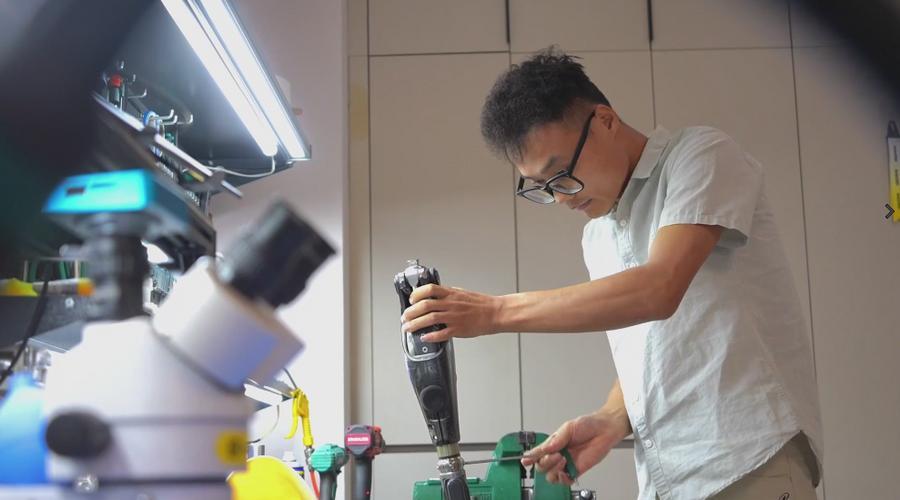
JINAN, Oct. 14 (Xinhua) -- After losing most of his left leg in an accident, Liang Kaiyu spent so much time perfecting his prosthetic that it eventually became his livelihood.
The prosthetic he first ordered frequently buckled mid-stride and needed constant charging. So Liang set to work, modifying it until it fit him like a glove.
Since then, he has made or refitted more than a dozen artificial legs. One has a mountain bike shock absorber at the ankle. Another has a thruster for swimming. Some of them have electronic knees and ankles he programmed himself.
Going by "Steel Leg" online, Liang posts videos of his work, repairs prosthetics for other amputees and makes a living from it. "Every day there's something I want to do," he said. "I tinker with a part, solve a problem, and when it works I'm happy."
Liang is among more than 2 million registered residents with disabilities in east China's Shandong Province. Late last year, the province announced a three-year plan running through 2027, with targets for job training, self-employment and supported work. At least 45,000 disabled people will receive vocational training.
The plan encourages local governments to reserve space for disabled entrepreneurs in government-funded business incubators and startup parks. Eligible entrepreneurs can apply for guaranteed startup loans of up to 300,000 yuan (44,828 U.S. dollars).
The province is also promoting a "community micro-business" model that requires government-run convenience service outlets to set aside at least 10 percent of their stalls for disabled workers.
WHERE THERE IS A NEED, THERE IS A WAY
Like Liang, people with reduced mobility sometimes become entrepreneurs, driven by needs that aren't otherwise met.
Gong Yuben runs an online shoe store in the port city of Yantai that sells shoes one at a time, not in pairs. He lost his right leg in a traffic accident in 2012, when he was a teenager. Because shoes are sold only in pairs, he accumulated too many new but useless right shoes over the years.
This year, he began working with suppliers to split pairs and sell them individually. His store soon drew a small group of clients who also recommended it to friends with similar needs. Sales are modest, but they answer a real need. "To someone who actually needs it, one shoe is a complete pair," Gong said.
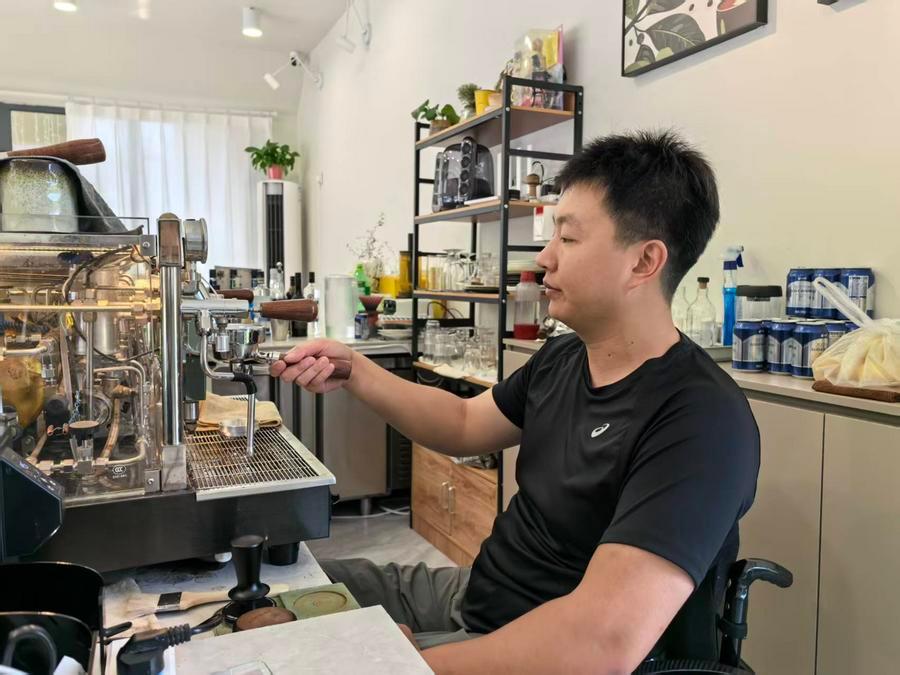
Zou Jiahao's entrepreneurship was driven by a different need: a good cup of coffee from his wheelchair. His wheelchair-accessible cafe in his home city of Qingdao has a ramp at the entrance, a wide doorway for wheelchairs, and a lower counter set at the ideal height for customers on wheels and for him on the other side.
Zou said the initial investment for the 60-sqm shop was about 100,000 yuan, spent mostly on coffee machines and furniture. The local federation for people with disabilities helped negotiate favorable rental fees.
"Equal employment means having the chance to learn a skill, use it, and earn the life you want," Zou said, adding that he is betting on customers, with disabilities or not, to keep coming back for his coffee and service.
China has an estimated 86 million people with disabilities as of 2023, according to the National Bureau of Statistics. In 2025, more than 8.9 million were employed, the China Disabled Persons' Federation (CDPF) reported earlier this year.
China's plan for the protection and development of people with disabilities during the 15th Five-Year Plan period (2026-2030) outlines a wide range of priorities and initiatives to enhance social protection, life-cycle care and rights protection for disabled citizens.
A major target is to create a million new jobs for people with disabilities in urban and rural areas, said Cheng Kai, chairman of the CDPF.
BUILDING ON WHAT THEY CAN DO
Guangming Experience Hall, a darkness exhibition in Jinan, Shandong's provincial capital, hires visually impaired people exclusively as guides, turning their navigation skills into a new profession. Though "Guangming" means "light," the museum invites visitors to make their way around in the dark, simulating experiences like a bus ride or a shopping trip -- relying only on touch, sound, and smell.
When it opened in early 2024, only six of the about 60 visually impaired applicants were hired. They became familiar with every corner of the hall and learned to "read" visitors' moods from their voices.
Chang Wanxiu, 29, said the job has boosted her confidence and made her feel like everyone else. "With this job, I need to leave home, take the bus, and talk to different people," she said. "At first I was nervous. But after walking through it again and again, I found my footing."
A government-backed program also trains visually impaired therapists for community health centers and helps them open private clinics. "People with disabilities have their own strengths and potential," said Tang Jianquan, head of the Shandong provincial association for the visually impaired. "Once put in the right place, they can prove to be valuable workers for their enterprises as well as for their personal fulfillment."
Despite being hearing impaired, Xiao Wei (not his real name) is as well-prepared as any seasoned food deliveryman. When a customer calls, his smartwatch buzzes, an AI assistant answers and converts the conversation to text, and he quickly replies with one of dozens of pre-edited messages stored on his phone.
The delivery service center trained him and paired him with veteran riders. "I don't feel like a disabled person on the job," he typed in response to Xinhua. "I can feel my own sense of value."
A Starbucks outlet in Qingdao's Shibei district began recruiting and training hearing-impaired workers in 2021 with the municipal disabled persons' federation. Training usually takes a month, but at least twice as long for a hearing-impaired employee, said store manager Lyu Yan. "It's important to slow down the training but keep the same standard, so that all our employees are treated as equals."
To help them, the store installed screens that convert speech to text in real time and lower counters that make it easier to read customers' lips.
Lu Lin, chairman of the China Association of Persons with Physical Disability, said helping people with disabilities find work is a complicated project and one needs to get every step right, from their leaving home to settling into a job.
These often involve infrastructure such as accessible roads and transport, as well as fair wages, social insurance, adequate labor protections and personal development opportunities. "We want more job opportunities for them and every support they need, so that they can live with independence and dignity." ■