YINCHUAN, Oct. 13 (Xinhua) -- Since opening in August this year, a 22.77-kilometer avenue in northwest China's Ningxia Hui Autonomous Region has been drawing a steady stream of visitors from both home and abroad.
"To the west is the majestic Helan Mountain, and to the east are endless vineyards. It is full of surprises and so much fun," Wang Xiaotong, a tourist from north China's Shanxi Province, said in describing the avenue flanked by vast vineyards.
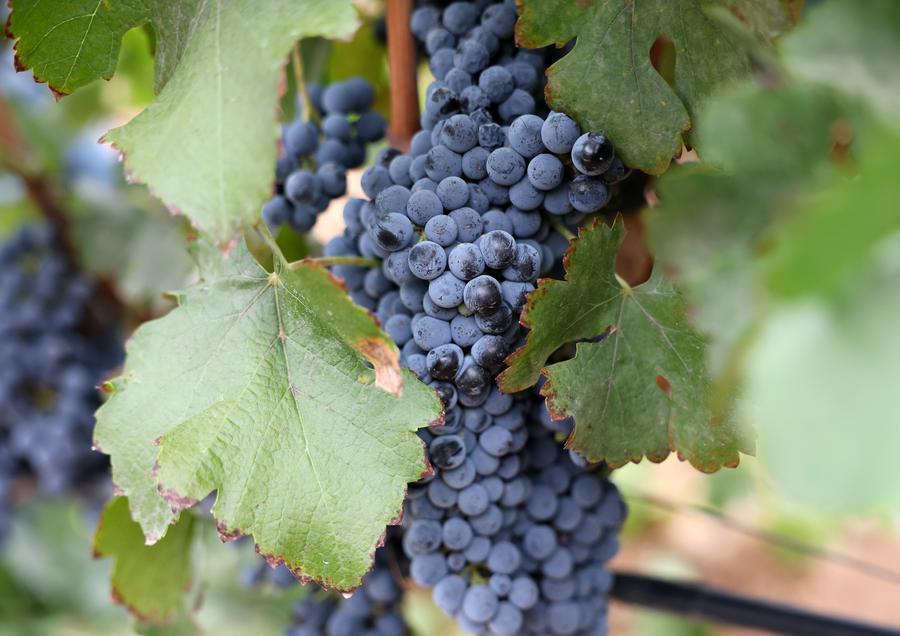
She was unaware that, just decades ago, this place had been a barren stretch of desert. Through years of sustained effort, Ningxia has turned over 400,000 mu (about 26,667 hectares) of barren land at the eastern foot of Helan Mountain into a world-renowned ecological wine-producing base.
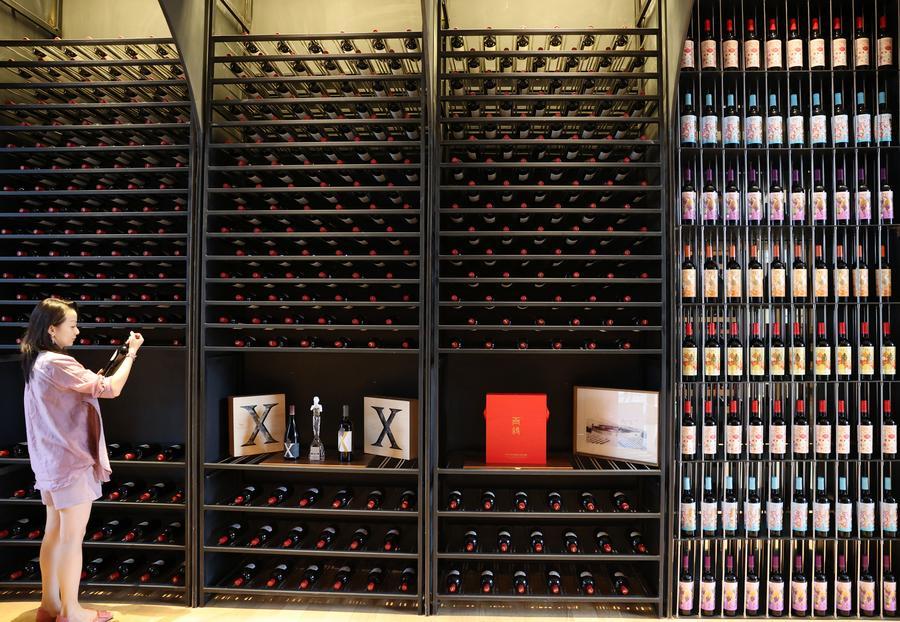
At a local winery, the owner Ding Jian boasts an underground wine cellar that she describes as able to "breathe." The cellar is designed with a naturally constant-temperature, constant-humidity structure, and a natural circulation system formed by ventilation holes in the walls.
Without any refrigeration or heating equipment, it maintains a stable environment suitable for wine aging and storage while consuming minimal energy, no matter how extreme the outdoor temperature is.
Another local winery has adopted an environmentally friendly layout at its production area, using dense windows to create a "chimney effect" that allows free air circulation and significantly reduces reliance on temperature control equipment.
The winery's manager, Zhang Xueyan, outlined a comprehensive ecological scheme. "Grape skins from the winery are supplied to cosmetics companies as raw materials, while discarded vines are provided to farmers free of charge to feed their cattle and sheep. The manure is then returned to the fields to nourish the organic vineyards," she said.
"Every step, from planting to brewing, is aimed at saving energy and cutting emissions, which is also the key to the sustainable and sound development of the industry," the manager concluded.
Ningxia has also explored "carbon asset" models since 2023, seeking to transform a vineyard's ability to absorb carbon dioxide into a tradable asset. In December 2025, the country's first wine vineyard carbon transaction was completed in Ningxia.
This transaction was of great significance as it verified that the "carbon asset" has a market-oriented foundation, while also providing a replicable and scalable practical model for the green transformation of the global wine industry, according to the management committee of the wine industrial park at the eastern foot of Helan Mountain.
In December 2025, the wine region at Ningxia's eastern foot of Helan Mountain was awarded the International Sustainable Development Award at the 20th Bettane & Desseauve Ministry of Foreign Affairs Celebration held in France, becoming the first Chinese wine region to receive this honor.
Sergio Cabrera, ambassador of Colombia to China, said Ningxia's wines not only excel in quality but also embody an outstanding environmental protection philosophy that puts ecology first in industrial development, an approach worthy of global reference.

The 47th World Congress of Vine and Wine, meanwhile, opened on Monday in Yinchuan, capital of Ningxia. This is the first time the congress, held alongside the 24th General Assembly of the International Organization of Vine and Wine (OIV), has been hosted in Asia since its launch in 1924.
Yvette van der Merwe, OIV's president, hailed China's important role and its growing contribution to the international vine and wine industry, highlighting Ningxia's significant development as a wine-producing region.
The eastern foot of Helan Mountain in Ningxia has become China's largest contiguous wine grape production area. This region has roughly 40,467 hectares dedicated to wine grape cultivation and development, accounting for nearly 42 percent of China's total planting area. ■