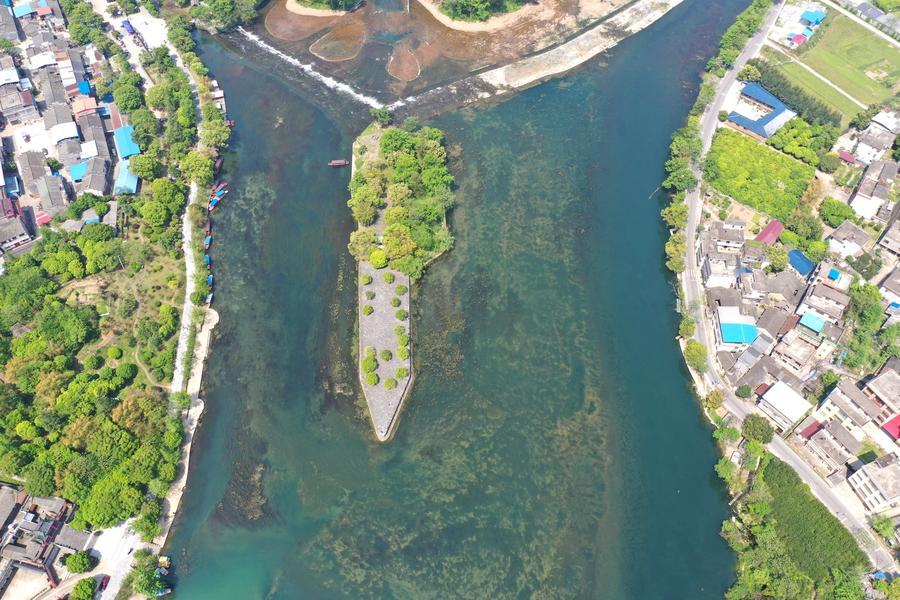
NANNING, Oct. 12 (Xinhua) -- On free mornings, Ai Chenggang gets on his bicycle and rides along the Lingqu Canal, checking for rubbish tangled on the banks and watching out for children playing too close to the water.
Ai, in his 70s, has spent his life in Xing'an County in south China's Guangxi Zhuang Autonomous Region, where the canal has flowed past homes and fields for more than two millennia.
"This canal is what home means to us," he said.
The waterway Ai tends, quiet and enduring, is drawing crowds of visitors from far and wide this week.
Canal experts and enthusiasts from around the world are gathering in the city of Guilin in Guangxi for the World Canals Conference, which opened on Monday. The Lingqu Canal, about 60 kilometers from downtown Guilin, is a centerpiece of the event.
The conference has brought together representatives from canal cities, research institutions and waterway organizations in more than 20 countries. It is the third time the event has been held in China and the first in Guangxi. Discussions focus on how to preserve historic waterways while maintaining their value for local communities along the banks.
AN ANCIENT LINK
Ai's work as a canal guardian follows a family tradition. He is a descendant of the doujun, canal keepers who once patrolled the banks, repaired embankments and operated water gates to keep boats moving safely.
This role faded when roads and railways replaced the canal as a transport route, and Ai now serves with a volunteer group protecting the waterway.
The 37-kilometer Lingqu Canal was built on the orders of Emperor Qinshihuang of the Qin Dynasty (221 B.C.-207 B.C.), connecting the Xiangjiang and Lijiang rivers and, through them, the Yangtze and Pearl river systems.
Originally built to transport supplies for Qin armies campaigning in Lingnan, it later became a vital trade route linking China's interior with the southern region.
Along with Dujiangyan and the Zhengguo Canal, Lingqu is regarded as one of ancient China's three major hydraulic projects.
No cargo ships travel its waters today, but the canal still irrigates farmland, aids flood control and feeds the Lijiang River flowing through Guilin's famous karst landscape. Locals walk and rest under old trees on its banks, while farmers continue to work nearby fields.
Chen Xinghua, a former deputy director of the Xing'an county museum, has studied Lingqu for decades.
Figurines depicting foreigners, dating to the Han Dynasty (202 B.C.-220 A.D.), have been unearthed near the canal, offering evidence of early cultural exchanges between China's interior and the outside world, he said.
"Lingqu was an important part of the ancient Maritime Silk Road," Chen noted. "Protecting it helps us better understand the past and draw lessons for the present."
In 2018, Lingqu was listed as a World Heritage Irrigation Structure, the first in Guangxi to receive this designation.
KEEPING IT ALIVE
Protecting a canal involves more than restoring old stonework.
Authorities have banned quarrying along the waterway, improved sewage treatment and cleared waste, while regional and local regulations provide legal protection for the site.
Further efforts will focus on preserving the canal's original structures, expanding archaeological research, and using digital technology to make its history more accessible to the public, according to Wu Xiaogang, spokesperson of the Guilin municipal government.
Tourism has grown alongside these efforts.
The 12,000-square-meter Lingqu Museum houses more than 10,000 cultural relics. An immersive theater, meanwhile, takes visitors on a simulated boat ride through different periods of the canal's history, with warships from the Qin Dynasty, passenger boats from the Tang Dynasty (618-907), and merchant vessels from the Ming and Qing dynasties (1368-1911) appearing on a 360-degree screen.
The Lingqu scenic area received more than 1 million tourist visits in 2025, including over 10,000 visits by participants in educational tours, boosting business for local restaurants, hotels and transport operators.
For local residents, protecting the Lingqu Canal and preserving its cultural heritage have become part of everyday life.
Zeng Jinglan, 69, grew up beside the canal. A finger painter whose works have been exhibited around the world, she returned to Xing'an three years ago and opened a studio nearby.
"I grew up drinking water from the canal," she said. "In summer, my friends and I ran along its banks, listened to stories about it and watched my father paint by the water."
Today, the canal's scenery, plants and wildlife inspire her paintings. She hopes her art will help keep its cultural heritage alive for future generations.
More than 2,000 years after Lingqu was built, another canal has opened in Guangxi. The 134.2-kilometer Pinglu Canal, which began operating in September this year, gives southwestern China a shorter waterway route to the sea.
Experts said the two canals underscore the enduring role of waterways in connecting regions, facilitating trade and driving China's development.
Ai still gets on his bicycle and follows the canal his ancestors once guarded. The cargo boats have disappeared. Generations of canal keepers have come and gone. But the water is still flowing.
"As long as the canal is here, our home has a root," Ai said. ■