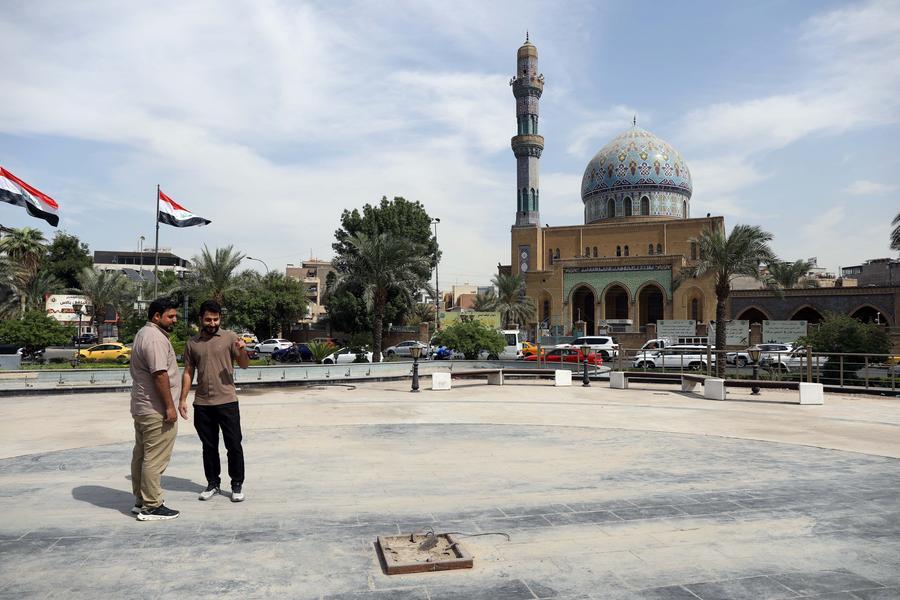
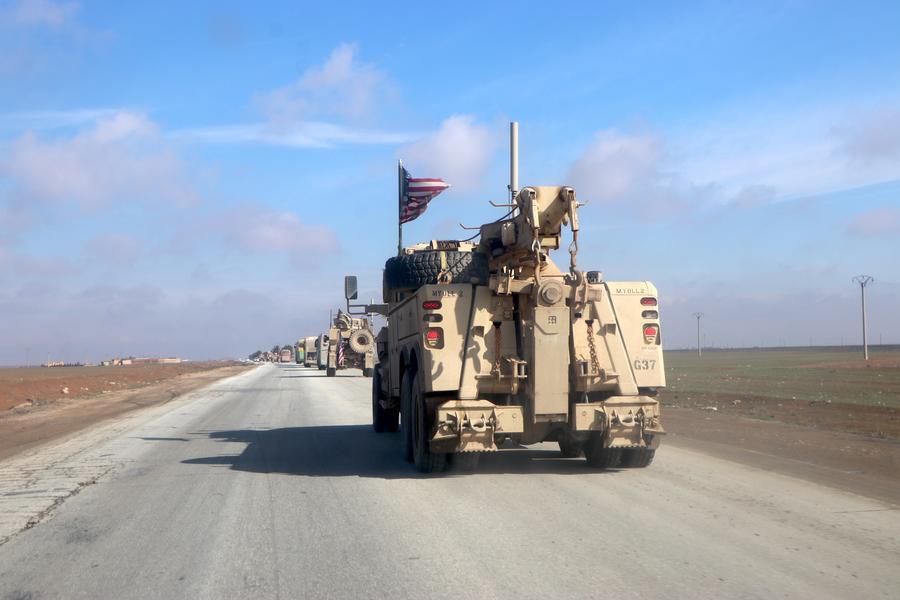
BAGHDAD, Sept. 30 (Xinhua) -- The U.S.-led international coalition concluded its military mission to combat the Islamic State (IS) in Iraq on Wednesday, following a withdrawal from Iraq's Erbil Air Base. The pullout coincided with Iraq's Sovereignty Day, a celebration of national independence and dignity.
The move ends a turbulent two-decade U.S. military presence defined by invasion, occupation, withdrawal, and redeployment, a cycle that fundamentally reshaped Iraq's destiny, fueled regional instability, and exacted a heavy toll on Washington itself.
Analysts view the withdrawal as the outcome of U.S. strategic realignments and shifting regional dynamics, signaling the end of an old era and the start of a complex geopolitical reshuffle.
FROM INVASION TO DEPARTURE
"The orderly departure of coalition forces and equipment from Erbil Air Base marks the successful conclusion of the military mission that defeated IS in Iraq," the Pentagon's chief spokesman said in a statement on Wednesday.
While media described the U.S. forces departure as low-profile, experts emphasize its deep historical resonance. In 2003, Washington invaded Iraq without UN authorization under the pretext of searching for weapons of mass destruction, toppling Saddam Hussein's rule and plunging the nation into chaos.
When U.S. forces hastily withdrew in 2011 under domestic and diplomatic pressure, the resulting security vacuum enabled terrorism to spread, leading to the rise of the IS in 2014, which seized vast swathes of territory in Iraq. Washington then assembled an international coalition and returned to Iraq. Despite Iraq declaring victory over IS in late 2017, thousands of U.S. troops remained.
Rising public and governmental demand for sovereign control led to a September 2024 agreement between Iraq and the United States formalizing the coalition's withdrawal timeline.
Analysts note the pullout reflects pragmatic considerations for both sides. For Baghdad, it marks a transition from external reliance to sovereign security management. For Washington, the diminished IS threat, alongside frequent attacks on U.S. troops by pro-Iranian militias, reduced the military rationale for staying. The pullout also aligns with U.S. domestic electoral commitments to end "endless wars" and reallocate military resources.
TRAUMA & CHALLENGES
The U.S. invasion left deep scars. According to Statista, a global statistical database, from 2003 to 2021, about 209,000 Iraqi civilians died in wars and violent conflicts. About 9.2 million Iraqis became refugees or were forced to leave their homeland. In Fallujah, high rates of cancer and birth defects persist due to the past use of depleted uranium and white phosphorus munitions by U.S. forces.
While Iraq framed the departure as a milestone for national development, structural security challenges remain in the war-torn country.
Iraq is under great pressure from the U.S. administration to disarm Iran-backed Shiite militias, many of which are defying state efforts to bring them under control, creating potential instability in the country, said Jumaa Mohammed, a politics professor at Iraq's Tikrit University.
Concerns are also acute in Iraq's semi-autonomous Kurdistan region, which has faced repeated strikes since the United States and Israel launched joint military actions against Iran in late February. Kurdish authorities fear that the security situation could become even more dire following the U.S. withdrawal as they view U.S. forces as a vital security counterweight.
Furthermore, physical troop withdrawal does not mean an end to Washington's influence. Ding Long, a Chinese expert on Middle East affairs at Shanghai International Studies University, notes that the United States is shifting from direct military occupation to leveraged influence through bilateral security agreements, energy partnerships, and financial mechanisms.
Notably, Iraq's foreign exchange earnings from oil exports have been deposited in accounts at the Federal Reserve Bank of New York since 2003, giving Washington lingering economic leverage with control over the actual supply of U.S. dollars, said Li Ruiheng, an expert at the Center for Middle Eastern Studies of Peking University.
NEW REGIONAL SHUFFLE
Regional analysts consider the departure a continuation of U.S. strategic contraction in the Middle East, with lasting geopolitical ramifications.
The withdrawal of U.S. forces could create space for Iran to expand its regional influence. Iran has long viewed U.S. military bases in the Middle East as a major security threat. The U.S. withdrawal from Iraq, a country bordering Iran, will diminish American military deterrence in Iran's immediate vicinity and, in effect, create room for Iran to further extend its influence.
Conversely, Washington may seek deeper security cooperation with Syria, which joined the anti-IS coalition last year, focusing on intelligence sharing and counter-terrorism to constrain pro-Iranian supply corridors, analysts said.
Ultimately, Iraq's quest for strategic autonomy depends on internal governance and regional balance. Reconciling political factions, addressing Kurdish security concerns, integrating militias, and preventing an IS resurgence remain critical long-term tasks.
Experts said that as the region seeks to cut back on foreign interference, it will take sustained regional dialogue and inclusive diplomacy to deal with the geopolitical fallout and security gaps left by the United States.■