
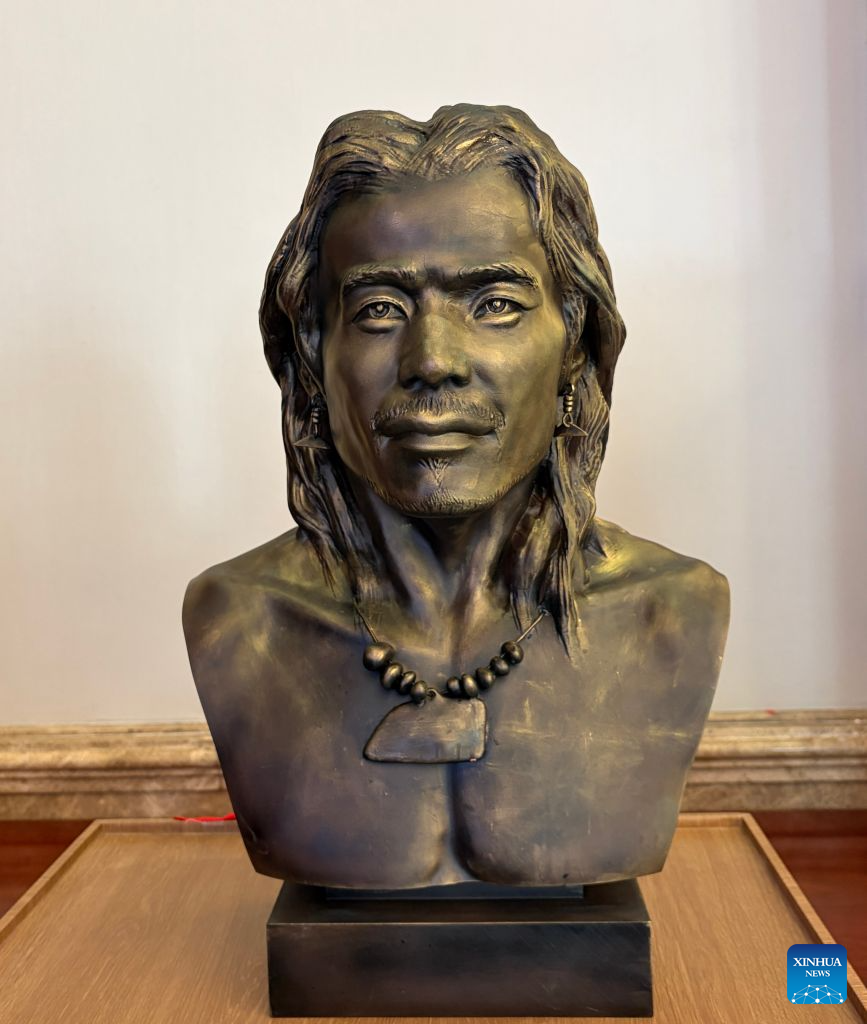
This photo taken with a mobile phone on Sept. 29, 2026 shows a reconstructed face of a man based on human remains unearthed at the Jiahu archaeological site in central China's Henan Province. (Xinhua/Ren Zhuoru)
ZHENGZHOU, Sept. 30 (Xinhua) -- A reconstructed face of a man who lived more than 8,000 years ago was unveiled Tuesday in Zhengzhou, capital of central China's Henan Province, providing insight into the region's prehistoric inhabitants.
The sculpture, based on human remains unearthed at the Jiahu archaeological site in Henan, combined physical anthropology with high-precision 3D facial reconstruction technology, according to researchers from the Henan Provincial Institute of Cultural Heritage and Archaeology and Jilin University's bioarchaeology laboratory.
This work represents a significant application of scientific methods in archaeology and gives the public a more direct way to visualize the people of Jiahu, said Wang Wei, head of the institute.
The individual was identified as a man aged between 25 and 30, based on the shape of his pelvis and the wear on his teeth, according to Zhu Hong, a professor at the laboratory.
His skull was regularly oval, with a prominent brow ridge and strong cheekbones, while his face was angular and relatively flat, and his nose was of moderate size, Zhu said. The features reflect physical traits typical of prehistoric people in the Central Plains, he added.
Researchers collected high-resolution 3D data and built a detailed model of the skull of the man. For the facial reconstruction, they used 28 key points on the skull and assessed muscle attachment features to shape the contours. They also added subtle wrinkles and a natural beard, taking the man's age at death into account, Zhu said.
The Jiahu site, located in Jiahu Village in Wuyang County, dates from about 9,000 to 7,500 years ago. It is a large and culturally rich early Neolithic settlement. Archaeologists have unearthed bone flutes, tortoise shells, pottery and stone items there, among other artifacts, which hold great importance in exploring the origins of the Chinese civilization.
Digital tools are increasingly used in archaeology in China. The country's latest five-year plan for the protection and inheritance of cultural heritage calls for using technologies such as artificial intelligence, satellite remote sensing, drones, 3D reality modeling and virtual reality to improve digital protection, and for stronger management of cultural heritage archives and digital assets. ■


