
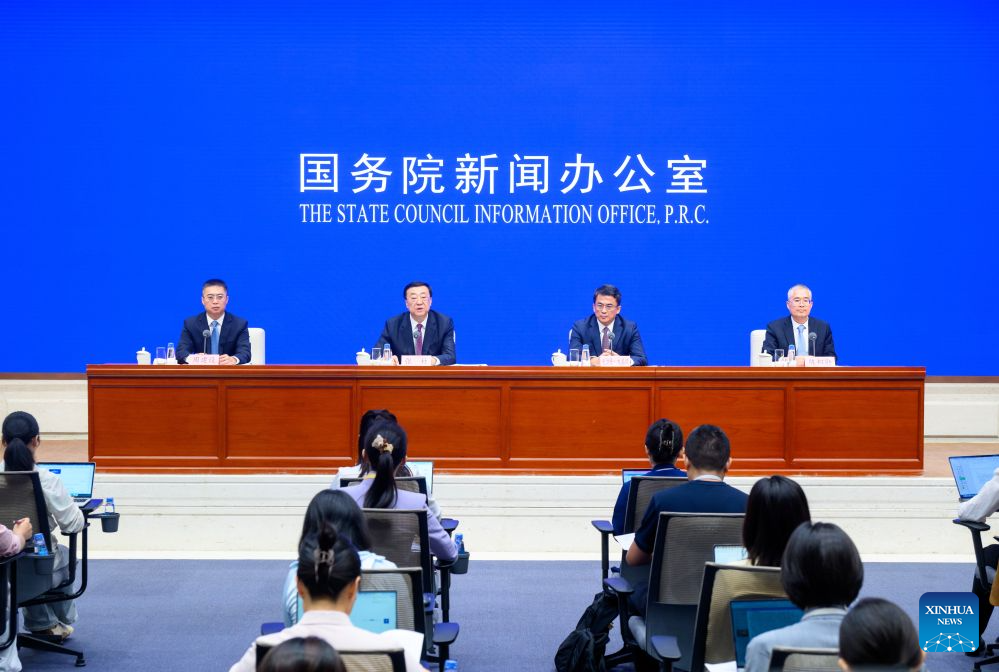
The State Council Information Office (SCIO) holds a press conference on accelerating agricultural and rural modernization to drive all-round rural revitalization during the 15th Five-Year Plan period (2026-2030) in Beijing, capital of China, Sept. 29, 2026. (Xinhua/Jin Liangkuai)
BEIJING, Sept. 29 (Xinhua) -- China is on track for a bumper grain harvest in 2026 amid steady progress in agricultural and rural modernization, the Ministry of Agriculture and Rural Affairs said Tuesday.
This year, summer grain output exceeded 150 million tonnes for the first time, and early rice output remained above 28 million tonnes for the sixth consecutive year, the ministry said at a press conference.
Autumn crops, the mainstay of China's annual grain production, are now being harvested, with the planted area expanded and that of high-yielding crops, particularly corn, increasing notably, according to Zhang Zhu, minister of agriculture and rural affairs.
"Against the backdrop of increased volatility in global grain markets, China has a solid foundation and ample confidence to ensure stable grain production and supply," said Zhang.
SOLID FOUNDATION FOR FOOD SECURITY
Food security has long been an important priority for China, which feeds nearly one-fifth of the world's population with less than 9 percent of the world's arable land. Ensuring a stable food supply is becoming more challenging amid geopolitical uncertainties and increasingly frequent extreme weather events.
Despite the headwinds, China's annual grain output has remained above 700 million tonnes for two consecutive years of 2024 and 2025. Per capita grain availability has surpassed 500 kg, which is higher than the global average.
The country has achieved basic self-sufficiency in grains and ensured a secure supply of staple foods, Zhang said. "We are firmly holding the rice bowl of the Chinese people in our own hands."
Beyond grains, China is also expanding food sources to ensure a diverse and abundant supply of agricultural products.
Last year, China's meat production exceeded 100 million tonnes for the first time, with per capita meat availability reaching about 1.5 times the global average. Per capita egg availability exceeded the level in developed countries.
The country aims to ensure that its population of more than 1.4 billion has enough to eat and access to a healthier, more nutritious diet over the five years between 2026 and 2030, said Chen Bangxun, a spokesperson for the ministry.
Efforts will be made to advance modern facility-based agriculture, develop more food resources from fisheries, forests and grasslands, and use synthetic biology to create new sources of food, Chen added.
TECHNOLOGY DRIVES AGRICULTURAL MODERNIZATION
The role of technology in China's agricultural modernization continues to grow, according to the ministry.
The contribution of science and technology to agricultural development has now exceeded 64 percent, with innovations such as smart agricultural machinery and agricultural robots increasingly being applied in farming, according to Maierdan Mugaiti, vice minister of agriculture and rural affairs.
Such progress is supported by a series of policy measures. The outline of the 15th Five-Year Plan (2026-2030) sets out specific measures to advance agricultural science and technology and modernize agricultural equipment.
The latest move in this regard is a plan for China's agricultural and rural modernization for the same period, which sets a target of raising the contribution of science and technology to agricultural development to 67 percent by 2030. It also calls for wider application of AI in agriculture and breakthroughs in developing new quality productive forces in the sector.
China will foster more agricultural technology companies and support them in taking on more research tasks addressing urgent industry needs, Mugaiti said.
The country will also accelerate the application of new technologies and the commercialization of agricultural research results to serve the industry and benefit farmers, he noted.
CONSOLIDATING POVERTY ALLEVIATION GAINS
Consolidating the gains from poverty alleviation and promoting rural development remain key priorities, with a focus on job creation, local industry development, and increasing farmers' incomes, according to the ministry.
By 2021, China had lifted 98.99 million rural residents living below the then poverty line out of poverty and announced the completion of its fight against absolute poverty. It then established a five-year transition period from 2021 to 2025 to consolidate and expand those gains and prevent people from falling back into poverty.
Over the past five years, development conditions in areas and among people lifted out of poverty have continued to improve, while their capacity for self-development has grown stronger, Zhang said.
With the five-year transition period wrapped up, China has entered a new stage of regular, targeted assistance. China has established a nationwide system covering all provinces and the entire rural population to identify people at risk of falling back into poverty and provide targeted assistance. So far, all 2.56 million people identified as being at risk have received assistance, Zhang said.
This year, the central government has allocated 177 billion yuan (about 26.26 billion U.S. dollars) to support rural industries, employment and development-based assistance in less-developed areas.
This has provided greater support for rural development and helped boost farmers' incomes. The per capita disposable income of rural residents in counties that have been removed from the poverty list rose from 12,588 yuan in 2020 to 18,627 yuan in 2025, achieving average annual growth of 8.2 percent, a State Council report revealed.
China is also developing local specialty industries to boost farmers' incomes, the ministry said. Efforts should be made to strengthen agricultural product processing, foster new industries and business forms and develop new types of rural services, said Mugaiti.
"We will continue to create more opportunities for farmers to benefit from rural industries, strengthen links between farmers and businesses, create more jobs in rural areas and ensure continued growth in farmers' incomes," he said. ■


