BARCELONA, Spain, Sept. 28 (Xinhua) -- Music flowed into squares, dancers and street performers filled public spaces, and fireworks lit up Barcelona's waterfront as the city celebrated La Merce, one of its most important annual festivals, from Sept. 23 to 27.
This year, the familiar festival rhythm carried a distinctive Chinese note. As 2026 marks the 25th anniversary of the sister-city relationship between Shanghai and Barcelona, Shanghai became the first Asian city to serve as La Merce's guest city. More than 100 artists delivered 14 performances spanning acrobatics, dance, jazz, and traditional Chinese music.
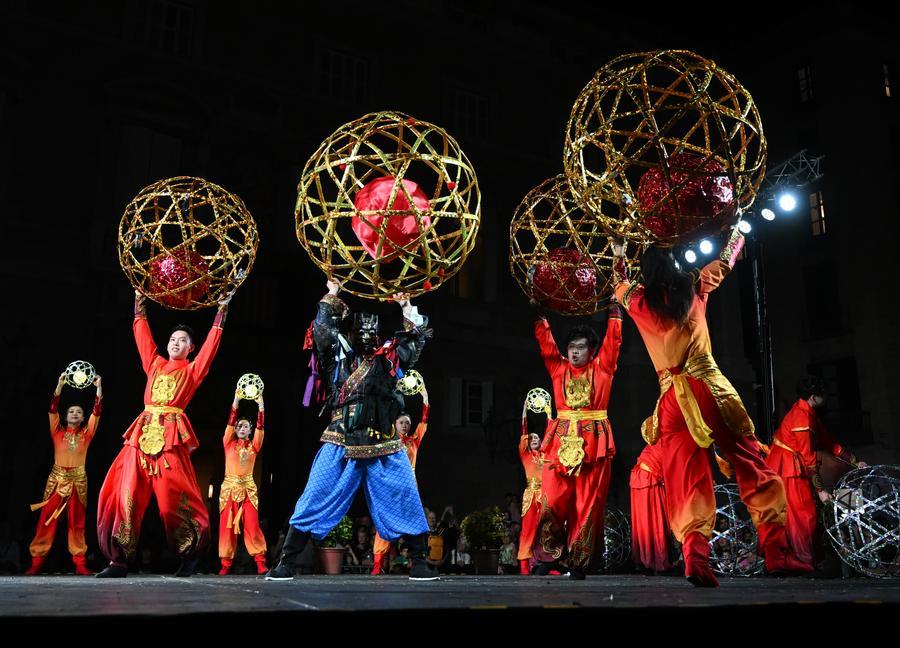
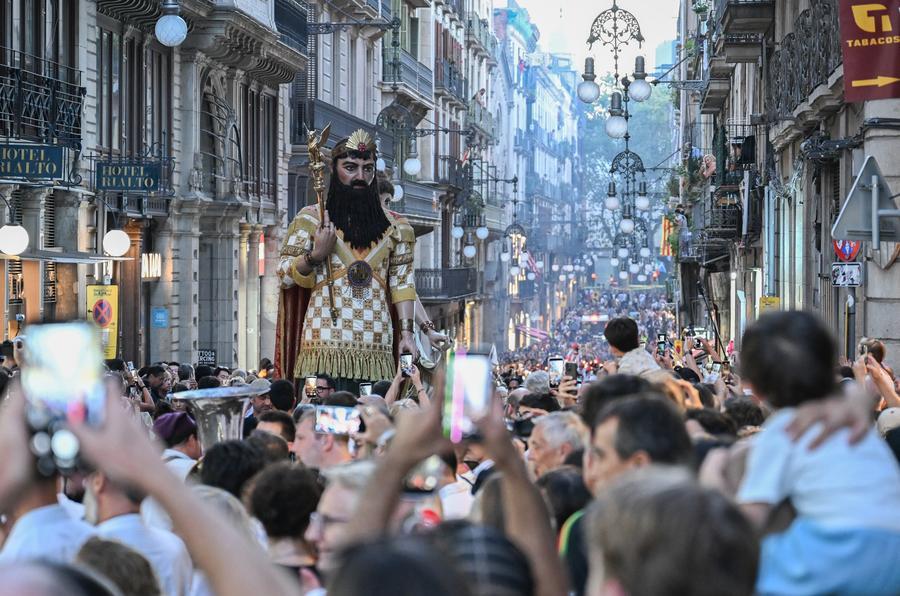
The Fengxian rolling lantern performance was among the opening-night highlights. After traditional Catalan giant figures performed at Sant Jaume Square on Sept. 23, artists from Shanghai's Fengxian District took the stage with large golden lanterns, lifting and rolling them through a series of demanding moves. Near the end, sparks burst from the lanterns, echoing an earlier traditional Catalan dragon that sprayed sparks into the night and drawing cheers from thousands of spectators.
Esteve Carames, director of cultural programs at the Barcelona Institute of Culture, said the Fengxian rolling lanterns were chosen for the opening ceremony because of their distinctive regional character and connection with coastal life.
"Barcelona is also a coastal city," he told Xinhua. "We blended Barcelona's distinctive traditions with those of Shanghai."
Similar cross-cultural touches ran through Shanghai's guest-city program.
Later that evening, at Doctor Pla i Armengol Gardens, the Shanghai Conservatory of Music Jazz Ensemble incorporated the suona, a traditional Chinese wind instrument, into contemporary jazz arrangements. Its bright, piercing sound mingled with trumpet and percussion as audience members danced along.
Two nights later at Barcelona's Cathedral Square, the Shanghai Chinese Orchestra presented the AI-composed concert "Zero/One: Colors of China," featuring Shanghai-style traditional music as well as an adaptation of the Spanish flamenco work "Gitana Hechicera."
"One of the most attractive things about Shanghai is the way tradition is combined with highly innovative projects, and that is very similar to Barcelona's understanding of culture," Carames said.
That cultural dialogue was also visible onstage.
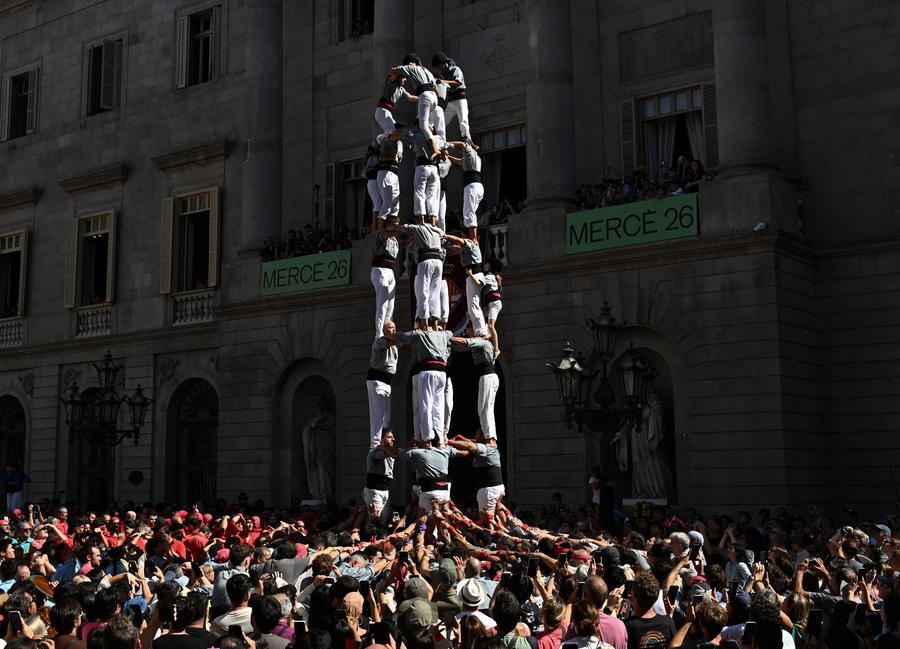
Castells, or human towers, are among Catalonia's best-known folk traditions, with participants climbing onto one another's shoulders to build towers several levels high.
Echoing that tradition, the Fengxian performers added a "stacked rolling lantern" sequence, lifting the lanterns layer by layer.
Beyond the stage, the program invited local residents to take part.
At Estacio del Nord Park, a Chinese games corner organized by the Confucius Institute Foundation of Barcelona drew more than 6,000 participants. Visitors learned Chinese numbers and simple greetings through games and joined handicraft activities.
Wang Jinwei, co-director of the Confucius Institute Foundation of Barcelona, said such activities had no clear boundary between performers and spectators, allowing children and parents to experience Chinese culture through play.
After a performance by the Shanghai Dance School in the same park, one Barcelona resident asked a Xinhua reporter whether there would be another show. "I want to come back during the holiday and bring my family with me," he said.
The Chinese presence also took to the sky.
On Sept. 24, 750 drones rose into the night sky above the Barceloneta waterfront to mark the 25th anniversary of the sister-city relationship. The drones formed images including the Monkey King and the Oriental Pearl Tower alongside familiar Barcelona landmarks such as the Sagrada Familia.
Tens of thousands of residents and tourists gathered along the waterfront, cheering as new images took shape in the sky.
Videos of the drone show later spread across Chinese social media. On Xiaohongshu, a video captioned "Seeing Shanghai's skyline in Barcelona" drew thousands of likes and comments. One Shanghai user wrote: "Wishing my family in Barcelona good health and all the best." The video was posted on the Mid-Autumn Festival, a traditional occasion for family reunions in China.
Barcelona Mayor Jaume Collboni said at the opening ceremony that the 25-year relationship between Barcelona and Shanghai is not only a link between municipal governments, but also a human bond built day by day by Barcelona's Chinese community.
Xavier Marce, Barcelona city councilor for culture and creative industries, said the events had opened a door to further exchanges.
"This is only the beginning," he said. "We are very confident that, taking this event in Barcelona as a starting point, there will be more exchanges and cooperation between Barcelona and Shanghai in the coming years." ■