He cannot hear the applause, and he has never learned to speak. But on the climbing wall, He Mingliang has found a language that needs no sound.
by sportswriters Dong Yixing and Shen Nan
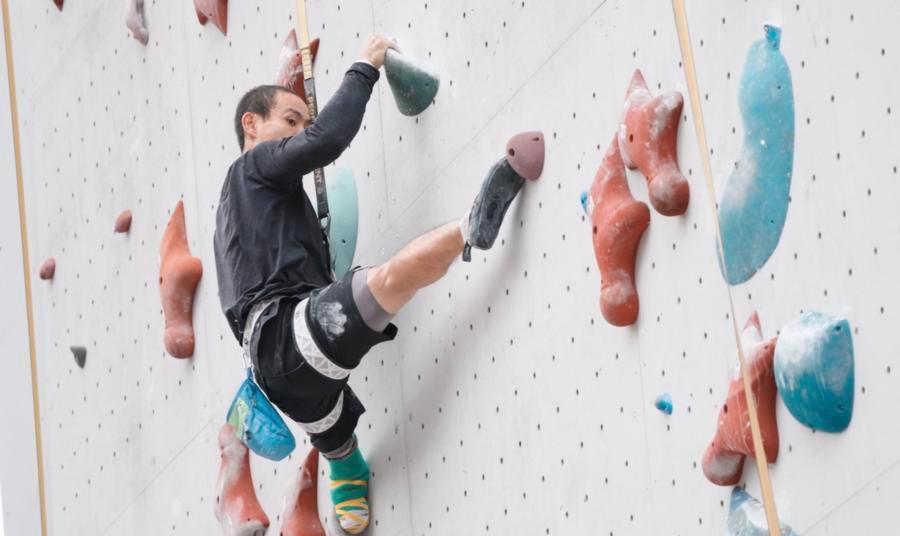
BEIJING, Sept. 27 (Xinhua) -- He Mingliang hangs on the outdoor climbing wall, more than 10 meters above the ground. His right hand grips a small orange hold. His taped left leg, amputated below the knee, presses against the overhanging surface. Above him, a pale blue sky stretches wide.
Mingliang cannot hear. He has never learned to speak. He was six when he lost his leg.
Then his foot slips. He drops half a meter before his arms lock, swinging him back toward the wall. He dangles there, rotating slowly, facing the surface. A low sound rises from his throat, not language, just breath and effort.
Watching from below, Wang Junjian, head coach of Zhejiang's provincial para-climbing team, raises his thumb. On the wall, the two rely largely on gestures.
"Sometimes he glances at me, but I can't precisely convey what I want him to do through sound," Wang said.
For most of Mingliang's life, his older brother was his main link to the people around him.
THE BOY IN THE ROOM
Mingliang was born in 1999 in a rural village in Guizhou Province, southwest China. His mother is deaf and unable to speak. His father, a farmer with little education, struggled to make ends meet. His older brother, He Mingfeng, was born just one year earlier.
When Mingliang was around six, the brothers were playing by the road. Mingfeng was on the other side when he saw a truck approaching and shouted for his brother to stop.
"He couldn't hear me," Mingfeng recalled. "He stepped out. The truck was too fast. It couldn't brake in time. His foot was crushed."
With no money for proper medical care, Mingliang's leg was beyond saving.
For years afterward, he barely left the house.
"He felt different from everyone else," Mingfeng said. "He didn't want to follow us anymore. He locked himself in the room and watched TV all day."
The family had one television. Mingliang watched whatever was on, but basketball captured him.
"He watched Kobe Bryant, watched the NBA," Mingfeng said. "He fell in love with it, and he started training himself. He learned the moves - dribbling, crossover, how to jump, how to drive. All by himself. Watching and figuring it out."
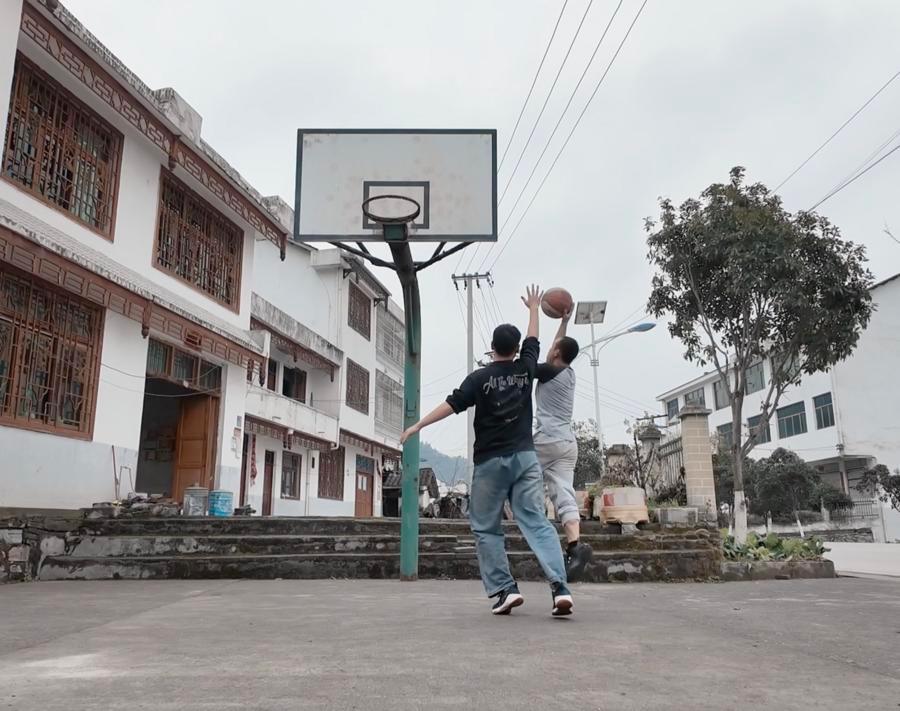
He taught himself to balance and play basketball on one leg, practicing alone on the concrete court outside the family home.
"Other kids wouldn't play with him," Mingfeng said. "They were afraid of hurting him. So he just practiced by himself."
At 12 or 13, Mingliang began pushing back against his isolation.
"He cried and expressed, 'You won't let me do this, won't let me do that - what am I supposed to do?'" Mingfeng recalled. "After that, we stopped interfering."
THE BROTHER WHO STAYED
Mingfeng left home at 13 and a half to work. He met his wife Deng Bing in Shanghai in 2015, and they later settled in Shaoxing, Zhejiang Province, where they had a daughter.
In 2023, Mingfeng brought his younger brother to Shaoxing. Their parents were getting older, and Mingliang had begged to come.
"He wanted to help me, to work," Mingfeng said. But communicating with potential employers proved difficult, and Mingliang was unable to find work.
Instead, he helped take care of his niece, picking her up from school and cooking for her when his brother and sister-in-law were at work.
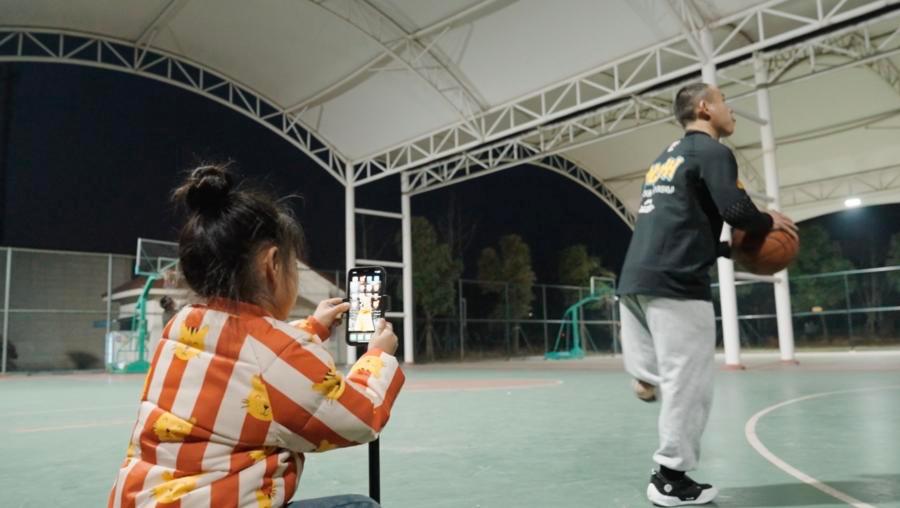
"He's very good to her," Deng said. "He cooks noodles for her in the morning. He buys her snacks."
In one video on Mingliang's social media, he plays basketball on an outdoor court in the rain. He drives to the basket, slips and lands flat on his back. The camera shakes as his niece, who is filming, laughs.
Mingliang lies there for a second. Then he starts laughing too.
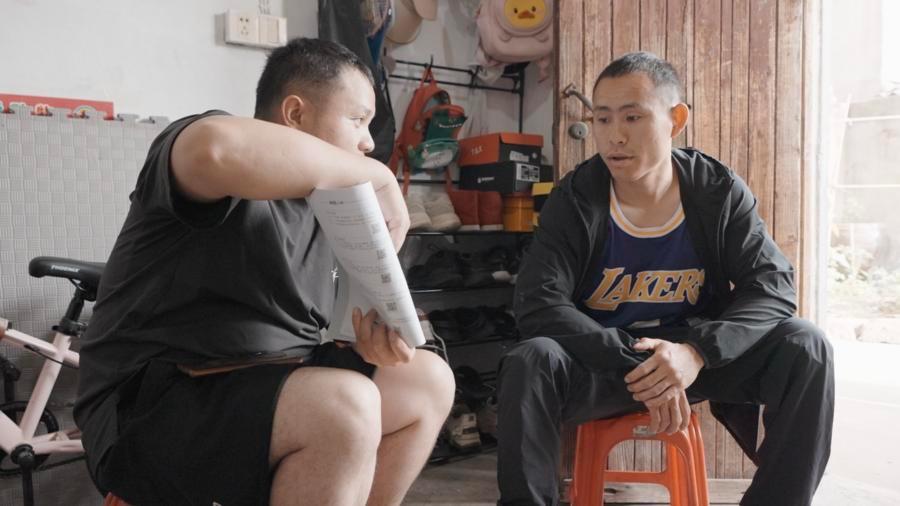
The two brothers developed a private language over years of living together. Mingliang never learned formal sign language, so they rely on their own system of gestures and expressions.
"We communicate with our eyes, pointing, describing things," Mingfeng said. "Mostly it comes from life. We've been together so long, there's a kind of tacit understanding."
When Mingliang wants to communicate, his face transforms. His eyes widen, his mouth shapes exaggerated syllables and his hands move rapidly through the air.
But the brothers' language has limits. Mingliang knows only a few dozen Chinese characters. His brother has tried to teach him more, without much success.
"I dream about it," Mingfeng said. "I can't sleep. It's like an unsolvable problem. But there's no other way. We just take it one step at a time."
THE VIRAL MOMENT
In Shaoxing, basketball remained Mingliang's main pursuit. He would ride his electric bike to outdoor courts and practice alone for hours.
In September 2024, he started posting videos of himself playing on Douyin, China's version of TikTok. They attracted little attention until November, when former Chinese Basketball Association player Han Delong saw one.
"I was scrolling at night, and suddenly I saw this one-legged kid hopping to shoot," Han said. "I was shocked. I thought, is that even possible? I checked the location and drove there the next day."
Han, who had left professional basketball in 2022 and was producing a social media series called "Challenge 100 Strangers to Play Basketball," filmed an 11-minute one-on-one game with Mingliang.
The video received more than 50 million views in 10 days and drew 41,000 comments.
Han tried playing on one leg.
"After one minute, my leg and hip were sore. After 40 minutes, I asked for a break," he said. "But he kept dribbling and shooting, no sign of fatigue. He gestured for me to feel his thigh muscle. It was like stone."
The attention led to a one-day contract. CBA club Zhejiang Lions signed Mingliang on December 2, 2024, giving him a custom No. 98 jersey and a place in the locker room alongside national team players including Hu Jinqiu and Sun Minghui.
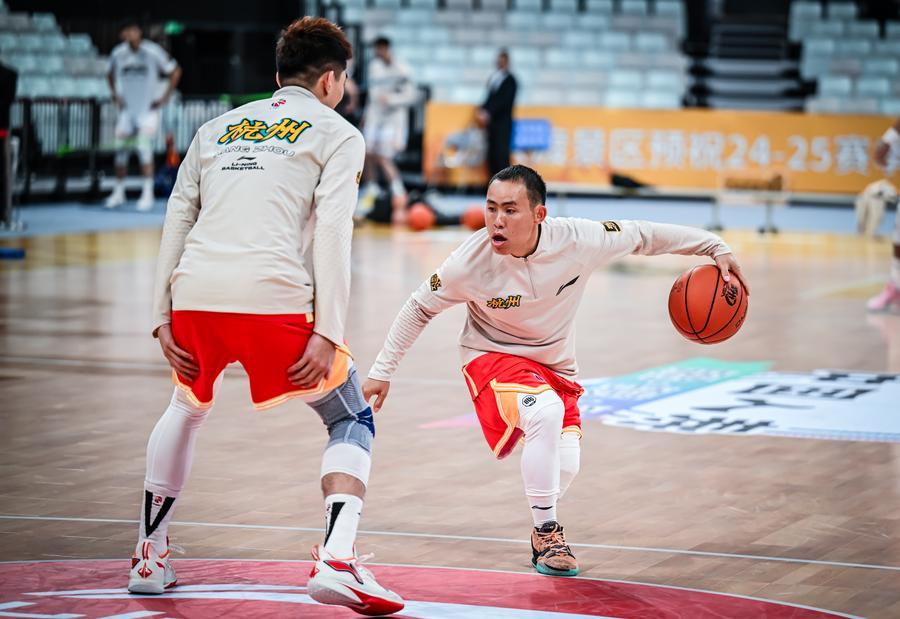
Before the game, Zhejiang player Joshua Carlton lifted Mingliang toward the basket so he could dunk for the first time.
"He was not nervous at all," Mingfeng said. "Standing there, my hands were sweating, I was so nervous. But he looked like he had done it a thousand times."
THE WHEELCHAIR THAT DIDN'T WORK
The club's donation paid for a custom prosthetic and helped open another door: a wheelchair basketball tryout in Hangzhou in March 2025.
"We thought he'd get selected," Mingfeng said.
But wheelchair basketball presented a problem. Players relied heavily on verbal communication.
"He can't hear the coach, can't hear his teammates," Mingfeng said. "They call out to each other on the court. He can't respond. He can't even hear his name."
When Mingfeng visited, he found his brother's palms covered in blisters from pushing the wheelchair.
"They were bleeding," he said. "I asked if he wanted to rest. He refused. He wanted to do everything the others did."
At the end of the tryout, the coach pulled Mingfeng aside and suggested that Mingliang try an individual sport instead.
"He looked so helpless," Mingfeng said. "He wanted to try, but he couldn't."
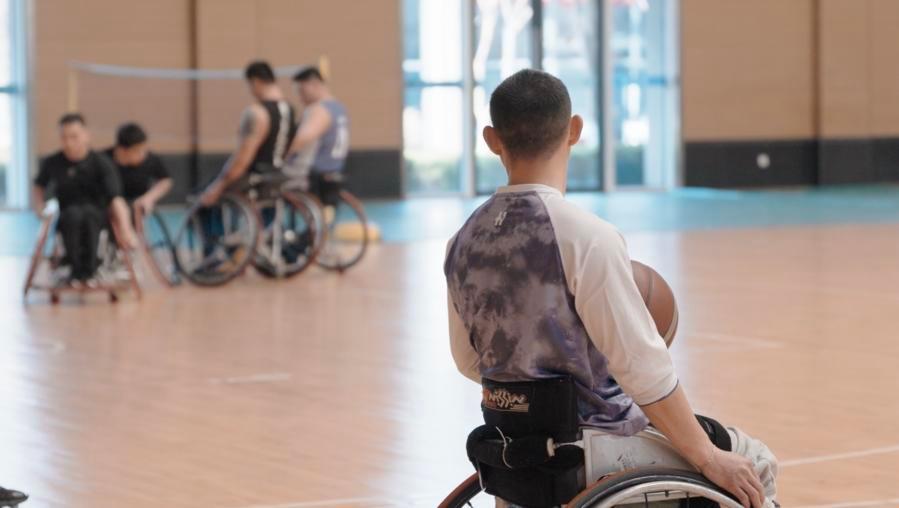
As they were leaving Hangzhou, another opportunity emerged. The provincial disabled persons' federation had received word about a new sport: para climbing. Mingliang's upper-body strength and physical conditioning made him a candidate.
"I asked him if he wanted to try," Mingfeng said. "He said yes. So I agreed."
THE WALL
In April 2025, Mingliang attended a national para-climbing training camp in Beijing. It was his first extended period away from his family.
"I was worried he wouldn't adapt, that he couldn't communicate with the team," Mingfeng said. "But my worries were unnecessary. He got along with everyone."
With climbing newly added to the Paralympic program for Los Angeles 2028, China was beginning to develop its para-climbing program. The camp, run with international experts, was part of an effort to build a national team.
Wang met Mingliang at the provincial disabled persons' federation before the camp.
"We couldn't communicate, but his spirit was good," Wang said.
Videos of Mingliang playing basketball and climbing on a playground structure showed his strength and coordination.
"His athletic foundation was good, his upper-body strength was good," Wang said. "I thought he had potential."
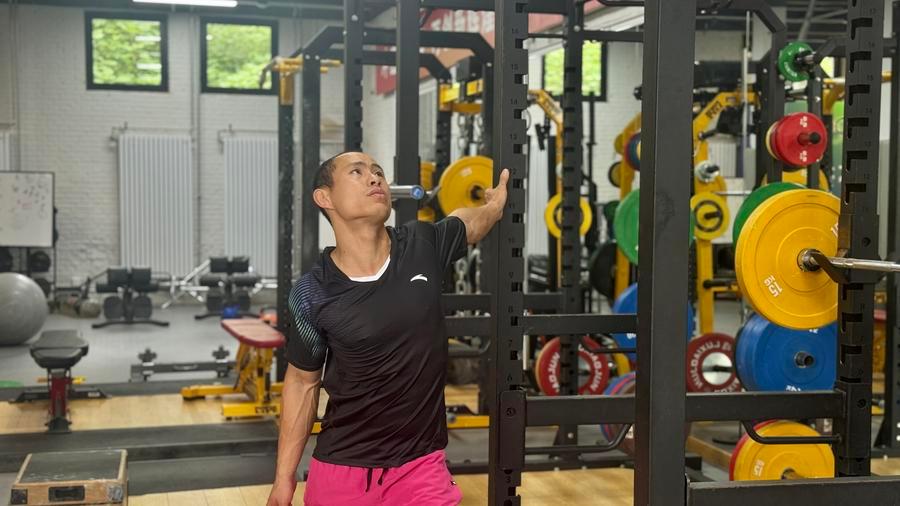
Mingliang is just over 1.6 meters tall, with a neat buzz cut and heavily muscled shoulders and arms after years of relying on them to compensate for his missing lower leg. His right leg, which has carried his full weight for two decades, is thick and powerful.
But conventional coaching methods were of limited use.
"He has one leg, and he has a hearing impairment," Wang said. "In this category, he's an individual case."
The coaches adapted.
Assistant coach Wu Zhenchen demonstrated movements repeatedly, sometimes using his own knee to simulate how Mingliang could use his residual limb against the wall.
"With other athletes, I can just say, 'Put your foot here, rotate your hip,'" Wu said. "With him, I have to do it once, twice, three times. I have to find a similar situation on the ground and simulate it."
Wu learned a few signs online, and the pair developed their own shorthand: a tap on the shoulder for "rest," pointing at the clock for "time," and another gesture for "warm up."
"It's self-created," Wu said. "We've agreed on it without saying anything."
What impressed the coaches was how quickly Mingliang absorbed what he could see.
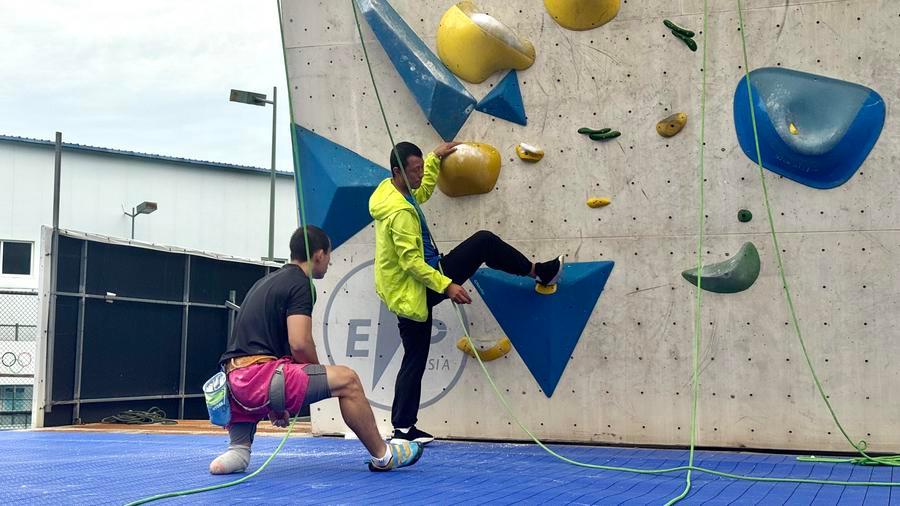
International route setter Cai Luyuan recalled explaining whether to step inside or outside a triangular position.
"He came up and pointed, showing he understood," Cai said. "I think he was the only one who remembered."
Wang noticed the same thing.
"I can see he's thinking," Wang said. "There are movements he's never done, but he thinks about them, and then he can do them. He gets very excited."
THE FIRST TITLE
In September 2025, Mingliang competed in the first National Para-Climbing Championships in Jilin Province. Although he had first tried the sport several months earlier, he had been training full-time for less than a month.
"He was a bit tight today," Wang said after the preliminary round. "He made a mistake with his hand sequence. But his rhythm was good, he knew when to rest. That shows his mental resilience."
The final route posed new problems.
"There was a reverse hold he didn't see," Wang said. "A blue hold he didn't use. If he had, it would have been easier."
On the wall, Mingliang moved without hesitation. His right arm locked as his body swung toward the next hold. He never looked down at the crowd.
He finished first in his category.
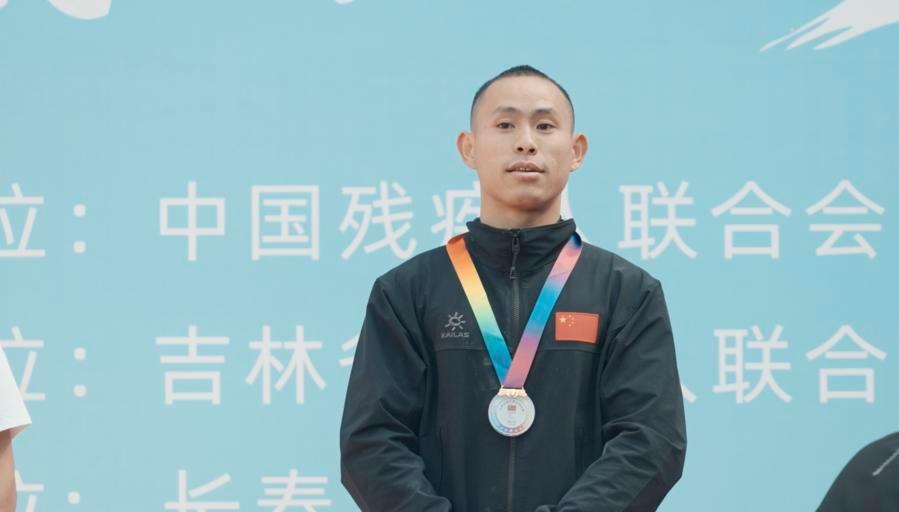
"When he won, he didn't call me," Mingfeng said. "His coach sent me a photo of him standing on the podium. I was so happy."
Mingfeng called their father in Guizhou.
"I said, 'Dad, my brother won first place in Jilin.' He said, 'Good, that's great.'"
Mingliang video-called his brother later.
"He was so excited, he was crying," Mingfeng said. "He felt this medal was different. He knew how hard he worked for it. How much pain he endured."
Soon afterward, Mingliang traveled to South Korea for the World Para Climbing Championships, China's first international competition in the sport.
"He came back so confident," Deng said. "He'd never been that far from home."
He brought gifts: Korean cigarettes for his father, snacks for his niece and face masks for his sister-in-law.
Nothing for his brother.
"His brother was so angry," Deng laughed. "But that's how he is. He thinks about us when he's away, but he doesn't call or text. He only reports good news."
The World Championships also showed how far Mingliang still had to go. He finished 19th out of 21 climbers in his category.
THE WAIT
Mingliang returned to Shaoxing afterward and kept training.
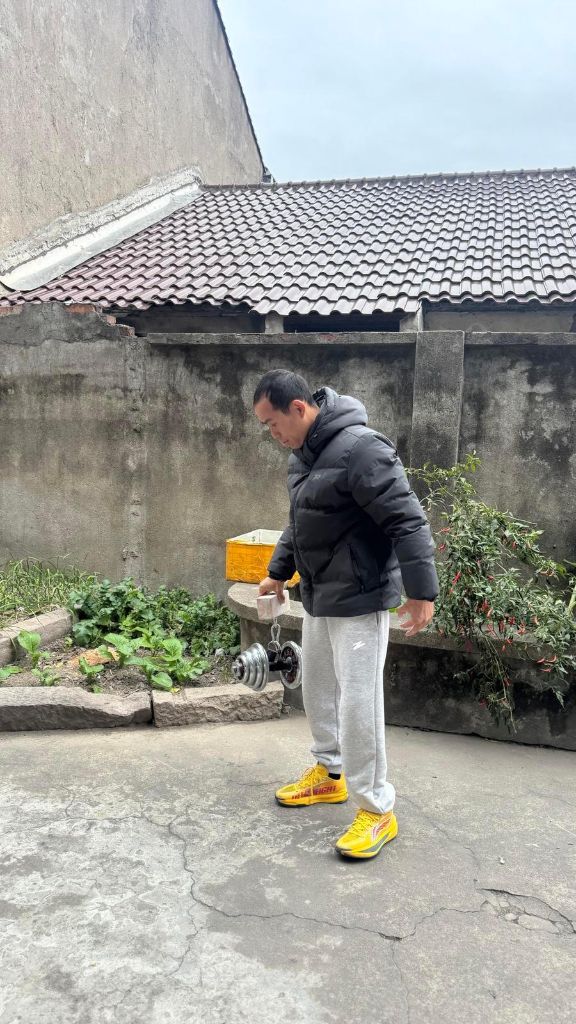
Every day brings morning walks and upper-body work, basketball in the afternoon and evening leg exercises on a second-hand stationary bike his brother bought for 200 yuan (about 30 U.S. dollars).
His hands are covered in calluses, some split open. He wraps them in tape and continues.
"He's more confident now, more open," Mingfeng said. "It's like he has a goal."
The brothers still argue, in their own way.
"We fight with sign language. No sound. He gets so angry he punches the wall," Mingfeng said.
"One time I said something harsh. I told him, 'You're deaf and mute and disabled, no one will want you.' He ignored me for a week. I was scared. I thought, what if something happens? I'm the only one who takes care of him."
He paused.
"I can't leave him. I'm his brother."
At their Shaoxing home, three photos appeared on a phone screen: basketball, climbing and fishing.
Mingliang looked at them and pointed at climbing.
He didn't hesitate. ■