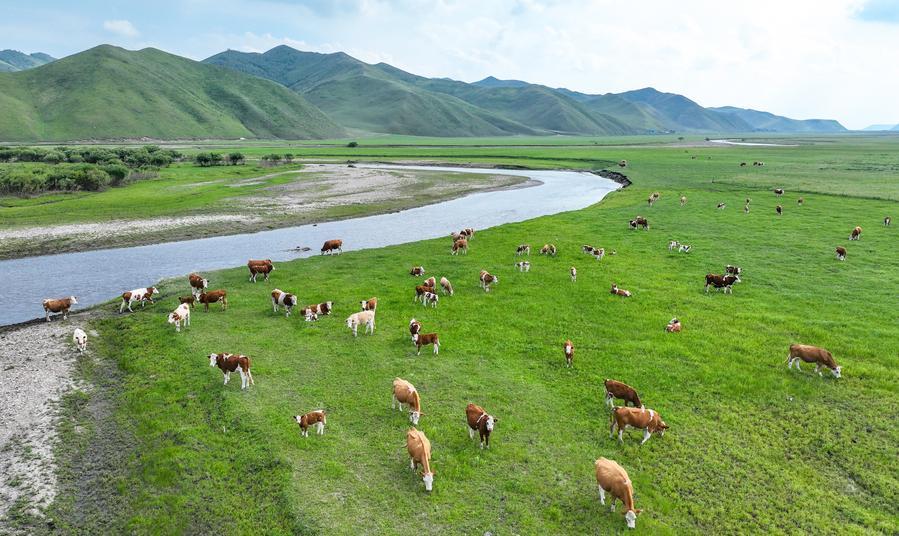
HOHHOT, Sept. 26 (Xinhua) -- Across the grasslands of northern China, mornings still begin much as they have for generations: herders check their cattle, feed them and watch for any sign that something may be wrong.
For Zhang Weijian, an ethnic Mongolian herder in Inner Mongolia Autonomous Region, however, part of that daily routine now involves managing her cattle through an online mini-program on her smartphone.
Each of her more than 30 cattle wears an electronic ear tag that can not only monitor its activity but also measure its body temperature. When the temperature rises above 40 degrees Celsius, she can spot the unusual reading on her phone and know it may be time to take a closer look.
GOING SMART
Zhang, born and raised in Horqin Left Middle Banner in the city of Tongliao, has been using the digital platform for more than two years.
"Before, we kept everything on paper. Now I just enter the ear-tag number of one head of cattle on my phone, and its records come up," Zhang said, adding that the records cover breeding and calving history as well as vaccination details.
Zhang is among the cattle farmers served by a national modern agricultural industrial park in the banner, one of four such parks in China centered on the beef cattle industry.
Established in 2019, the park has so far collected traceability information on over 90,000 head of cattle, accounting for more than 90 percent of total cattle in the park. It aims to track beef cattle throughout the entire production chain, while making agricultural and livestock production more standardized and digitalized.
Like Zhang's family, many villagers in the area have long relied on cattle raising for their livelihoods. "Better herd management helps us raise better-quality cattle, reducing losses and increasing our income," Zhang said.
Notably, technology is also changing how herders grow and manage the grass that feeds their cattle.
At a village in Horqin Right Front Banner, Hinggan League, herder Sainbayar uses quadcopter drones to fertilize his grassland. From June to July, he flies them along preset routes, with three drones taking turns to cover the pasture.
"The grass grows better when it gets enough fertilizer," Sainbayar said. The rising pasture yield in recent years has ensured a steady supply of feed for his cattle, while mixers, silage machines and feed conveyors have reduced the manual labor needed to raise them.
Inner Mongolia is a major agricultural and livestock production base in China, ranking among the country's top producers of milk, beef, mutton, forage and cashmere.
In April 2025, this autonomous region issued an implementation plan for smart agriculture and animal husbandry, setting targets for the development of big-data services, smart farms and digitalization across the agricultural and animal-husbandry industry chain through 2027.
The shift toward modern pastoral production is also supported by improvements in infrastructure. Some remote areas deep in the grasslands are located at the end of the power grid, where electricity supplied from afar can fluctuate in voltage, while power outages are not uncommon during snowstorms and strong winds.
Recently, a wind-solar-storage microgrid began operating in a village in Chen Barag Banner in the city of Hulun Buir, providing more reliable electricity to 122 herder households. The system uses wind and solar power, along with batteries, to generate and store electricity locally.
"Electricity has become much more reliable for us," said Liu Xuebin, a herder in the village. With a stable power supply, his family can now run livestock equipment throughout the day to care for more than 200 cattle and sheep.
GREEN PROMISE
Across the Horqin sandy land in the autonomous region, stretches of once-bare sand are giving way to trees, grasses and new forms of land use.
Located on the northern edge of the sandy land, Horqin Right Middle Banner in Hinggan League is an important area in China's efforts to combat desertification. Its endeavors form part of the three major battlefronts of China's Three-North Shelterbelt Forest Program, a decades-long initiative to curb desertification across northern China.
Years of work have continued to improve the local ecological environment. From 2021 to 2025, China treated a total of 152 million mu (about 10.13 million hectares) of desertified land, according to the National Forestry and Grassland Administration.
But restoring the land is not simply about planting trees. Increasingly, local efforts are combining ecological restoration with technologies and industries suited to the local environment.
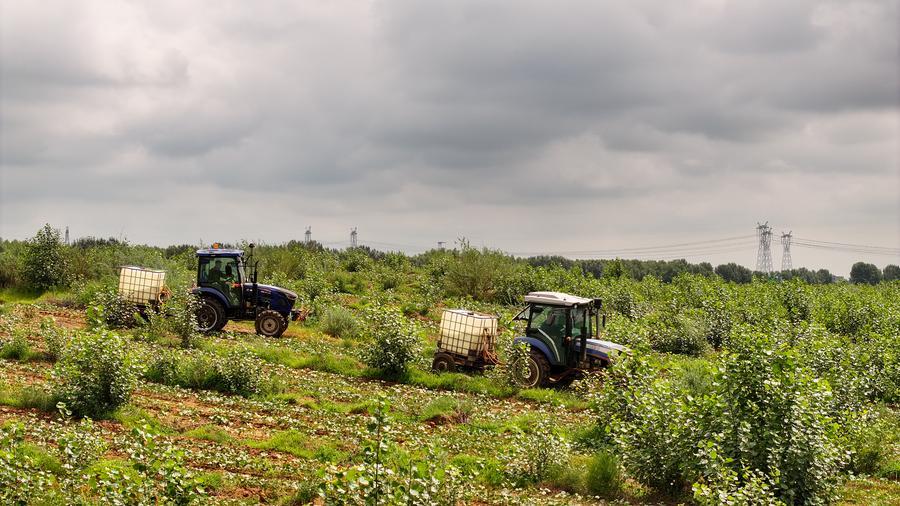
At a yellowhorn planting base covering 4,600 mu in a village of the banner, local authorities have partnered with a forestry company to combat desertification via measures including fencing, land leveling, well drilling, drip irrigation and replanting. So far, 308,200 yellowhorn trees have been planted at the base.
"It used to be nothing but sandy land here. When the wind blew, sand would fill the air," said Tong Anran, a forestry technician.
Yellowhorn, a unique oilseed tree found in China, serves a variety of purposes. "Its seeds can be pressed for oil, its leaves can be made into tea, and its branches can be used for medicinal purposes," said Wang Liwei, the first Party secretary stationed in the village by the Inner Mongolia Academy of Agricultural and Animal Husbandry Sciences.
Wang said his research team is exploring processed yellowhorn products to extend the industrial chain and increase the value of the crop.
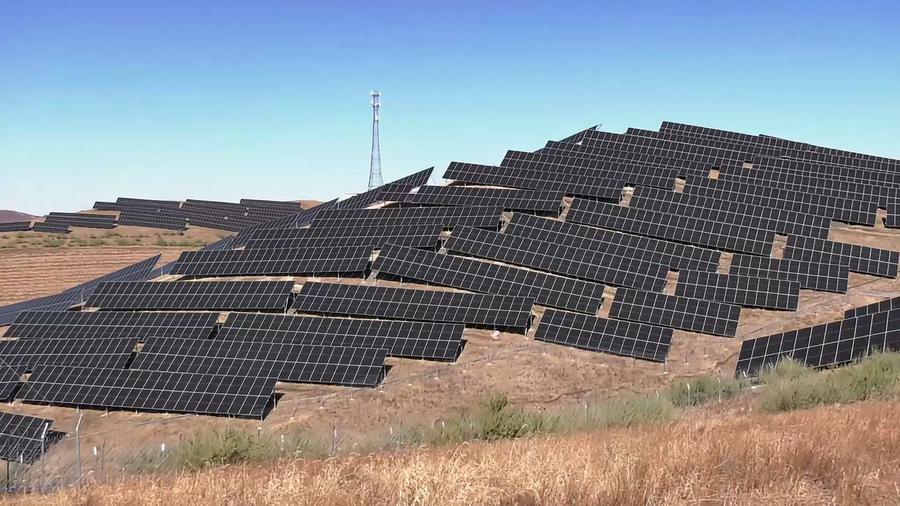
Renewable energy is also being integrated into desertification control. At a photovoltaic desertification-control site in Horqin Right Middle Banner, deep-blue solar panels glint in the sunlight, while plants such as alfalfa sway in the breeze beneath them.
Dai Yuliang, an official with the banner's development and reform commission, said the project adopts an ecological restoration model that combines solar power generation with grassland and livestock farming. With an installed capacity of 300 megawatts, the project is expected to generate around 530 million kilowatt-hours of electricity annually, equivalent to saving 159,000 tonnes of standard coal.
The project has also encouraged nearby residents to participate through local employment, land leasing and seasonal grass harvesting, creating a model in which solar panels generate electricity, grass grows underneath and desertification control generates income.
"Three years ago, this was bare sandy land. Look how well the grass is growing now," said villager Li Jincai, who has also taken part in desertification-control work and earns 200 yuan (approximately 29.63 U.S. dollars) a day.
More broadly, in areas covered by the Three-North program, the forestry and grassland industries generated 800 billion yuan in output in 2025. More than 1.5 million farmers and herders have participated in such programs, receiving a total of 10.24 billion yuan for their work. ■