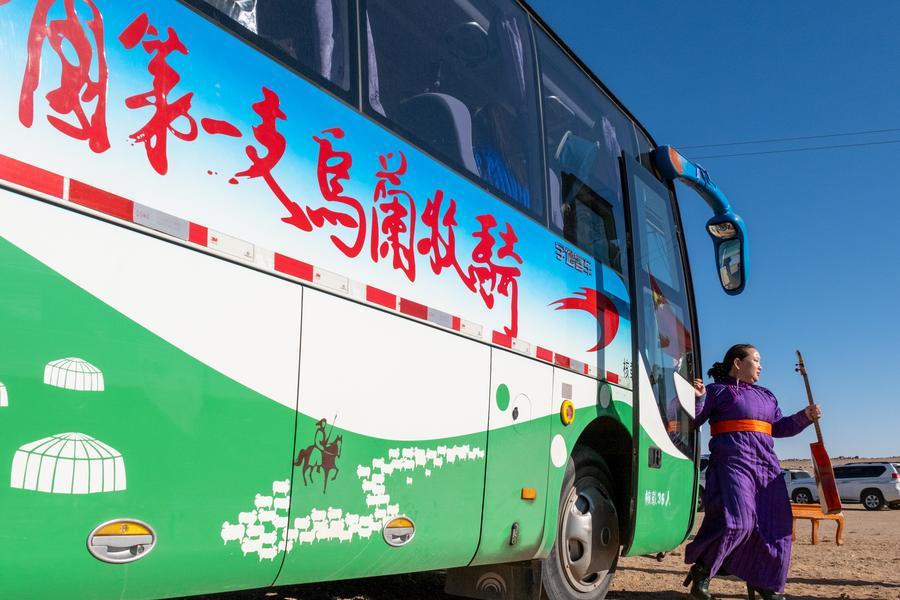
HOHHOT, Sept. 25 (Xinhua) -- As a bus pulled into an open patch of grassland in north China, the space in front of it turned into a stage within minutes.
There is no curtain, no backstage and no elaborate set. Under the vast sky, performers from the Ulan Muqir troupe of Sonid Right Banner in Inner Mongolia Autonomous Region prepared for another show for local herders.
Soon, villagers gathered around the makeshift stage. The air came alive with the music of the horsehead fiddle and the lively movements of the dancers.
Cao Xia, who joined the troupe in 1991 as a dancer, was hosting the performance, introducing the programs for the audience.
Offstage, she also spent recent years helping tell the troupe's story as a guide at the Ulan Muqir exhibition hall in Sonid Right Banner, where the first Ulan Muqir troupe was formed in 1957.
Ulan Muqir (Red Bud Troupe) is the Mongolian name for a traveling troupe that travels from one grazing site to another, performing for the herders who live in some of China's most remote areas.
The first troupe had only nine members and five musical instruments. Its members traveled by horse-drawn cart and camel to reach herders living far apart on the grasslands, bringing performances to their doorsteps.
For Cao, telling the story of Ulan Muqir means more than showing visitors its history through exhibits.
She often showed visitors hand-drawn dance sketches left by earlier performers, and recalled how earlier generations faced shortages of food and water and sometimes had nowhere to stay during trips to remote pastoral areas.
"They never gave up on bringing performances to the herders," Cao said.
From carts and camels to tractors, trucks and buses, the vehicles have changed over the decades. With more than 3,000 members, Inner Mongolia's 75 Ulan Muqir troupes stage over 8,000 performances a year.
Their work has also gone beyond the stage, with members sharing information on fire safety, disease prevention and livestock production, while sometimes helping with everyday tasks such as cutting hay and cleaning sheep pens.
For Meng Ke, who joined the troupe more than 20 years ago, years of traveling have given him a close-up view of how life on the grasslands has changed, from improved access to drinking water and electricity to better schools and medical services.
He jotted down these changes in a notebook he carried with him. Its edges have become worn, while the stories inside have continued to pile up. Some of these observations later found their way into his songs, including "Ode to the New Pastoral Areas."
And some of the stories born on the grasslands have found their way onto bigger stages.
Wuyunga, a Gen Z performer with the troupe, has performed in cities such as Beijing and Shanghai in recent years while taking part in various cultural exchange activities.
This year, she joined more than 90 Ulan Muqir performers from across Inner Mongolia on the stage of the country's Spring Festival Gala. Their performance was adapted from a classic Mongolian long song from Inner Mongolia, bringing a piece of grassland culture to one of China's most-watched stages.
"The audience response was beyond our expectations. We didn't expect it to be so well received," Wuyunga said.
The performance also resonated with viewers online. Some described it as a song that "people across China can relate to," while others said they were moved by the song's heartfelt love for the grasslands and their homeland.
"Ulan Muqir is an excellent example of public cultural services," said Wei Pengju, dean of the cultural economy research institute at the Central University of Finance and Economics, adding that although Ulan Muqir troupes have limited resources, the public cultural services they provide have been warmly welcomed by herders and praised by various sectors.
Over the years, Cao has traveled deep into the pastoral areas of Sonid Right Banner, visiting communities across the land.
"They see us as their own children," she said. "It feels like we are family."
Today, the troupe of Sonid Right Banner brings together about 40 members from different ethnic groups, including Mongolian, Han, Manchu and Hui, according to Cao.
As the Ulan Muqir exhibition hall is welcoming more visitors from outside Sonid Right Banner, it now has a team of full-time guides and schoolchildren who serve as "little guides" during activities, Cao said.
When the bus leaves the grassland after another performance, the stage disappears as quickly as it came, and the stories remain. ■