BEIJING, Sept. 25 (Xinhua) -- As the Mid-Autumn Festival approaches, mooncakes, China's time-honored festival delicacy, are taking on smaller portions, lighter recipes and simpler packaging, while increasingly finding their way into everyday consumption.
For generations of Chinese consumers, traditional mooncakes with fillings such as lotus seed paste, egg yolks and mixed nuts have been a festive staple. But as living standards rise and health awareness grows, consumers are increasingly seeking lighter, more balanced options rather than indulgence alone.
Such a shift is visible at a pastry shop in Taiyuan, capital of north China's Shanxi Province, where customers are browsing shelves stocked with low-sugar and multigrain-based mooncakes.
"I want to buy some mooncakes for the Mid-Autumn Festival, but traditional ones are often quite large and contain a lot of sugar and oil," said a customer surnamed Jia. "These new, smaller low-sugar mooncakes are just what I need."
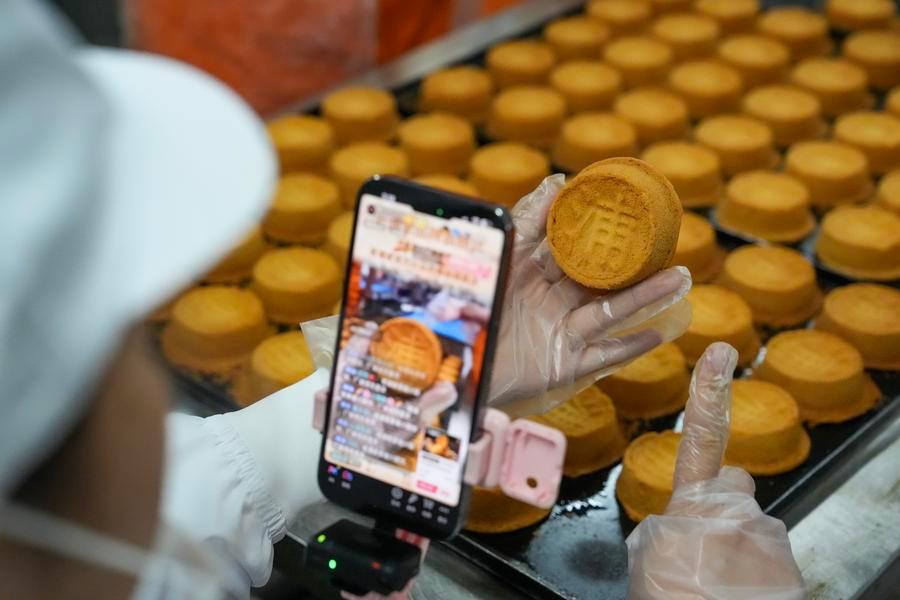
Tan Zhenjun, who runs a mooncake factory in Shenchi County, a major mooncake-producing area in Shanxi, said Jia's choice reflects a trend that has gained momentum in recent years, prompting producers to offer more mini-sized products.
Traditional mooncakes were often larger and richer, serving not only as festive treats but also as a source of extra nourishment when food was less abundant, Tan said.
As living standards improved, mooncakes gradually shifted from a filling food to a more leisurely treat, paving the way for today's lighter, lower-calorie varieties.
Tan said the mooncakes produced by his bakery have "shrunk" from 120 grams each to 100 grams and now to 50 to 80 grams.
Sales of eight-piece boxes are also gradually overtaking those of 20-piece boxes, he said. Consumers are increasingly choosing box sizes based on family size and actual needs, rather than buying large quantities for holiday display.
Healthier recipes are following the same trajectory. At a major pastry brand's flagship store on an e-commerce platform, a low-sugar mooncake has sold more than 300,000 units, while customer service staff said sales of low-sugar varieties have quickly caught up with those of traditional ones.
"People are paying more attention to health nowadays," one consumer wrote in a review, saying the low-sugar version satisfied her cravings with fewer calories.
The trend toward healthier choices is perhaps more evident in handmade mooncakes developed by a public hospital in Zhengzhou City, central China's Henan Province, which feature fillings inspired by traditional Chinese medicine.
Developed by the hospital's clinical nutrition department, the mooncakes use Chinese yam, dried tangerine peel, powdered sesame and other traditional Chinese medicinal ingredients, drawing on the traditional concept of food as medicine. The products have become popular at the hospital restaurant, attracting consumers interested in healthier alternatives.
Low-sugar products are expected to remain a major direction for innovation in China's mooncake industry, with natural sugar substitutes, low-glycemic-index ingredients, plant-based recipes and probiotics gaining attention, according to a 2026 report by iiMedia Research.
The shift is not limited to recipes and flavors. It is also changing how mooncakes are packaged and consumed.
For years, elaborate mooncake gift boxes were closely associated with Mid-Autumn Festival gift-giving. Today, simpler paper wrapping and compact packaging are gaining traction as consumers place greater emphasis on the products themselves rather than dazzling presentation.
For younger consumers, mooncakes are no longer just a festival specialty shared by families. They can also serve as workplace snacks, afternoon treats or pop-up indulgences for their appetite and mind.
On Chinese social media platform Rednote, Gen-Z content creators posted videos of molding pies, ice cream and even cheeseburgers into mooncake forms, garnering thousands of likes and joyful comments.
"So it's the pastry pattern that matters, right?" asked a viewer in the comments.
"I don't know, but that's a perfect beef-and-cheese-flavored mooncake for me," another viewer replied.
As mooncakes take smaller, simpler and more diverse forms, the boundary between mooncakes and other pastries and snack foods is becoming less distinct.
For traditional mooncake makers, the changes mean that innovation is no longer simply about new flavors or eye-catching gift wrappings. Increasingly, it is about finding the right balance among ingredients, recipes, portion sizes, packaging and consumption scenarios.
The shift also reflects a broader effort in China to upgrade consumption and better meet people's growing needs for a better life. The country's plan to expand consumption during the 15th five-year plan period, released in July, calls for initiatives to boost consumption, upgrade goods consumption and enrich consumption scenarios, including measures to promote health-oriented consumption.
Against this backdrop, the changing mooncake market offers a glimpse into how rising living standards are reshaping Chinese consumption habits: from quantity to quality, from elaborate packaging to the product itself, and from one-off festive purchases to more casual and personalized treats. ■