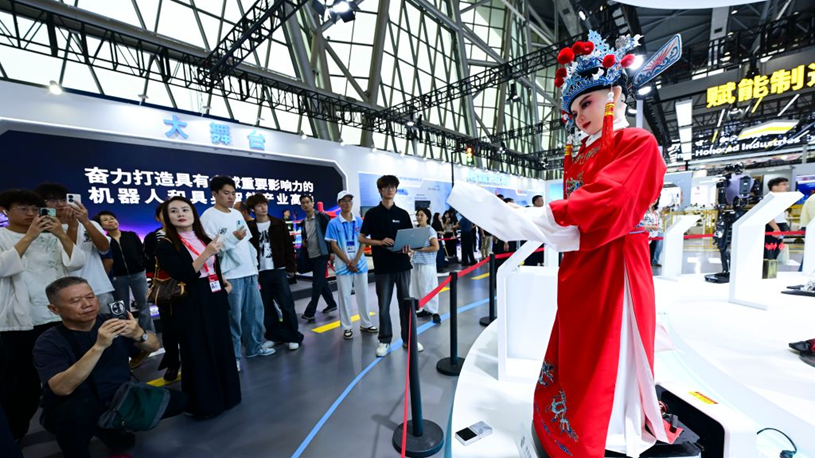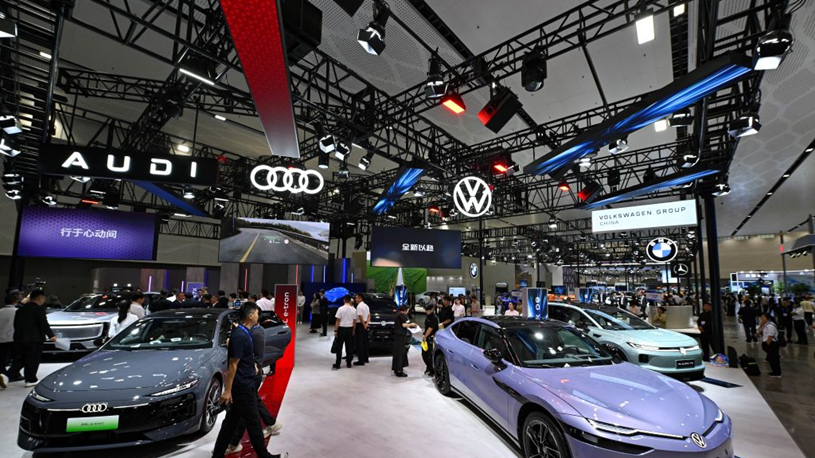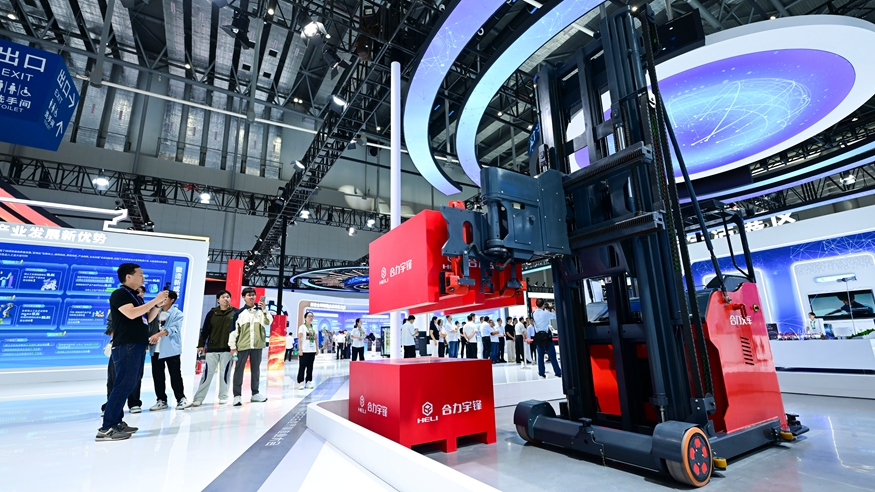
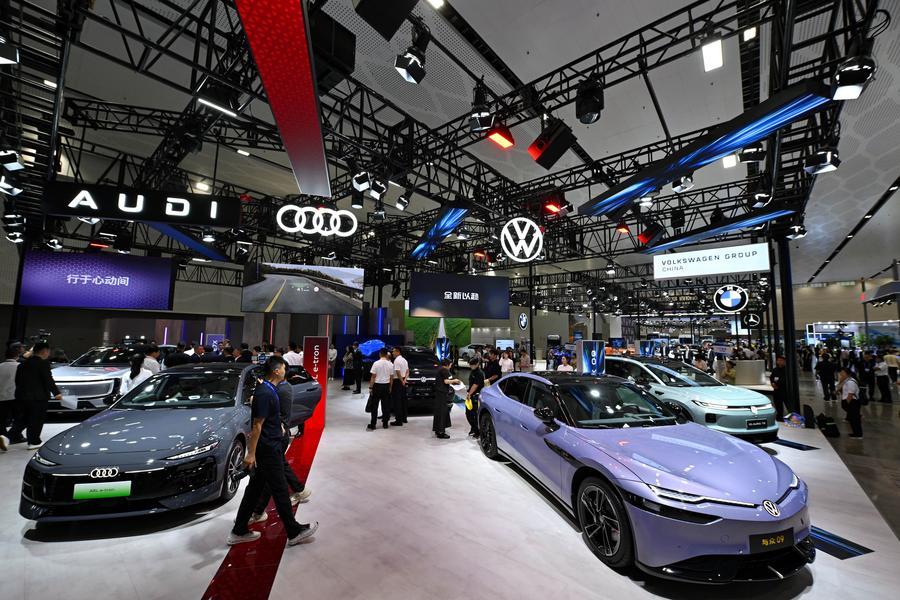
HAIKOU, Sept. 24 (Xinhua) -- The new energy vehicle (NEV) industry is on a fast track in south China's Hainan, as the tropical island province leverages advantages to advance intelligent connected vehicles.
As China's first province to set the goal of banning the sale of combustion-engine cars by 2030, Hainan has remained at the forefront of the country's NEV promotion.
In the first eight months of this year, Hainan's NEV penetration rate reached 66.1 percent, ranking first in China, while NEVs accounted for 25.7 percent of the province's vehicle ownership, ranking second nationwide, Hainan's governor Liu Xiaoming said at the 2026 World New Energy Vehicle Congress, held in the provincial capital Haikou from Sept. 22 to 24.
Leveraging free trade port policies, Hainan is accelerating the development of its auto industry by extending preferential policies to the sector. So far, several special-purpose vehicle projects have been launched in Hainan, and modified special-purpose vehicles have been exported in batches.
Behind the robust NEV development in Hainan is a wider trend. Data showed that during the 14th Five-Year Plan period (2021-2025), China's NEV industry grew rapidly, with sales reaching 16.49 million units in 2025. The average annual growth rate reached 65 percent from 2020 to 2025.
In September this year, China issued a development plan for intelligent connected NEVs, focusing on core fields such as vehicle-road-cloud integration.
"China's auto industry has developed clear advantages, particularly in electrification and intelligent technologies," said Yu Zhuoping, a professor at Tongji University and an expert with the Hainan New Energy Vehicle Industry International Expert Advisory Committee.
Hainan laid a solid foundation for the development of intelligent NEVs at an early stage. From 2021 to 2022, it built a provincial NEV data monitoring platform, which has connected nearly 600,000 NEVs to date. In 2024, the cities of Haikou, Sanya and Qionghai were selected as a national pilot region for vehicle-road-cloud integration. Hainan's latest five-year plan from 2026 to 2030 also identifies innovative AI in transportation as a key direction.
"Hainan has three unique core advantages for comprehensively advancing province-wide intelligent connectivity of vehicles," Yu said. "First, Hainan's closed island terrain and independent, complete road network make the operational space for vehicles controllable, thus making the island naturally suited to unified and standardized intelligent traffic management."
He added that the Hainan Free Trade Port can pilot institutional innovation in cross-border data flows, market access and rules, providing an excellent testbed for breakthroughs in the intelligent connected vehicle industry.
"Hainan's high NEV penetration and large-scale vehicle ownership also provide a solid application base for technology iteration, scenario implementation and data accumulation," Yu added.
More policies are yet to come.
Governor Liu said that Hainan will focus on special-purpose vehicle manufacturing and the intelligent connected vehicle industry, and promote coordinated development of specialty-vehicle manufacturing, professional supporting services and intelligent innovative applications.
Hainan will "strive to build a global hub for intelligent connected NEV manufacturing and overseas services, so as to contribute to China's auto industry transformation and upgrade toward intelligence and internationalization," Liu added. ■