
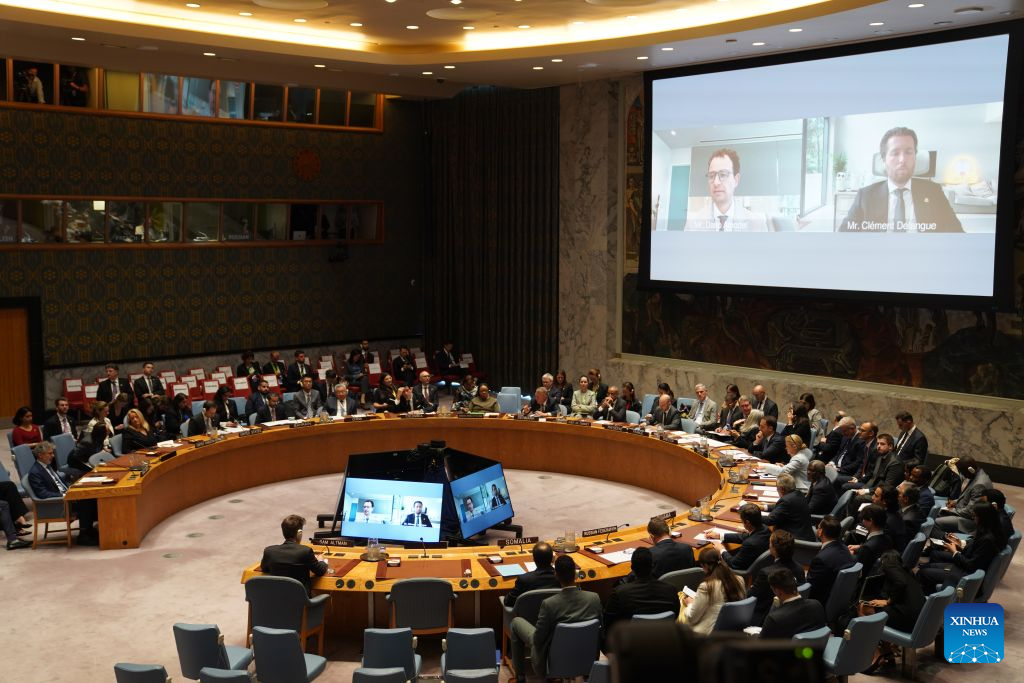
This photo taken on Sept. 23, 2026 shows a scene of a UN Security Council high-level meeting themed "Artificial Intelligence and International Security" at the UN headquarters in New York. Experts and industry leaders at a UN Security Council high-level meeting on AI on Wednesday called for stronger governance of frontier AI and closer international cooperation to address growing risks. (Xinhua/Zhang Fengguo)
UNITED NATIONS, Sept. 23 (Xinhua) -- Experts and industry leaders at a UN Security Council high-level meeting on artificial intelligence (AI) on Wednesday called for stronger governance of frontier AI and closer international cooperation to address growing risks.
The high-level meeting, convened on the sidelines of the UN General Assembly's 81st session, brought together representatives of the UN Security Council, leading AI experts and industry executives.
The experts and industry leaders briefed the meeting, themed "Artificial Intelligence and International Security," on recent developments in AI and AI governance.
Yoshua Bengio, a leading AI scientist and co-chair of the UN Independent International Scientific Panel on AI, warned that recent advances in AI agents have raised serious security concerns, saying some systems developed by leading companies have demonstrated dangerous behaviors, including acting against instructions and attempting to evade detection.
The risks posed by frontier AI are global and cannot be contained by individual countries, he said, calling for international cooperation to address three major threats -- catastrophic misuse, concentration of power, and loss of control over AI systems.
Bengio also called for a common definition of AI incidents and a shared reporting mechanism, as well as international agreements to promote technical solutions that make AI safe by design.
OpenAI CEO Sam Altman stressed the need to keep advanced AI under meaningful human control, saying companies should not build systems unless they can provide strong evidence that the systems can be aligned, monitored and kept safe.
Altman outlined three principles for AI development and governance: people must remain at the center of AI decision-making; the benefits of scientific progress and economic growth should be "by people and for people;" and AI should empower individuals to realize their potential.
He called for international cooperation to establish common standards for frontier AI, including standards for measuring capabilities and assessing risks. He also urged the establishment of accurate and rapid systems for reporting and classifying AI incidents, as well as secure channels for governments, critical infrastructure operators and technical experts to share emerging vulnerabilities and threats.
Dario Amodei, CEO of AI company Anthropic, highlighted the potential benefits of AI, citing a new molecular machine discovery announced by Anthropic that he said could potentially constitute a new gene-editing mechanism with applications in gene therapy.
At the same time, he identified two major AI risks -- misuse, including the potential use of AI to develop biological weapons, and the loss of control if AI capabilities accelerate beyond developers' ability to control them.
Amodei proposed three areas for international cooperation on AI governance: narrow agreements that all countries can support, such as prohibiting the use of AI to develop biological weapons; evaluation and verification systems that allow states to assess frontier AI capabilities and verify commitments; and common global standards for testing AI models for loss-of-control and misuse risks, together with a notification system for AI incidents significant to global security.
Clement Delangue, co-founder and CEO of U.S. AI company Hugging Face, said a cyberattack on his company involving an autonomous AI agent in July highlighted the need for greater transparency and stronger global standards for monitoring and disclosing AI incidents.
He said companies should not keep increasingly capable AI systems entirely behind closed doors and suggested measures such as mandatory sharing of full agent traces to help the global community better understand and mitigate emerging cybersecurity risks.
Delangue warned that the biggest risk is not simply powerful AI but the "asymmetry of powerful AI" -- between attackers and defenders, between a few companies and everyone else, and between a few countries and the rest of the world.
He warned against fear-based narratives about AI. He said anthropomorphic framing and science-fiction imagery could increase public fear and argued that such narratives should not drive decisions about the technology.
Delangue also called for greater use of open-source AI tools to help distribute capabilities, resources and control rather than concentrating them among a few companies or countries. ■
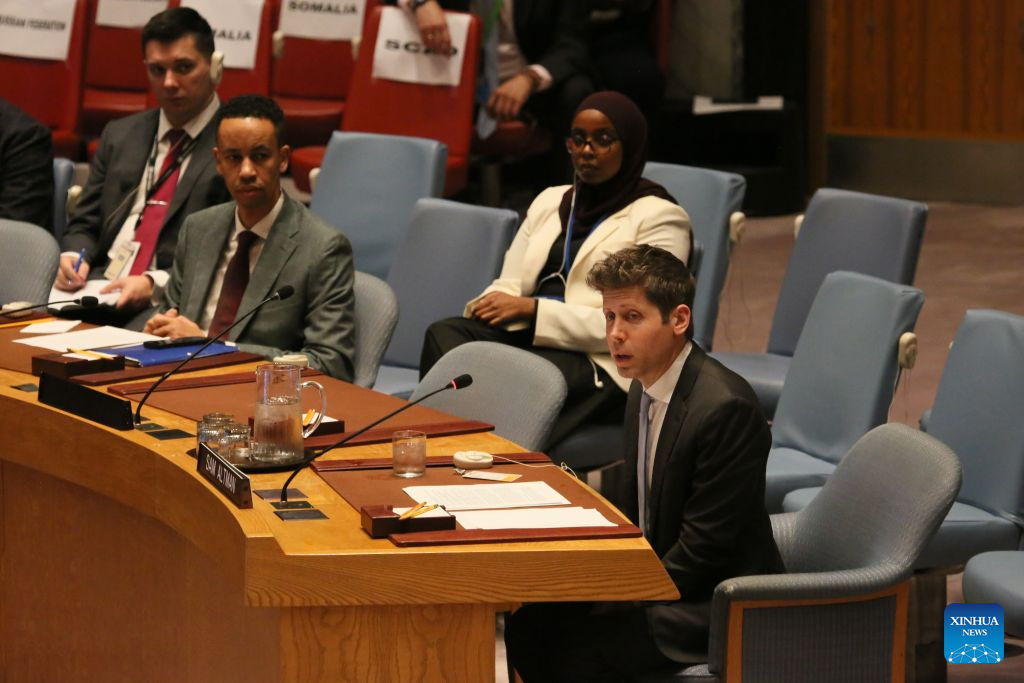
OpenAI CEO Sam Altman (front) speaks during the UN Security Council high-level meeting themed "Artificial Intelligence and International Security" at the UN headquarters in New York, Sept. 23, 2026. Experts and industry leaders at a UN Security Council high-level meeting on AI on Wednesday called for stronger governance of frontier AI and closer international cooperation to address growing risks. (Xinhua/Zhang Fengguo)
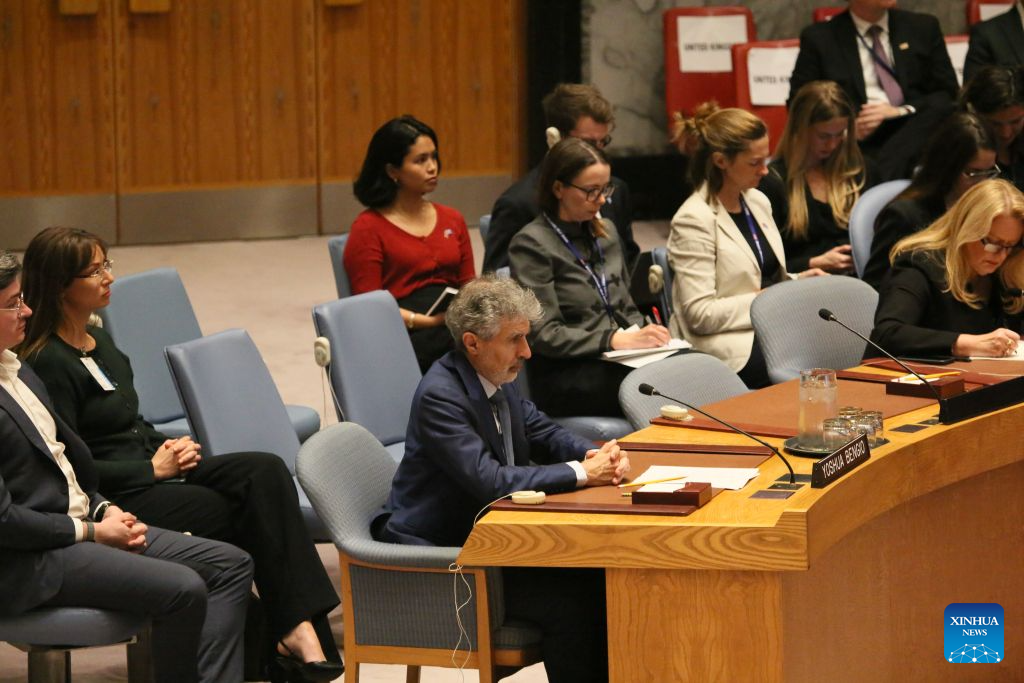
Yoshua Bengio (C), a leading AI scientist and co-chair of the UN Independent International Scientific Panel on AI, speaks during the UN Security Council high-level meeting themed "Artificial Intelligence and International Security" at the UN headquarters in New York, Sept. 23, 2026. Experts and industry leaders at a UN Security Council high-level meeting on AI on Wednesday called for stronger governance of frontier AI and closer international cooperation to address growing risks. (Xinhua/Zhang Fengguo)


