
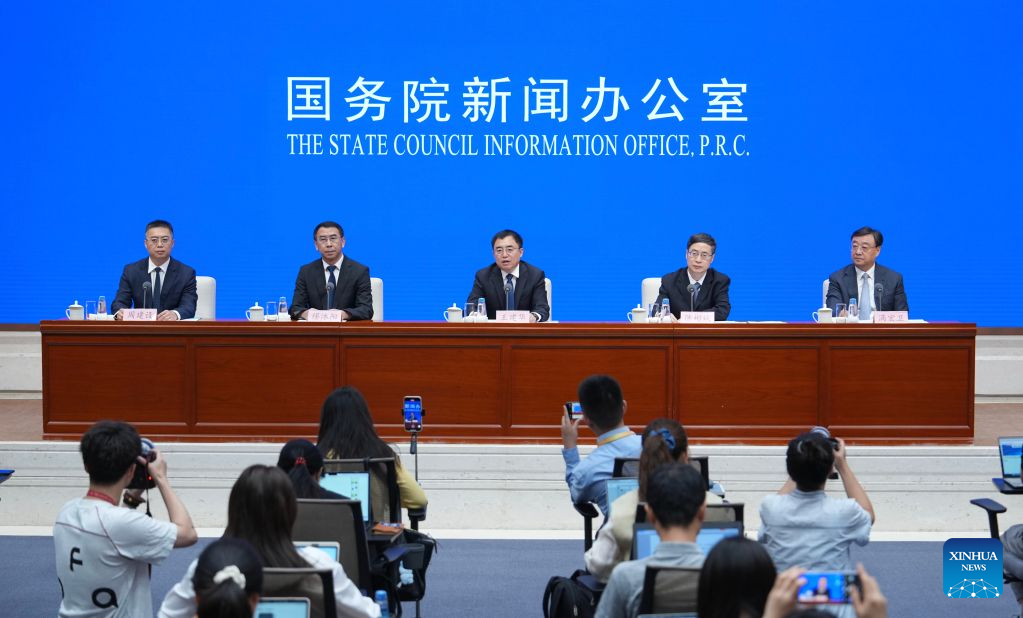
The State Council Information Office (SCIO) holds a press conference on promoting high-quality development of culture and tourism during the 15th Five-Year Plan period (2026-2030) in Beijing, capital of China, Sept. 24, 2026. (Xinhua/Cai Yang)
BEIJING, Sept. 24 (Xinhua) -- As more overseas visitors come to experience China firsthand, the country plans to make inbound travel easier and offer more ways to explore its culture over the next five years, a senior culture and tourism official said Thursday.
China recorded 154 million inbound tourist trips in 2025, up 17.1 percent from a year earlier. Spending by inbound travelers surpassed 130 billion U.S. dollars, up nearly 40 percent from the previous year.
During the 15th Five-Year Plan period (2026-2030), authorities will continue to improve inbound tourism services, making visas, payments, tax refunds, guided tours, accommodation and transport more convenient for international visitors, Vice Minister of Culture and Tourism Wang Jianhua told a media conference.
Authorities will also develop more travel experiences that combine traditional culture with modern life, while expanding cultural programs overseas. Wang said the aim is to help foreign visitors travel more conveniently, enjoy more comfortable stays and gain a closer view of contemporary China.
China has steadily expanded measures to facilitate inbound travel in recent years. Since December 2023, when China launched a trial policy granting unilateral visa exemptions to visitors from six countries, it has expanded unilateral visa-free entry to travelers from 50 countries, allowing eligible visitors to stay for up to 30 days.
In a separate move, authorities extended the visa-free transit period for certain countries from 72 or 144 hours to 240 hours in December 2024. Kyrgyzstan and Vietnam were added to the program last month, bringing the number of eligible countries to 57.
In March, Chinese authorities released a package of measures to improve tourism services, including optimizing departure tax refund services, encouraging everyday service apps to offer multilingual versions and further improving visa procedures.
In July, China set its inbound tourism goals. The country's 2026-2030 tourism development plan proposes attracting 190 million inbound tourist visits a year by 2030, with annual inbound tourism spending exceeding 150 billion U.S. dollars.
Beyond policy measures, China's appeal as a travel destination has also been gaining visibility overseas. Video clips and other online content about traveling in China and experiencing the Chinese lifestyle have gained traction, with hashtags such as "China Travel" and "Chinamaxxing" going viral.
GLOBAL CULTURAL COOPERATION
The push to attract more international visitors comes as China's domestic tourism market reaches new highs and its cultural industry continues to grow.
Domestic travelers made a record 6.52 billion trips and spent 6.3 trillion yuan in 2025, Wang said. The cultural industry generated 20.8 trillion yuan in revenue, averaging 8.4 percent annual growth from 2021 to 2025.
The country also staged 640,000 commercial performances last year, generating 61.6 billion yuan in box-office revenue. Both figures rose by more than 6 percent year on year.
Wang said China will also deepen cultural and tourism cooperation with countries around the world through bilateral and multilateral mechanisms, guided by the Global Civilization Initiative.
The ministry will make greater use of the six Silk Road international alliances covering theaters, museums, arts festivals, libraries, art museums and tourism cities, as well as platforms such as the China International Travel Mart, to promote cooperation among cultural institutions and tourism businesses, he said.
China will also strengthen cooperation with international organizations, host a UNESCO conference on intangible cultural heritage, pursue nominations for world heritage and intangible cultural heritage listings, and support more Chinese villages in seeking recognition under the UN Tourism Best Tourism Villages initiative, Wang added. ■


