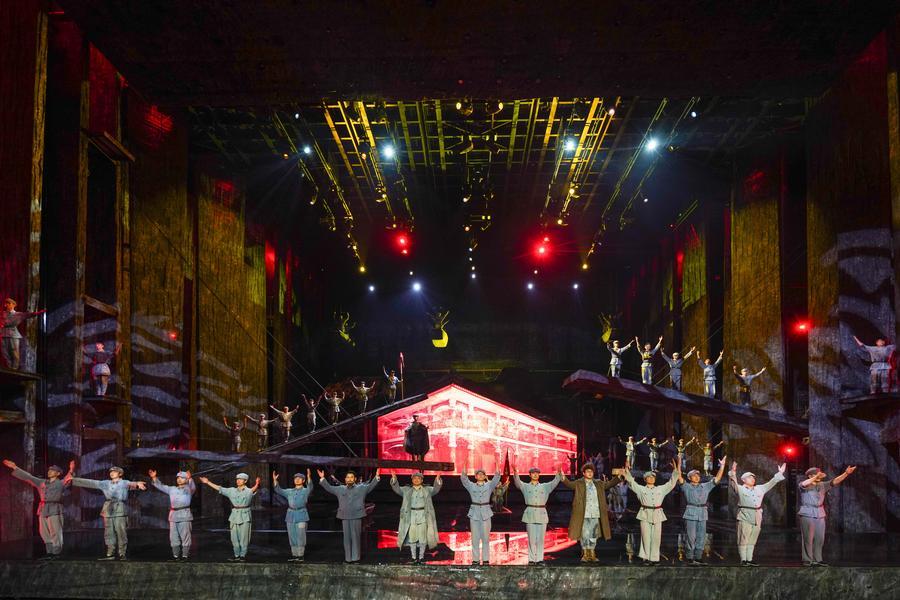
GUIYANG, Sept. 24 (Xinhua) -- On stage, Red Army soldiers on the Long March braved raging rivers, snow-covered mountains and vast grasslands. Some fell amid a hail of gunfire, while others marched on to the end.
When the performance ended and the lights came up, 24-year-old actor Tian Hongqiang found himself back in the present, witnessing a new China for all those who had sacrificed their lives.
"I saw a glimmer of light shining in the audience's eyes. Grey-haired elders and young students in school uniforms gave us their thumbs-up," Tian said. "That makes me feel the power of the spirit we are trying to convey."
For over two years, Tian has performed in "The Great Turning Point," a large-scale immersive production about the Long March being staged in Zunyi, southwest China's Guizhou Province.
Known as China's "city of historic turning point," Zunyi holds a special place in the nation's history. In January 1935, during the Long March, the Communist Party of China (CPC) convened the Zunyi Meeting in a two-story building here at a critical historical crossroads.
In October 1934, the CPC was forced to retreat from the Central Soviet Area in east China's Jiangxi and move northwest after enduring a series of encirclement campaigns by rival forces of the Kuomintang party (KMT). The setback was the result of left-leaning errors in military strategy and rigid Soviet-inspired dogmatism.
The CPC-led Red Army fought its way across the Xiangjiang River in Guangxi and broke through the KMT troops' blockade, but suffered tens of thousands of casualties in the battle.
The three-day meeting was thus convened to draw lessons. In the end, many key issues were resolved, including the establishment of a new Party leadership with Mao Zedong at the helm.
Today, Zunyi is one of China's best-known destinations for historical education tours, which take visitors to sites associated with the country's revolutionary history.
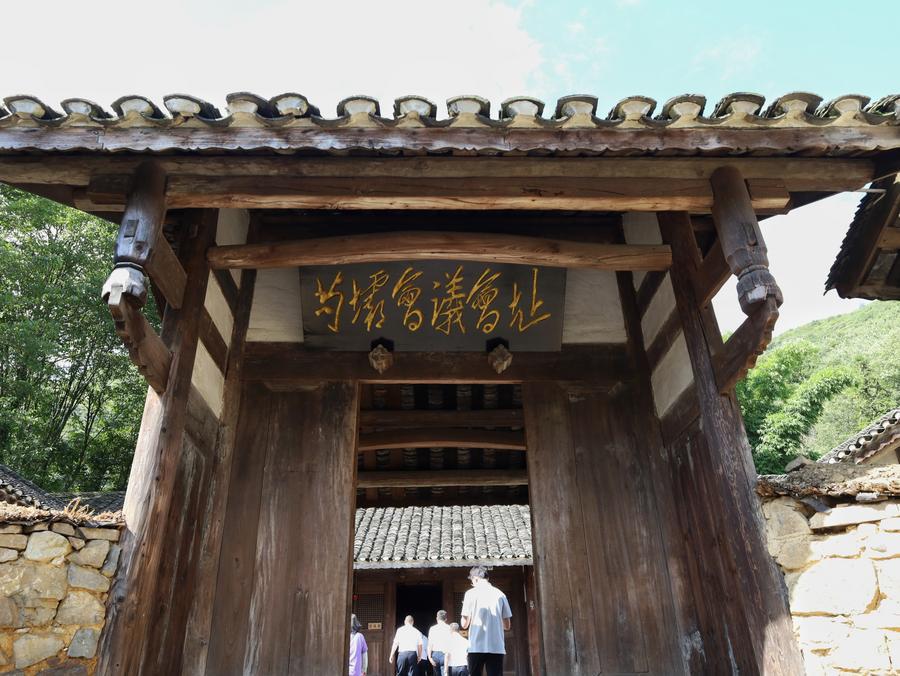
This year marks the 90th anniversary of the victory of the Long March. In Zunyi, the history that once unfolded in meeting rooms, mountain passes and battlefields is being retold via theater, immersive experiences and cultural products, drawing younger generations closer to the historical events.
"The Great Turning Point," centered on the history of the Zunyi Meeting, premiered on Jan. 15, 2024, the meeting's 89th anniversary, and has staged more than 2,500 performances so far.
Wang Liming, a marketing executive with the company behind the production, said about 60 percent of its audience are 25 to 50 years old, with many parents joining their children to watch.
"We hope to help young people develop an emotional connection with this history, so that it is no longer just words and pictures in a textbook," Wang said.
Among the audience was 10-year-old Xu Chen'en, who traveled from Chongqing Municipality in southwest China with her mother, Chen Jinghong.
"I think the Red Army soldiers were very brave," Xu said. "We should learn from them and face our own difficulties courageously."
Her mother sees the experience as a form of education that sinks in over time. "It is like planting a seed in her heart," Chen said. "She can experience the culture of the Long March now and gradually come to understand it as she grows up."
For another visitor, surnamed Xia, the performance became an experience shared by three generations. She watched it with her 56-year-old aunt and 85-year-old grandmother.
"My grandmother's generation has a strong emotional bond with this history, and she was deeply moved," Xia said. "For us, theater makes it much more immersive."
The family's next stop was Loushan Pass, north of Zunyi, another landmark on the Long March route.
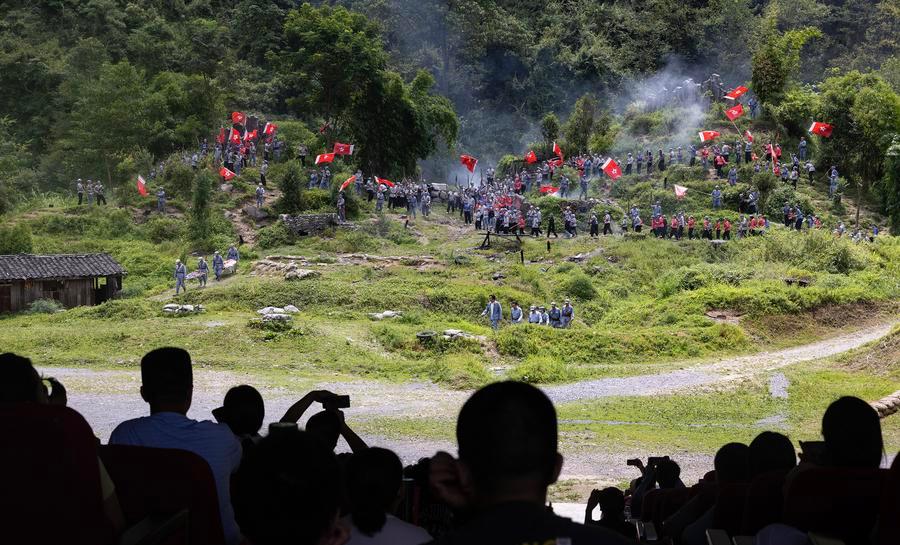
After the Zunyi Meeting, the Red Army achieved a major victory there. What was once a battlefield is now a popular tourism destination.
Twice a day, a live-action performance lasting nearly an hour recreates battle scenes. Roughly 90 performers are residents of nearby villages.
"We want to make the spirit of the Long March something visitors can see and experience," said Zhu Jingbo, a local culture and tourism official.
Visitors can take part in the performance, playing roles as local residents, helping to transport supplies and tending to wounded soldiers. Zhu said creators consulted historians while developing the show, including firsthand accounts of locals guiding Red Army troops across the region.
This approach, he said, is intended to move beyond static museum displays, make revolutionary history more accessible to younger visitors, and create new opportunities for local communities.
Around 15,000 students visit the Loushan Pass area each year on educational trips. Villagers who take part in performances can earn an additional 2,000 to 3,000 yuan (approximately 298 to 447 U.S. dollars) a month, depending on their roles.
Such immersive experiences are part of a wider shift in China's revolutionary education tours. In recent years, historical education tours have increasingly diversified, with performances, study tours and cultural products complementing traditional visits to memorials and historic sites.
China's plan for building the country into a tourism powerhouse during the 15th Five-Year Plan period (2026-2030) also calls for further exploring the historical and contemporary value of revolutionary heritage, improving exhibitions at revolutionary tourism sites, and expanding cultural products and performances.
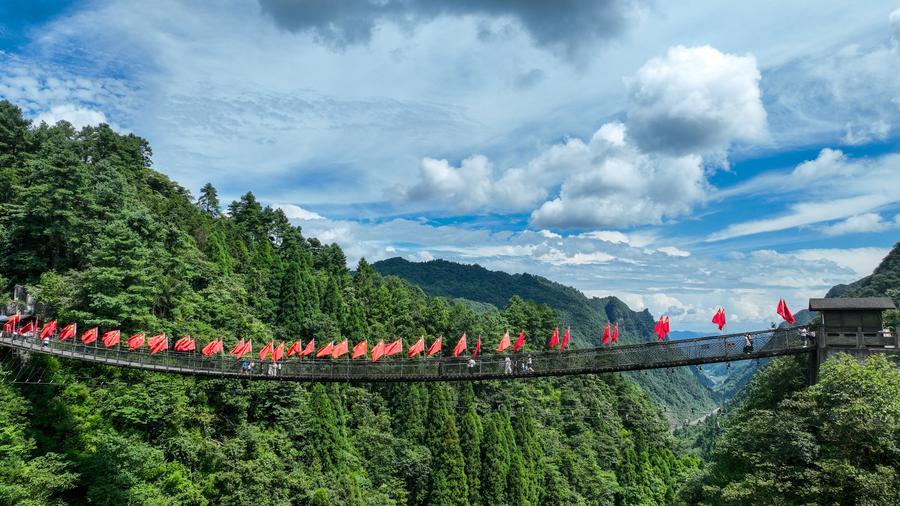
Thus the creative reinterpretation of the Long March spirit stretches far beyond museums and scenic spots. Zunyi's bustling downtown Red Army Street boasts a full range of Long March-themed cultural products, including figurines, backpacks and custom cups, making revolutionary culture accessible to younger audiences.
Near the historical site of the Zunyi Meeting, designer Han Bing sells small Red Army figurines. He said many of his customers are students, particularly from primary and middle schools, while older visitors often buy the figurines as gifts for children.
The shop, which opened in 2019, has maintained brisk business, with daily sales sometimes exceeding 12,000 yuan.
For Han, the connection with the Long March is personal.
He comes from Liping County in Guizhou, the first county seat reached by the Central Red Army after entering the province.
Han grew up hearing a family story about a wooden bridge across the Bazhou River that Red Army troops once crossed. His great-grandfather, he said, helped build the bridge, which later became known locally as the "Red Army Bridge."
Influenced by his family, Han developed an interest in revolutionary history at an early age and later studied art.
Growing up during the early decades of China's reform and opening-up, he said he was initially fascinated by cultures from abroad. But when he started his own business and began exploring Chinese history and revolutionary culture more deeply, he felt as though he had found his roots.
"I wanted to share that feeling with other people," Han said. "So I turned images of Red Army soldiers into figurines, using a form that younger people can relate to."
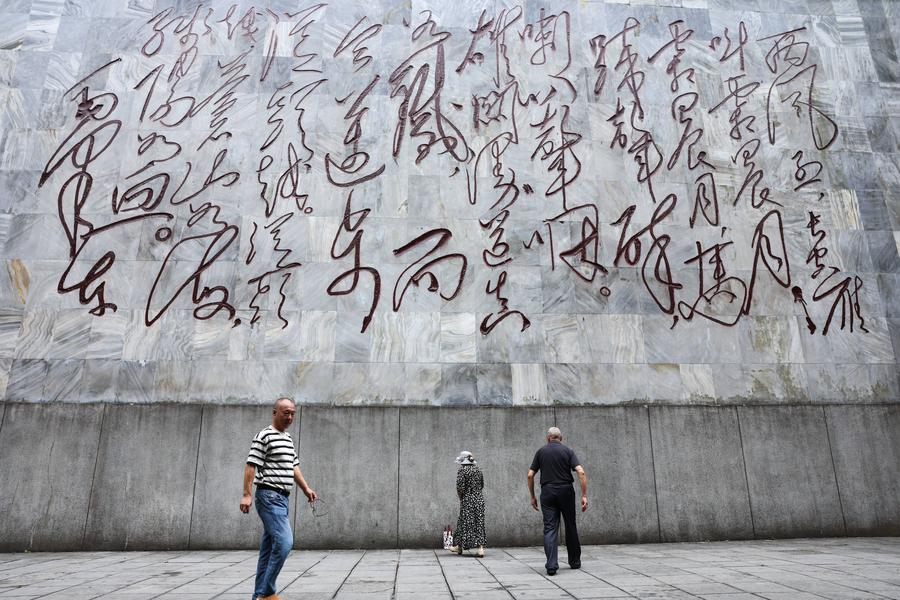
When asked why the Long March should still be remembered 90 years later, he answered with a story from his own life.
At the most difficult point in his entrepreneurial journey, Han said he had lost nearly all the money he had invested. Alone, he went to the top of Loushan Pass and recited a poem written there by Mao Zedong. "Fear not the strong pass iron-clad on all sides! The summit's now surmounted with big strides..."
As he recited, he said his determination gradually returned.
"What inspires me most is the enduring optimism of the Long March, the sense that hope never dies," Han said. "It's an inexhaustible source of strength." ■
(Reporting by Bai Xu, Cheng Lu, Yao Yuan, Rong Jiaojiao, Li Jingya and Shi Qiangui)