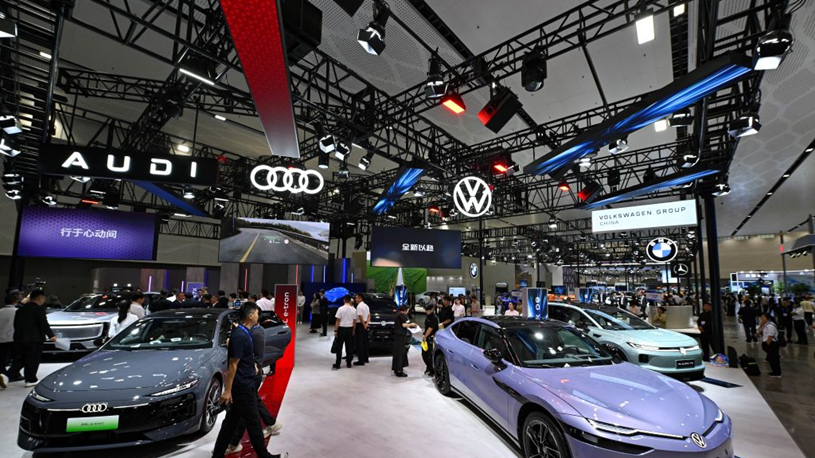
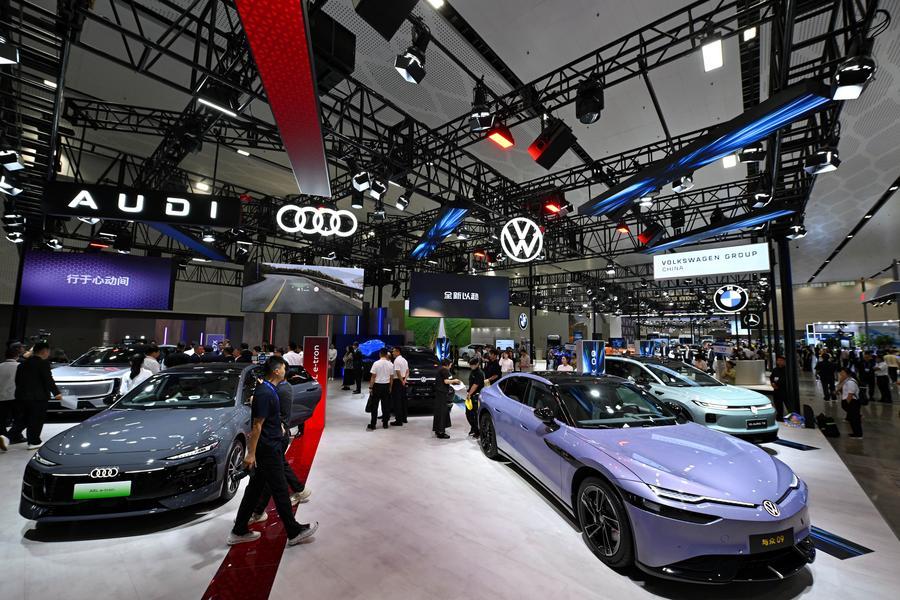
HAIKOU, Sept. 23 (Xinhua) -- German auto industry executives and experts have called for deeper cooperation with China on new energy vehicles (NEVs), batteries, artificial intelligence (AI) and automated driving, saying the two countries could draw on their respective strengths as the global auto industry undergoes a rapid technological shift.
Speaking at the ongoing World New Energy Vehicle Congress 2026 in Haikou, capital of south China's Hainan Province, participants pointed to the complementary strengths of the two countries, with Germany bringing engineering expertise, quality, safety and global industrial experience, and China offering rapid innovation, digital ecosystems, battery technology and smart mobility.
Hildegard Müller, president of the German Association of the Automotive Industry, said China is not only an important sales and sourcing market but also a key location for innovation. She called for closer exchanges in battery technologies, charging infrastructure, intelligent manufacturing, software-defined vehicles, automated driving, hydrogen and AI-based mobility.
"Combining our strengths can accelerate more sustainable, intelligent and customer-oriented mobility worldwide," she said.
China has been the world's largest NEV market for years.
The country's NEV production and sales reached more than 7.43 million and 7.44 million units, respectively, in the first half of 2026, up 6.7 percent and 7.3 percent year on year, according to the China Association of Automobile Manufacturers.
NEV exports, meanwhile, surged to over 2.35 million units during the period, a 120-percent increase from a year earlier.
The rapid growth has made China increasingly important not only as a market and manufacturing base but also as a center for automotive research and development. That shift is reshaping how German automakers operate in China.
Ralf Brandstätter, chairman and CEO of Volkswagen Group China, said the company's strategy had evolved from "from Europe, for China" to "in China, for China," and now toward "in China, beyond China."
He said Volkswagen has localized not only its products but also its ability to create them, with its Volkswagen Group China Technology Company (VCTC) in Hefei developing next-generation NEV technologies.
"German engineering precision, Chinese innovation speed, Volkswagen scale" is the combination Volkswagen brings to China, he said.
Volkswagen has invested more than 3.5 billion euros in Hefei, capital of east China's Anhui Province, where VCTC, its largest R&D center outside Germany, is located. In August, Volkswagen Anhui's 100,000th intelligent electric vehicle rolled off the production line there, marking another milestone in the German automaker's electrification push in China.
Drummond Jacoy, head of Mercedes-Benz China Research, Development and Procurement, said Sino-German automotive cooperation is moving from a focus on scale toward higher-quality cooperation.
"China is no longer only an important market, but an important part of the global automotive innovation network," he said.
Mercedes-Benz is deepening cooperation with Chinese technology partners and applying AI across its value chain, while its joint research with Tsinghua University has spanned AI, road safety and autonomous driving.
Jacoy called for joint development, validation and deployment across intelligent driving, software, batteries, low-carbon supply chains, testing and the circular economy, saying the two industries could move "beyond collaboration to co-creation."
While speakers acknowledged competition, market pressure and geopolitical uncertainty, they stressed that these challenges make dialogue and cooperation more important, not less.
"Competition and cooperation have always gone hand in hand in the automotive industry," said Christian Ach, president and CEO of BMW Group Region China, who added that China and Germany have maintained close ties for many years.
Germany has remained China's largest trading partner and biggest source of foreign investment in Europe. Data from the German Economic Institute show that new German direct investment in China amounted to roughly 7 billion euros in 2025, well above the roughly 4.5 billion euros recorded a year earlier.
The World New Energy Vehicle Congress, held under the theme "Transformation & Upgrading, Resilient Growth," runs from Sept. 22 to 24. ■