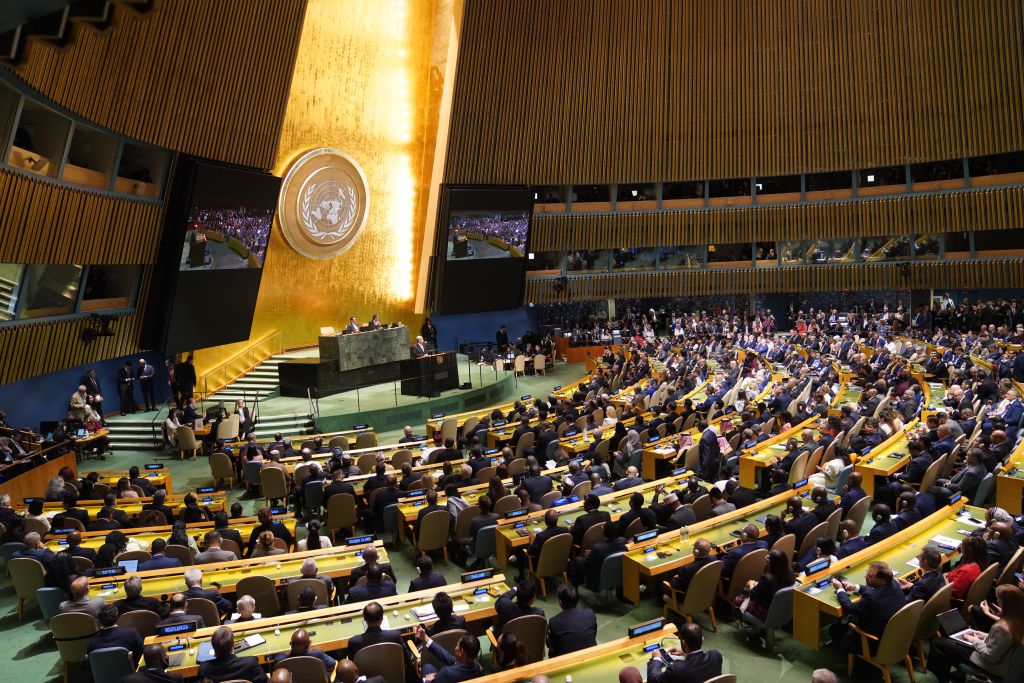
UNITED NATIONS, Sept. 23 (Xinhua) -- World leaders called for stronger international safeguards and oversight on artificial intelligence (AI) on Tuesday during the general debate of the 81st Session of the United Nations General Assembly, while also highlighting the need to balance innovation, security and cooperation.
United Nations (UN) Secretary-General Antonio Guterres called for stronger global coordination to manage AI risks, including work toward a multilateral AI Risk Management Framework backed by independent oversight.
"The danger is not technology. The danger is technology without accountability," Guterres said, urging countries at the forefront of AI development to strengthen dialogue, transparency, trust and cooperation.
Meanwhile, referring to AI as "super intelligence," U.S. President Donald Trump said in his speech that the United States "totally rejects any attempt to construct a globalist scheme" to control AI.
"We're going to encourage it, not rein it in," Trump said, adding that the United States would watch the technology closely while seeking to maintain its leadership in AI safely and responsibly.
French President Emmanuel Macron coupled the need for technological capacity with stronger oversight. He said every region should develop its own computing power, large language models and AI ecosystem, while retaining the ability to independently scrutinize the systems it uses.
"We must build the capacity to audit these models rather than depend on a handful of private actors," Macron said.
At the same time, Macron acknowledged that a global race to develop frontier AI models is already under way and said France intends to take part. He called for greater international cooperation in particularly sensitive areas, including the use of AI in space, defense and cybersecurity.
Brazilian President Luiz Inacio Lula da Silva went further in criticizing the concentration of technological power, warning that a handful of technology companies were promoting "a race with no ethical boundaries" while bypassing the UN and its Independent International Scientific Panel on Artificial Intelligence.
"It would be an unforgivable historical omission not to address the challenge of regulating the big techs and artificial intelligence," Lula said.
While much of the debate centered on safeguards and control, South Korean President Lee Jae Myung focused on another risk: that the benefits of AI could be distributed unevenly.
Lee said the AI revolution could become a core driver of new prosperity and sustainable development, but would deepen inequality and imbalance "unless we are properly prepared for it."
He said South Korea would establish a global AI hub, bringing together international organizations, multilateral development banks, industry and academia, with the goal of making AI a tool for tackling shared challenges ranging from climate change to health and food security.
The debate is set to move from the General Assembly to the UN Security Council on Wednesday, when the council is scheduled to discuss AI and international security.■