
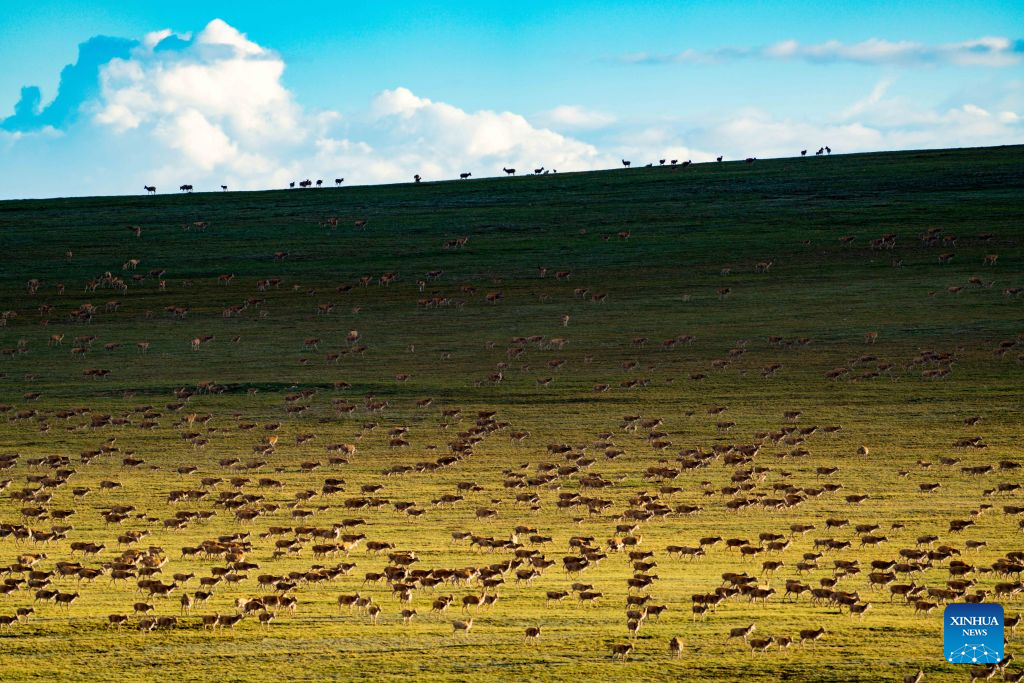
Tibetan antelopes are pictured in Changtang National Nature Reserve in southwest China's Xizang Autonomous Region, July 13, 2026. (Xinhua/Jiang Fan)
LHASA, Sept. 22 (Xinhua) -- Twenty-four years after her father was shot dead while chasing poachers, Tsewang Lhamo finally saw the place where he died.
It took a day and a half from Nyima County to reach the remote corner of the Changtang, a vast nature reserve in northern Xizang Autonomous Region in southwest China. There were no villages, power lines or clear roads at this spot, only rivers cutting through the grassland, distant mountains and wildlife roaming under a restless sky.
A cenotaph stood alone beside a few weather-beaten structures.
Tsewang Lhamo bent down before it and wept.
Her father, formerly a police officer named Norbu Yugyel, was killed there on June 1, 2002, after his patrol encountered suspected Tibetan antelope poachers. He was 40. The patrol vehicle, still marked by bullets, remains in the garage of Nyima County's forestry and grassland bureau.
His two daughters were waiting for him to come home for Children's Day back then. He never did.
"I was not yet 11," recalled his youngest daughter, Socho Lhamo. "I only knew that he had not come back as promised."
For years, she had struggled to understand why her father had spent so much time away protecting wildlife, until she saw piles of confiscated wildlife pelts in 2013 and began to see his work differently.
"You could no longer imagine what those animals had looked like when they were alive and running," Socho Lhamo said. "It was 11 years after his death that I came to understand my father."
She later entered a police academy. Today, she works primarily on household registration, while also serving as Nyima County's first police officer assigned specifically to ecological protection, taking part in patrols, public education and wildlife protection work.
A wildlife protection station named after her father stands opposite her workplace.
Karma Trinley joined a wildlife protection station in 2016 at the age of 17. When he first saw Tibetan antelopes on patrol, he wanted to get closer. Now he does the opposite.
He later learned that even a well-meaning approach could frighten a mother into running, potentially separating her from a newborn calf. Now, while on patrol, he watches the herd's direction, the wind and the distance, and keeps well away until the animals have passed.
The rangers still drive along the same rough tracks into the Changtang. What has changed is what happens when they encounter wildlife: often, the right response is simply to stop and wait.
Two decades ago, protecting wildlife here could mean moving toward armed poachers. Today, it can entail simply keeping a respectful distance from the animals themselves.
The Changtang reserve covers nearly 300,000 square kilometers, much of it above 5,000 meters. Since 2015, 73 wildlife protection stations have been built and more than 700 rangers deployed.
This growing network has also changed what protection looks like on the ground. Herders now often call protection stations when they find injured animals or young animals separated from their mothers. Rangers monitor wildlife, carry out rescues when needed and, as Karma Trinley's experience shows, increasingly know when to keep their distance.
China's law on ecological conservation of the Qinghai-Tibet Plateau in the west of the country, which took effect in September 2023, has also strengthened protection of the plateau's ecosystems and nature reserves.
The results are increasingly visible on the grassland. Tibetan antelopes in Xizang have increased from just more than 70,000 in the late 20th century to over 300,000 today, while the wild yak population has risen from several thousand to more than 20,000.
Tibetan antelopes now appear more often on the grassland, and wild yaks sometimes stop across a valley and look at patrol vehicles.
The rangers do not rush after them. They stop, lift their binoculars and watch the animals move deeper into the wilderness. Only then do they move on.
Twenty-four years ago, a gunshot echoed across this grassland. Today, the rangers hope to leave behind as little sound as possible.
"The best way to remember those who came before us, is to let the gunshots grow ever more distant, and let the sounds of life grow louder across the grassland," said Kalzang Lhundrup, head of the Norbu Yugyel wildlife conservation station. ■
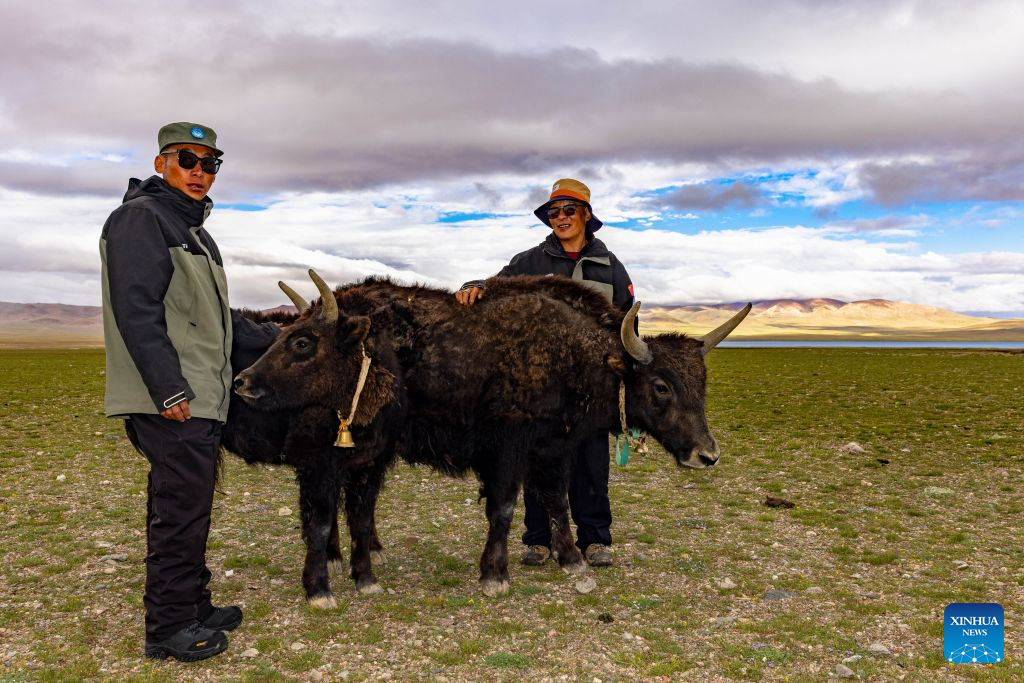
Rangers are pictured with adopted wild yaks at a wildlife conservation station in southwest China's Xizang Autonomous Region, July 11, 2026. (Xinhua/Jiang Fan)
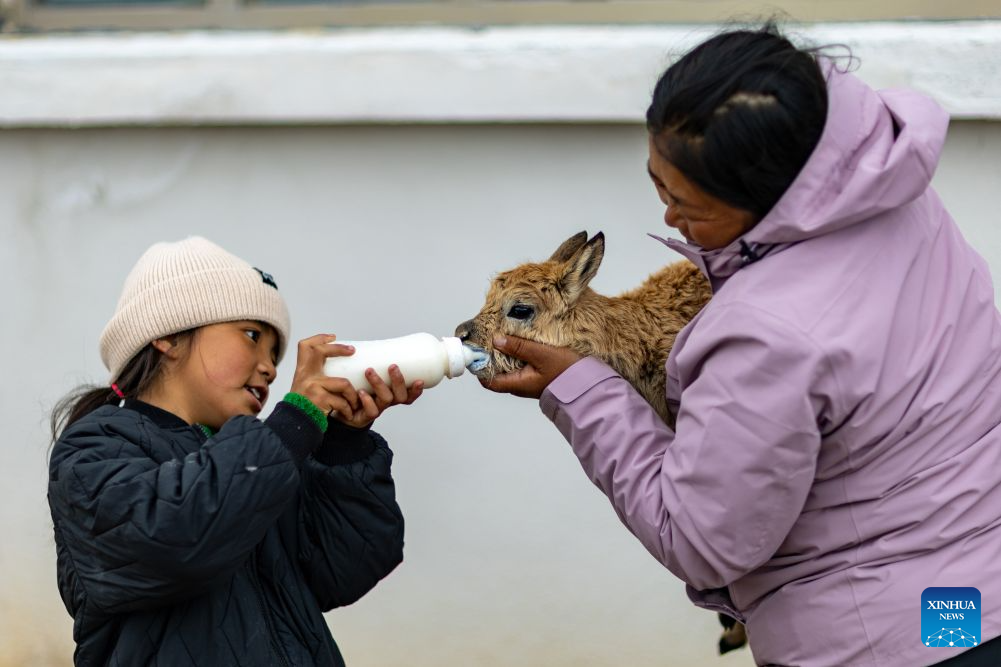
Norbu Yugyel's eldest daughter, Tsewang Lhamo (R), and his granddaughter bottle-feed an orphaned Tibetan antelope calf at a wildlife conservation station in southwest China's Xizang Autonomous Region, July 11, 2026. (Xinhua/Jiang Fan)


