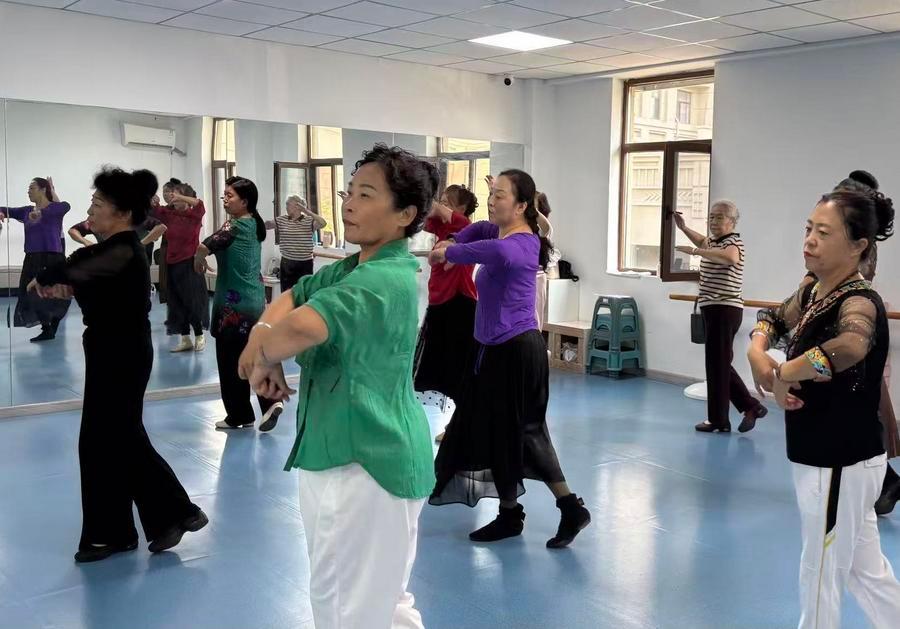
HOHHOT, Sept. 20 (Xinhua) -- As the music of the morin khuur, a traditional horsehead fiddle, fills the community center, Wang Jinrong rolls her shoulders, raises her arms and turns to the rhythm, leading her fellow dancers through the routine.
Wang, an ethnic Mongolian and retired resident of the Fu'an community in Xing'an League, north China's Inner Mongolia Autonomous Region, has been a member of the community's dance group for more than two years.
The community is home to more than 9,000 residents, including people from Han, Mongolian and Hui ethnic groups.
Xing'an League is home to residents from 40 ethnic groups, with ethnic minorities accounting for about half of its permanent population of more than 1.3 million.
On May 1, 1947, the people of Inner Mongolia established the autonomous government of the region in Xing'an, which marked the founding of China's first provincial-level ethnic autonomous region under the leadership of the Communist Party of China.
In the run-up to this year's Mid-Autumn Festival, Wang and her teammates performed a Mongolian dance, made traditional Chinese mooncakes and took photos together at a celebration held in the community.
"Mongolian dance has a certain strength to it, and the rhythm is really strong," said Wang Liyan, a Han resident who has been part of the dance group. She added that they follow online videos to learn traditional dances of multiple ethnic groups, including Mongolian, Uyghur and Korean dances.
But the group does much more than dance.
"We travel together, join community activities and keep in touch through WeChat groups," Wang said. "We've been together for so many years that everyone has become really close."
For Zhang Ruixin, Party secretary of Fu'an community, a "complete community is a shared home for people of different ethnic groups," where everyone can participate, benefit and develop together.
That idea is reflected in the development of community spaces. "When we were developing the neighborhood activity center, we collected residents' suggestions through home visits and online, so as to decide on the layout and functions," Zhang said.
The community has built a "Pomegranate Red Square" that integrates functional areas such as the Tongxin Pavilion, an ethnic unity and progress corridor, and a themed plaza. China often likens all ethnic groups to pomegranate seeds holding tightly together as a metaphor for unity.
In 2025, the community partnered with China Sports Lottery to convert an idle building elsewhere in the neighborhood into a 300-square-meter activity center.
Equipped with table tennis tables, chess and card tables and a reading area, the center is free and open to all residents regardless of ethnicity, household registration or age.
Meanwhile, some community services, such as social security and medical assistance, have also been made available online.
Bringing services closer to residents' daily lives is also part of a broader effort in Chinese cities to build "complete communities." The push aims to make public and commercial services, elderly care and cultural and leisure facilities more accessible within neighborhoods.
More young people have also been getting involved in the community, finding their own ways to help others.
A youth environmental volunteer association in Xing'an League, registered in the Fu'an community in 2020, provides regular volunteer services in more than 30 communities across the league and runs care programs for children during summer and winter vacations, according to Du Tieyi, the association's head.
It now has more than 3,000 registered volunteers, including people from ethnic groups such as the Han, Manchu, Hui, Mongolian and Daur, said Du.
Zheng Qinghui, a student at Xing'an Polytechnic University who joined the association this month, has quickly built a rapport with the children.
"The children may be too young to fully understand environmental protection at first," Zheng said. "But through our discussions and activities, they may start thinking about it in their daily lives."
For Du, volunteering often shows up in small moments. At the end of a weeklong summer program, a rather shy child handed him a small note.
"I hope you're happy every day, and I hope to see you again during the winter vacation," it read. ■