
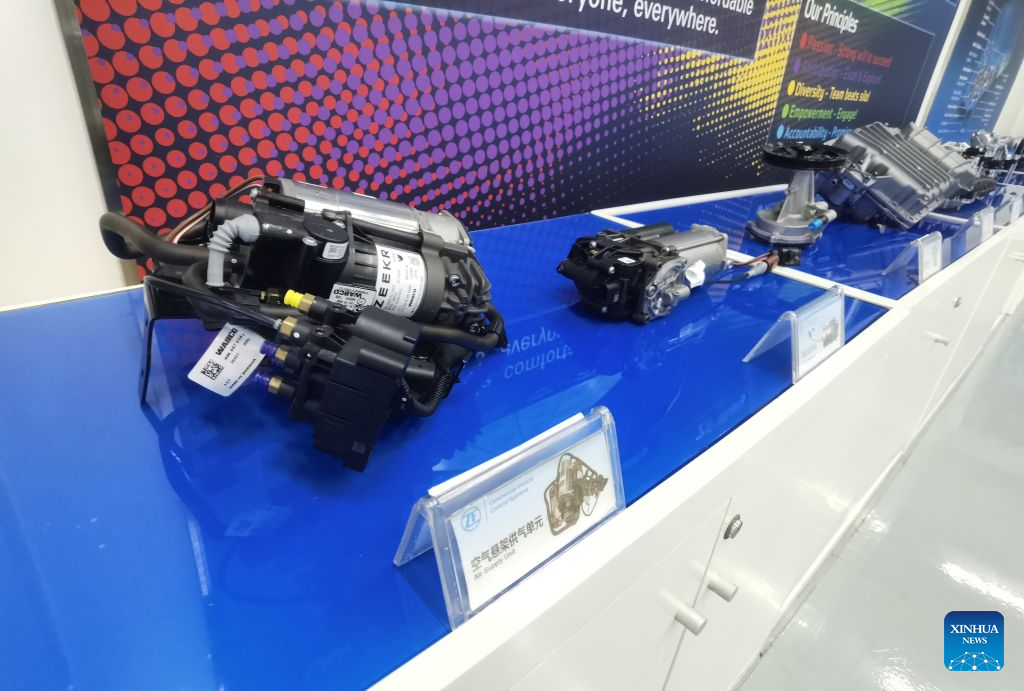
This photo taken on Aug. 19, 2026 shows products displayed at ZF Commercial Vehicle Systems (Qingdao) Co., Ltd. in Qingdao, east China's Shandong Province. (Xinhua/Wang Kai)
QINGDAO, Sept. 20 (Xinhua) -- German companies are stepping up investment and expanding production in China, tapping into the country's growing market and emerging opportunities.
Weiss Group, a German "hidden champion" specializing in mechanical, mechatronic and digital solutions, has opened its first production base in China in Qingdao, east China's Shandong Province.
With an investment of 10 million U.S. dollars, the project will serve as the group's China headquarters for production, research and development (R&D) and trade. Its first phase is expected to generate annual sales of about 60 million yuan (about 8.89 million U.S. dollars) and annual imports and exports of around 35 million yuan once operational.
The Qingdao project is among a growing number of examples of German companies deepening their presence in China, with investment increasingly extending from production to localized R&D and supply chains.
ZF Group, a German automotive parts supplier and Fortune Global 500 company, delivered its advanced driver assistance system to Chinese customers in April, marking a further step in its "In China, For China" strategy.
The company has operated in Shandong since 1996, with operations in Jinan, Qingdao, Rizhao and Weihai.
Qian Xinmin, general manager of ZF Commercial Vehicle Systems (Qingdao) Co., Ltd., said three of four new production lines at the Qingdao plant had been put into operation this year, with the fourth undergoing testing and expected to come online by the end of the year.
The company is also considering investment in next-generation solenoid valves and sensors, Qian said.
"Eighty percent of our business comes from the domestic market, and we expect revenue growth of 15 percent to 20 percent this year. The outlook is very promising," he said.
The experience of LOGOMAT Automation (Qingdao) Co., Ltd. illustrates a broader shift: German companies in China are moving from importing and assembling products to localized production and, increasingly, supplying global markets.
Facing intensified competition in the automotive industry, the German manufacturer of industrial automated conveyor-line equipment is maintaining its competitiveness through localized R&D and cost-reduction measures, while expanding into emerging fields in China, including embodied robotics, energy storage systems and solid-state fuel cells, said General Manager David Huemmerich.
Since establishing its Qingdao plant in 2019, the company has become deeply integrated into LOGOMAT's global production network.
"We not only serve the Chinese market, but can also ship our products to Europe and the Americas," Huemmerich said.
Other German companies across China are also expanding their operations like LOGOMAT.
In March, BASF's integrated production site in south China's Guangdong Province became fully operational. With a total investment of about 8.7 billion euros, it is the largest single wholly foreign-owned project in China by a German company.
In northeast China, BMW has invested more than 120 billion yuan in its Shenyang production base since 2010.
Henkel, which is marking its 55th year in China, continues to invest in projects including an innovation center in Shanghai and a production base in Yantai, Shandong Province.
The trend is also reflected in the investment plans of German companies. A survey by the German Chamber of Commerce in China found that 61 percent of surveyed German companies planned to increase investment in China over the next two years, the highest level since 2023.
Germany's large community of "hidden champions," many of them small and medium-sized enterprises specializing in niche markets, has shown particular interest in China's expanding market and technological development, industry insiders said.
The investment trend comes as China continues to expand institutional opening-up and improve conditions for foreign investment.
In June, China's Ministry of Commerce, together with other government departments, released an action plan featuring 15 measures to stabilize and optimize foreign investment utilization. The plan calls for wider market access in the services sector, promotion of the "Invest China" initiative, and efforts to address foreign-funded enterprises' concerns over equal participation in government procurement and fair access to business operations.
China saw 35,000 newly established foreign-invested enterprises in the first half of 2026, up 7 percent year on year, the State Administration for Market Regulation said.
Separate data from the Ministry of Commerce showed that nearly 4,800 foreign-funded enterprises increased investment in China in the first half of 2026, while foreign direct investment in high-tech industries surged 33.2 percent year on year.
At the opening ceremony of the Weiss project, Michael Kern, executive director of the German Chamber of Commerce in China - East China, said the investment was not only an investment decision, but also an expression of confidence in China and in the opportunities created by combining German engineering and technology with China's economic dynamism.
"The relationship between German and Chinese companies is changing," Kern said, adding that it is no longer simply about bringing German products to China, but increasingly involves jointly conducted R&D, shared growth and benefiting other markets around the world. ■
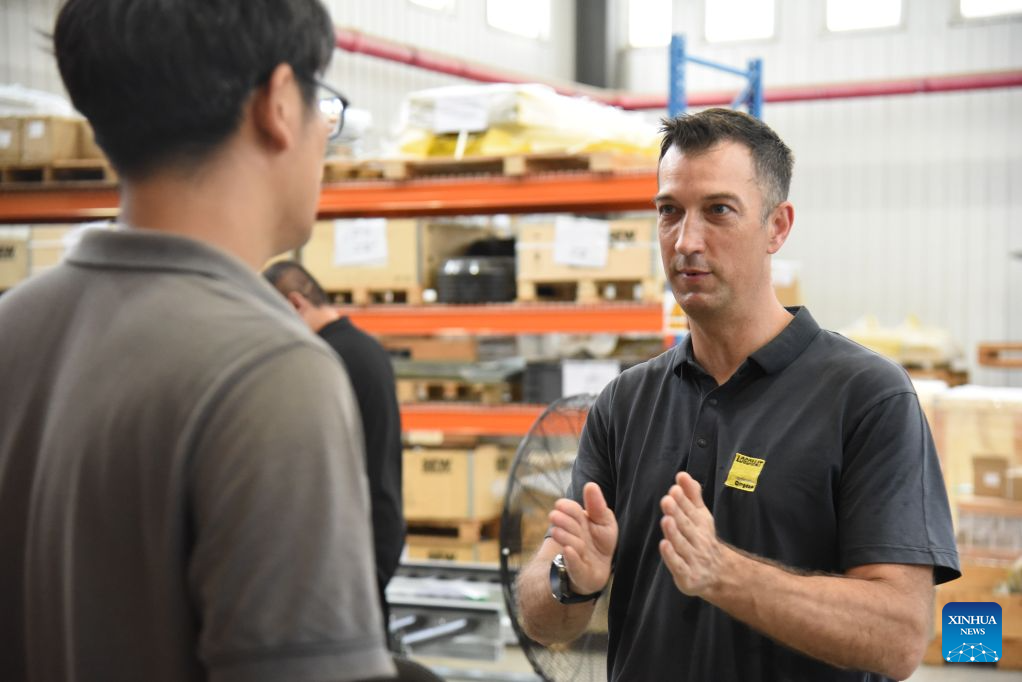
David Huemmerich, general manager of LOGOMAT Automation (Qingdao) Co., Ltd., talks with an employee in Qingdao, east China's Shandong Province, Aug. 26, 2026. (Xinhua/Wang Kai)


