
BEIJING, Sept. 20 (Xinhua) -- China's electricity consumption exceeded 1 trillion kilowatt-hours (kWh) again in August, with record peak load and much faster power demand growth in high-tech manufacturing and new-economy services, underscoring the economy's ongoing structural transformation.
Power use totaled 1.0332 trillion kWh in August, rising 1.7 percent year on year, the National Energy Administration (NEA) data showed on Sunday. Electricity load hit a record high of 1.56 billion kilowatts, 49.69 million kilowatts above the previous year's maximum, and exceeded that level on seven days in total during the month.
A breakdown of the August data revealed that power consumed by the primary industry rose 2.7 percent year on year to 16.9 billion kWh, while power consumed by the secondary industry increased 2.4 percent to 612.4 billion kWh. Power use by the tertiary industry reached 215.5 billion kWh, up 5.1 percent year on year.
"The secondary and tertiary industries are the main engines of electricity consumption growth," said Wu Liqiang, an official with the China Electricity Council.
"Within manufacturing, the pattern of 'new sectors rising and old sectors declining' continued. High-tech and equipment manufacturing maintained rapid growth, while consumer goods manufacturing was the second-largest positive contributor to manufacturing electricity demand after high-tech and equipment manufacturing."
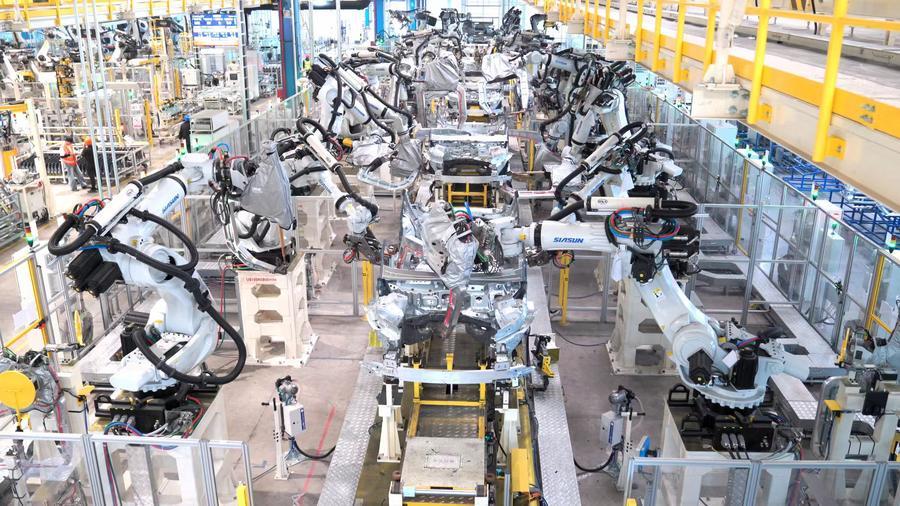
Notably, electricity consumption by the high-tech and equipment manufacturing sector reached 122.2 billion kWh in August, an increase of 7.2 percent. Computer and communications equipment, automobile manufacturing, general equipment manufacturing, special equipment manufacturing and electrical machinery manufacturing saw power use rise 7.5 percent, 7.6 percent, 7.6 percent, 8.2 percent and 12.3 percent, respectively.
Within automobile manufacturing, power consumption for new energy vehicle (NEV) production jumped 22.2 percent year on year.
Wu added that electricity consumption in new business formats has become an important source of incremental demand for the tertiary industry and the economy as a whole.
The charging and battery swapping service sector and internet data services reported rapid growth in electricity consumption in August, rising 51.2 percent and 37.9 percent, to 17.2 billion and 10.2 billion kWh, respectively.
In contrast, residential electricity consumption dropped by 4 percent year-on-year to 188.3 billion kWh in August, as more frequent typhoons and heavier rainfall compared to last year significantly reduced air-conditioning demand.
In the first eight months of the year, China's total power use reached 7.17 trillion kWh, up 4.3 percent year on year, the NEA said. Power use by the primary, secondary and tertiary industries rose 3.3 percent, 4.4 percent and 7.1 percent, to 104.6 billion kWh, 4.53 trillion kWh and 1.43 trillion kWh, respectively.
During this period, high-tech and equipment manufacturing electricity consumption climbed 9.3 percent to 845.1 billion kWh. Electricity use by charging and battery swapping services and internet data services grew 55.1 percent to 114.7 billion kWh and 42.5 percent to 69.5 billion kWh, respectively. Residential power use rose 0.3 percent to 1.11 trillion kWh.
In recent years, China has made major strides in terms of its power infrastructure, helping ensure a stable electricity supply during peak periods and effectively supporting economic and social development as well as meeting people's basic needs, the National Development and Reform Commission said in July.
According to an annual development report of China's electric power industry released by the China Electricity Council in July, total electricity consumption nationwide in 2026 is expected to increase by 5 percent to 6 percent year on year.
The total newly installed power generation capacity for the year is estimated at approximately 400 million kilowatts, with new energy sources continuing to be the main contributors to the added capacity. The increase in conventional power sources is expected to be around 100 million kilowatts, roughly matching the growth in peak load, the report added. ■