
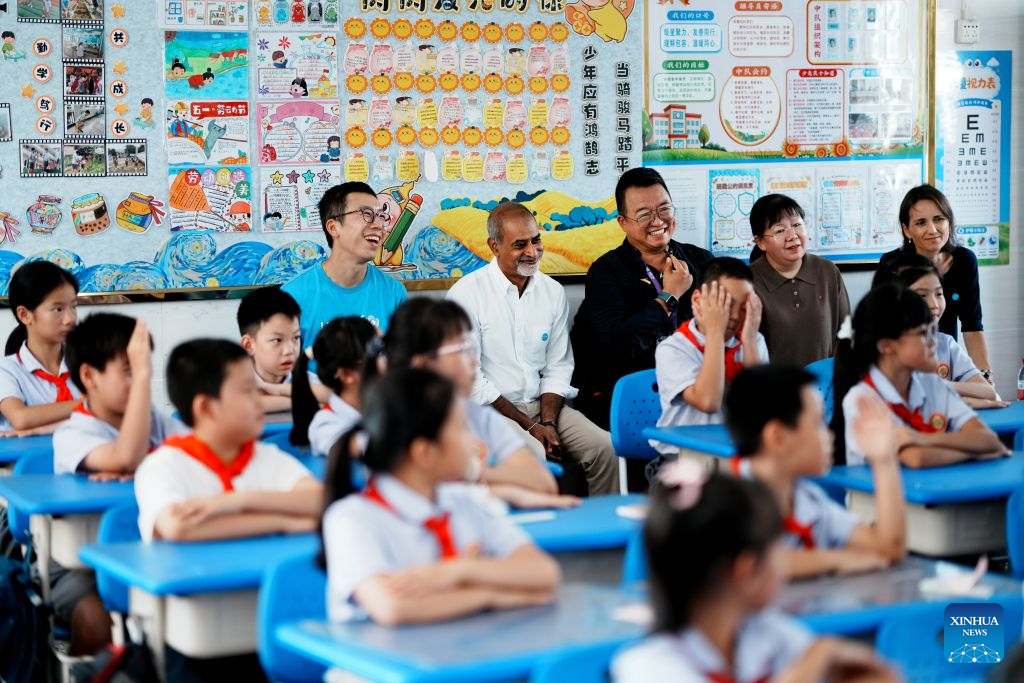
United Nations Children's Fund (UNICEF) Regional Director for Asia and the Pacific Sanjay Wijesekera (2nd L, back) observes a class meeting on social and emotional learning at a primary school in Liujiang District of Liuzhou, south China's Guangxi Zhuang Autonomous Region, Sept. 18, 2026. (United Nations Children's Fund/Handout via Xinhua)
NANNING, Sept. 20 (Xinhua) -- China's progress in child health, early childhood development, education, and child protection is generating experience that can be shared with other developing countries through South-South cooperation, said a United Nations Children's Fund (UNICEF) official.
Sanjay Wijesekera, UNICEF Regional Director for Asia and the Pacific, made the remarks during the 23rd China-ASEAN Expo, held from Sept. 17 to 21, in Nanning, capital of south China's Guangxi Zhuang Autonomous Region.
UNICEF welcomes China's policies and progress in supporting families, expanding childcare services, and building a child-friendly society, Wijesekera said, stressing that children's well-being depends not only on services for children but also on the environment, care and support around them.
He identified China's nationwide childcare subsidy and child-friendly city initiative as important examples.
"A key example is China's nationwide childcare subsidy program, announced by the government of China last year. This is expected to support early childhood development and ease the cost of raising children," he said.
China introduced a nationwide childcare subsidy program in 2025 as part of broader efforts to support families and encourage childbirth. The program will offer families 3,600 yuan (around 540 U.S. dollars) per year for each child under the age of three.
During a visit to UNICEF-supported projects in Liuzhou, Guangxi, Wijesekera said he saw programs covering social and emotional learning, maternal and newborn care, and child protection services.
"What struck me most was the commitment and passion of the people we met. Across different services and institutions, I saw officials and professionals who are deeply committed to improving outcomes for children," he said.
Wijesekera said China's experience in artificial intelligence (AI) and digital technology could also contribute to children's development, particularly through digital learning and skills development.
"China's experience in digital technology, AI, clean energy and public infrastructure is highly relevant to children because these areas shape how children learn, access services, stay safe and prepare for the future," he said.
"Sharing experience from China is why I am participating in the China-ASEAN Expo. South-South cooperation is a key method for sharing China's experience with ASEAN countries," he said.
He said that since 1979, UNICEF has been working closely with the Chinese government to improve the lives of children and their families in areas such as health, nutrition, education, child protection and emergency response.
This year marks the launch of the China-UNICEF Country Program for 2026-2030. Wijesekera said the new Country Program would place greater emphasis on government ownership and system strengthening, while continuing to work on child protection, climate action and social policy. Specific issues include children with disabilities, mental health and ending violence against children.
"We will also work with the government and Chinese institutions to enable other countries to learn from China's rapid development and how children can benefit," he said.
Since 2018, UNICEF and the Chinese government have worked together to reach vulnerable children in low- and middle-income countries, Wijesekera said.
He cited cooperation in Lao PDR as a practical example.
"In Lao PDR, cooperation between China, Lao PDR and UNICEF has contributed to combating acute malnutrition, improving child health outcomes and strengthening child protection services, with funding from the government of China," Wijesekera said.
Launched in October 2022 and concluding in December 2025, the Lao government and UNICEF jointly implemented a child nutrition program, funded by China's Ministry of Commerce and the China International Development Cooperation Agency. The program targeted 10 provinces with high rates of acute child malnutrition.
It has since treated more than 4,000 Lao children with severe acute malnutrition.
"Through South-South cooperation, countries can share practical solutions and innovation, helping accelerate progress for children across the region, especially the most vulnerable," he said. ■


