
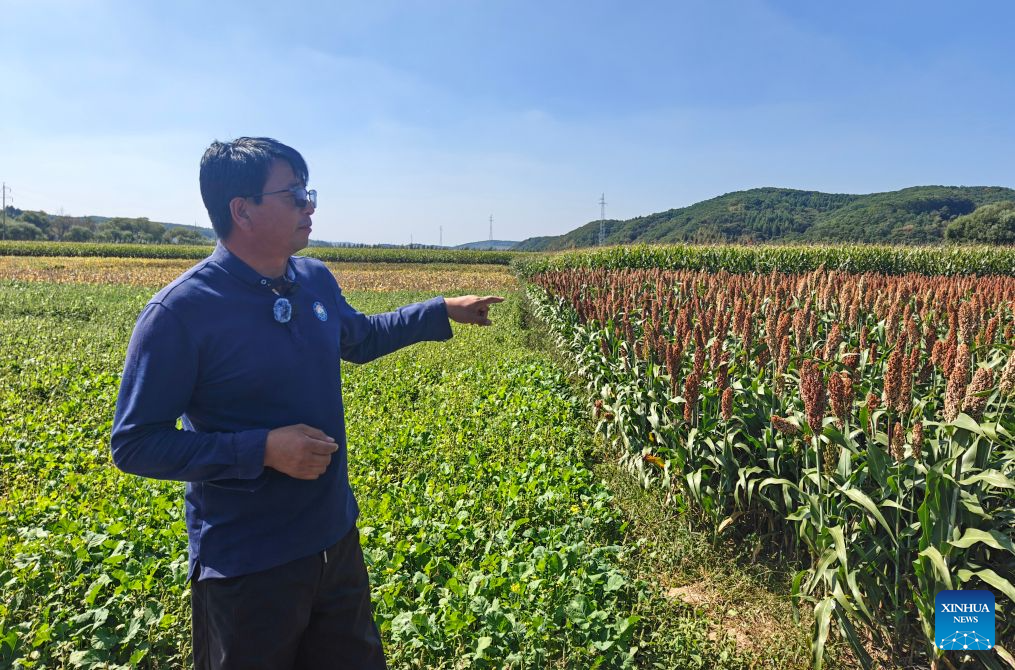
Leng Jiantian, a researcher at the Northeast Institute of Geography and Agroecology (IGA) of the Chinese Academy of Sciences (CAS), introduces a crop rotation model to protect the black soil in Dongliao County, northeast China's Jilin Province, Sept. 16, 2026.(Xinhua/Yu Fei)
CHANGCHUN, Sept. 20 (Xinhua) -- When agricultural scientist Leng Jiantian arrived in the hilly area at the source of the Liaohe River in northeast China's Jilin Province about 10 years ago, he found that local farmers planted only corn year after year. Pests and diseases were frequent, pesticides and fertilizers were overused, and the soil and river were seriously polluted.
Through investigation and research, Leng and his team developed a crop rotation model involving soybeans, sorghum, wheat and rapeseed. As a result, the use of pesticides and fertilizers is greatly reduced, the ecological environment is better protected, and farmers have higher incomes.
From soil ecological restoration to innovation in farming models, and from sky-ground monitoring to molecular breeding chips, Chinese scientists are deploying an integrated strategy to protect the country's precious black soil and maximize its value.
The black soil in Heilongjiang, Jilin and Liaoning provinces, all located in China's northeast, and in some parts of north China's Inner Mongolia Autonomous Region, is hailed as the "giant panda of arable land." With high fertility and stable yields, it forms a vital foundation for China's food security. Yet high-intensity cultivation for decades has left this valuable land facing a crisis involving thinning, impoverishment and hardening.
The Chinese Academy of Sciences (CAS), together with authorities in the four provincial-level regions, launched the "Black Soil Granary" program in 2021 to provide sci-tech support for the fight against soil degradation.
Under this program, scientists have built a sky-ground integrated monitoring system for black soil, mapped a comprehensive multi-factor information atlas covering the entire black soil region, and conducted pioneering theoretical research on soil organic matter evolution and degradation control.
DISTINCTIVE ENDEAVORS
In the black soil area of eastern Jilin, the challenges were complex: severe soil erosion on sloping farmland, soil acidification, prominent non-point source pollution, and low benefits from traditional planting models.
Rather than imposing a one-size-fits-all solution, the researchers devised tailored models targeting different problems, according to Leng, a researcher at the Northeast Institute of Geography and Agroecology (IGA) of the CAS.
Short-stalk and dense-planting crops are adopted in grain-soybean rotation to reduce soil erosion. A technique integrating straw, organic fertilizer and biochar is applied to increase carbon, reduce acidity and build fertility. High-value specialty industries are developed to boost farmers' incomes. Some sloping farmland is returned to forest to develop understory economies featuring forest-grown vegetables and medicinal plants.
Among these, the grain-soybean rotation model centers on soybeans, wheat (followed by rapeseed after the wheat harvest), and short-stalk sorghum. The research endeavor defines key technical parameters for crop pairing, planting density and field management, forming a standardized technical framework.
"Short-stalked, densely planted crops reduce surface exposure and soil erosion, and their straw is also easier to return to the field. At the same time, we have developed an integrated technology model that combines organic fertilizer, straw and biochar to increase carbon and reduce acidity. Our goal is to restore the carbon content in the soil to the level 20 years ago," Leng explained.
This grain-soybean rotation technology has been promoted on a large scale in the source region of the Liaohe River, covering more than 453,000 hectares.
In core demonstration zones, farmland fertilizer use was reduced by 20 percent, pesticide use by 30 percent, non-point source pollution load by 22 percent, and soil erosion by more than 17 percent. Output value of sloping farmland increased 23 percent to 38 percent. The soil pH level in the demonstration zones rose from 5.12 in 2021 to 6.44 in 2025, which means acidification is effectively brought under control, Leng said.
In Nongan County of Jilin Province, researchers have improved a comprehensive conservation tillage technology, including the strip tillage technique with straw covered on the soil surface, and compatible agricultural machinery. The measures reduce soil wind erosion and water erosion in the core demonstration area by more than 80 percent, cut fertilizer use by 12.3 percent to 15 percent, and increase yields by an average of 10 percent.
The Institute of Applied Ecology of the CAS has, meanwhile, established a modern agriculture experimental station in Changtu, a major grain-producing county in the city of Tieling, Liaoning Province. In the process of protecting black soil, researchers have attached importance to fully integrating livestock and poultry manure resource utilization technology, straw return and conservation tillage technology, and modern planting technology.
By establishing a manure treatment network, they have achieved the collection and centralized treatment of livestock and poultry manure, and developed a new anaerobic fermentation process to realize an efficient and harmless manure treatment system, thereby achieving precise manure return to fields and soil fertility improvement. Its technical system has been promoted over a cumulative area of more than 330,000 hectares, with chemical fertilizer reduced by 15 percent to 30 percent and crop yields increased by 6 percent to 21 percent.
China has the potential to showcase and share its black soil protection knowledge and information with other countries. According to the Land and Water Division of the Food and Agriculture Organization (FAO) of the United Nations, an FAO-China South-South cooperation program was launched last year to promote optimized black soil management practices, support the establishment of soil analysis laboratories, and develop national digital soil maps.
INNOVATIVE BREEDING
While protecting the black soil, researchers have advanced breeding innovation, which depends much on solid-phase breeding chips. These chips used to be largely monopolized by foreign companies, said Feng Xianzhong, director of the Key Laboratory of Soybean Molecular Design Breeding of the IGA.
Feng led his team in tackling the entire chain, from core reagents, chip substrates and DNA probe design to chip assembly and scanning instrument construction, and developed domestic soybean solid-phase breeding chips and detection equipment.
The researchers explained that some key sites in the soybean genome called SNP sites are highly associated with agronomic traits such as yield and disease resistance. Probes targeting these sites are pre-fixed on a chip. In processing, sample DNA hybridizes with the chip, fully matched fragments remain in corresponding positions, and fluorescent signals are scanned for genotypes to be read.
In 2025, the soybean breeding chip and detection equipment developed by the team were able to perform type detection of 20,000 SNP sites highly associated with agronomic traits, providing important support for the future development of an intelligent design breeding technology system for soybeans and other crops.
The chip's detection density reaches 100,000 probe sites per square centimeter, equivalent to packing 100,000 detection sites into an area the size of a fingernail. Technically, it has caught up with the indicators of related foreign products, according to Feng.
On the basis of the chips, the team further developed detection equipment that can accurately read the genetic information of 20,000 soybean SNPs within 10 minutes.
To address the high cost of existing solid-phase breeding chips, which can only be used once, the team is developing a new type of erasable and reusable solid-phase breeding chip. Its success will substantially reduce breeding detection costs and make large-scale breeding applications feasible.
Through gene chip screening, new salt- and alkaline-tolerant soybean varieties developed via molecular design, when planted in saline-alkaline land in western Jilin, produced roughly 40 percent higher yields than control varieties. It would take around 10 years to breed such varieties using traditional methods, but molecular breeding has shortened the time to approximately 5 years, Leng noted. ■
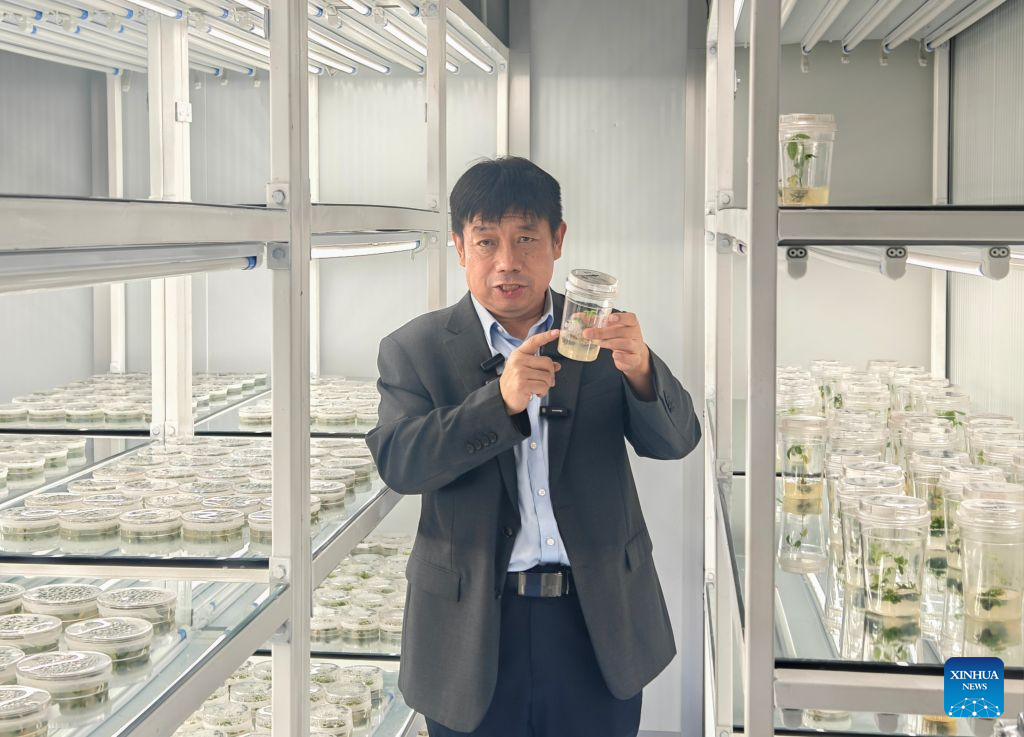
Feng Xianzhong, director of the Key Laboratory of Soybean Molecular Design Breeding of the Northeast Institute of Geography and Agroecology (IGA) of the Chinese Academy of Sciences (CAS), introduces soybean molecular design breeding in Changchun, northeast China's Jilin Province, Sept. 17, 2026.(Xinhua/Yu Fei)


